The Harvard Conservation Trust has been awarded a grant of $19,956 by the Nashua River Wild and Scenic Stewardship Council. The award, announced on Monday, is the largest of three land conservation grants made by the council during its spring 2023 round of funding. The HCT will use the money to remove invasive plants, reintroduce native plant species, and restore the wildlife habitat on the Coke and Newsham lands, which abut the Public Safety Building on Ayer Road.
The HCT has been working to remove the overwhelming amount of invasive plant species in Harvard. However, the 27-acre conservation area the HCT will focus on is also home to a number of small streams that intersect with Bowers Brook, a tributary of the Nashua River. The money would go toward making sure that, during their removal, invasive plant species do not travel through the streams and reestablish themselves elsewhere.
There is always a danger that invasive plant species will be reintroduced to the area by way of wind, birds, other animals, or water streams. To prevent this from happening, regular monitoring of the land will be required for at least two years after restoration.
As explained by Lucy Wallace, Harvard representative and chair of the Nashua River Stewardship Council, the grant serves as a bridge to allow both the council and the HCT to achieve their environmental goals.
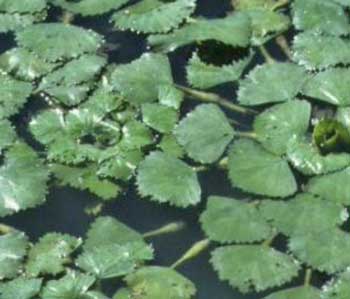
Water chestnuts are a common invasive in local waterways. (Courtesy photo)
“Invasives are a huge problem everywhere,” Wallace said. “Nobody can do it by themselves … we have the resources to help [the HCT].”
Conservation land requires preservation, but also frequent upkeep, which can be costly. Wallace said the grant project “is a way of saying, ‘this land is protected, let’s make sure it’s protected properly.’”
“The Coke and Newsham lands offer the potential to act as a demonstration project and education area for schools and town environmental organizations,” said HCT trustee Gina Ashe. “It will become an ecological ‘gem’ because it encompasses a mix of forested areas, wetland, and streams.”
The Nashua Wild and Scenic Rivers Act was enacted by the U.S. House of Representatives in 2019 and signed into law by the president. It protects 52.8 miles of the Nashua, Squannacook, and Nissitissit rivers in Massachusetts and New Hampshire. The Nashua River Wild and Scenic Stewardship Council was created to preserve and protect these rivers and their tributaries, including natural resources; biological diversity; and scenic, recreational, historical, and cultural values. The council is made up of representatives from 11 Massachusetts communities, the National River Watershed Association, and the National Park Service.