
This month’s focus is on the third of the seven areas needed to reach zero emissions by 2050—transportation.
Transportation-based greenhouse gas (GHG) emissions account for about 27% of total U.S. greenhouse gas emissions, making them the largest contributor to overall emissions in the United States. Between 1990 and 2020, greenhouse gas emissions in the transportation sector increased more in absolute terms than in any other sector.
Here’s a breakdown of GHG emissions by source in the transportation sector by major category:
- 57% – light-duty vehicles
- 26% – medium- and heavy-duty trucks
- 8% – aircraft
- 5% – rail
- 2% – ships and boats
- Less than 2% –buses
First, the bad news. There aren’t good solutions for the aircraft, rail, and ships categories. Sustainable aviation fuel exists, but the cost is about six times that of regular fuel. There is work on small electric planes, but there isn’t much going on to replace commercial airlines, especially for long-distance hauls. While many subways are electrified, not much is happening on long-haul rail transportation in terms of electrification. Research is underway on nuclear-powered cargo ships and wind-powered luxury liners, but it’s still in its infancy and may never come to fruition. We will all need to watch these areas and advocate for advances in them in the coming years.
With that said, there’s been a lot of progress in the two biggest categories, light-duty vehicles, which most of us in Harvard drive, and trucks. If the U.S. addresses these two areas, it will have addressed 83% of the greenhouse gases emitted by the transportation sector. This is important because, according to the Congressional Budget Office, the average carbon dioxide emissions per passenger mile are, not surprisingly, highest for automobiles.
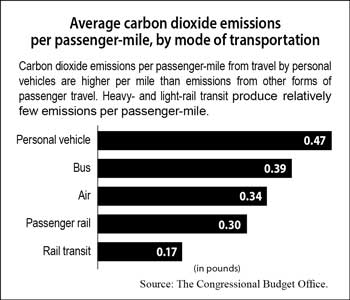
As shown in the chart, carbon dioxide emissions per passenger-mile from travel by personal vehicles are higher per mile than emissions from other forms of passenger travel. Heavy- and light-rail transit produce relatively few emissions per passenger-mile.
On light-duty electric vehicles, there’s plenty of good news. Electric vehicle purchases are exploding in the U.S. The market is projected to grow from $28.24 billion in 2021 to $137.43 billion in 2028 at a compound annual growth rate of 25.4% in the forecast period, 2021–2028. Every car manufacturer worldwide produces or will produce a wide range of electric models. Some manufacturers will retool their production lines in the next decade and produce only electric vehicles. Pretty good.
On trucks, there’s also good news, but developments aren’t as far along as they are with automobiles. UPS and Amazon, among others, have committed to electrifying their delivery fleets in the coming years. Tesla announced a promising heavy-duty truck to replace its gasoline-based alternative. Plenty of startups are working in this area, and a plethora of new trucks is expected in the next decade.
What should a Harvard resident do to help?
In Harvard, the most significant thing a resident can do to help meet the net zero goal is to buy an electric vehicle. Driving an EV instead of a gasoline-fueled vehicle significantly reduces carbon emissions, especially when the vehicle is charged using a green energy source such as we have in Harvard.
Still, there’s some complexity associated with purchasing an EV, so it’s best to consider the decision in parts. There are three parts to consider: tax incentives, charging, and maintenance.
Tax incentives
The good news is that some electric vehicles currently qualify for the $7,500 EV tax credit, and used electric cars qualify for a $4,000 credit. The used credit is excellent news for many potential buyers because it significantly lowers the cost of entry.
The new $7,500 EV tax credit is divided into two halves of $3,750. Eligibility is based on specific vehicle and consumer requirements:
- A vehicle is eligible for one-half of the total credit ($3,750) if its battery components are manufactured or assembled in North America.
- To be eligible for the other $3,750, a vehicle must have critical minerals extracted or processed in the U.S. or countries with which the U.S. has a free-trade agreement, or use critical minerals recycled in North America.
- The final assembly must take place in North America.
- Only cars under $55,000 or SUVs, vans, and pickup trucks under $80,000 are eligible.
- The consumer income cap to be eligible for the credit is $150,000 for single filers, $225,000 for head of household, and $300,000 for joint filers.
The used EV tax credit is for $4,000 or up to 30% of the vehicle price, whichever is lower, and must meet the following:
- The vehicle must be under $25,000.
- The vehicle model year must be at least two years old.
- A dealer must sell the vehicle.
- As with the new EV tax credit, the used EV tax credit has income caps for consumers. The income cap to be eligible for the used EV credit is $75,000 for single filers, $112,500 for head of household, and $150,000 for joint filers.
- The credit can be applied only once per vehicle.
Charging
Most Harvard EV owners charge at home. It’s convenient and reasonably priced, given the electricity prices in Harvard over the last few years. For example, on many electric vehicles, fully charging a battery costs about $24 for 300 miles of range. When you do the math and translate these numbers into the more familiar miles per gallon, it works out to about an equivalent of 44 miles per gallon, assuming a price of $3.50 per gallon for gasoline.
To charge at home, it’s best to have a 240-volt line installed in your garage for around $500. This will allow an owner to charge an EV overnight, fast enough for most families. If you want to charge even faster, home chargers on the market will fully charge a car in about seven hours. They cost about $2,000.
There are multiple ways to charge while on the road. Electrify America has several fast chargers in the area (and many more nationwide) that will add a hundred miles of range in about 20 minutes for $8. There are also several free chargers in the area, which will be clearly marked in your EV’s map function. For those with the time, you can charge your car for free if you work at it.
Finally, due to the Inflation Reduction Act, 500,000 new charging stations will be added across America in the coming years, so the charging infrastructure will only get better.
Maintenance
One of the best things about EVs is their low maintenance cost. Here’s a fun fact––there are 90% fewer moving parts in EVs when compared to gasoline-based automobiles and, therefore, fewer things that can go wrong. In addition, many longtime EV users have reported battery lives of up to 400,000 miles, about double the expected lifetime of a gasoline-based engine. For these reasons, the total cost of ownership of an EV over six years tends to be less than that of a gasoline-fueled automobile, by some estimates up to 20% less.
Conclusion
When you combine all the parts—tax credits, charging, and maintenance––now is a great time to buy a new or used electric vehicle. The tax incentives on a wide range of cars are excellent, the total cost of ownership is lower than the total cost for a gasoline-fueled car, and the charging infrastructure is readily available and growing. The lead times for many, but not all, cars are long, so you may need to order now if you want to take delivery in the next 12 months. By buying now, you’ll help reduce carbon emissions and help mitigate the climate crisis, something we will all need to focus on in the coming years.
Next month I’ll discuss using clean energy in agriculture.
Rich Marcello is a novelist and a member of the Climate Initiative Committee. In writing his latest novel, he spent several years researching the climate crisis.