For seven generations, the Blood family has maintained its West Groton slaughterhouse and retail store to serve surrounding communities, including Harvard. It is an inspiring example of how a small business has withstood a variety of challenges to emerge as a critical part of the localized food system and a climate solution.

Just 20 minutes down the road from Harvard, Blood Farm is one of two USDA-certified slaughterhouses in Massachusetts catering to local farmers raising cows, sheep, and pigs for processing. In a season, Blood Farm processes about 650 cows and 1,600 hogs or sheep.
Harvard residents and farmers Judy Warner and Bonnie Chandler fondly recalled the “delicious” bacon and hams that the Bloods sell in their retail store, a sentiment echoed by many in the Groton community.
Warner has processed her lambs and occasionally goats at Blood Farm for over two decades. She no longer raises animals for meat, but spoke positively of her time working with the Bloods. Small details make the difference—she recalled that their double-wrapped packaging always helped keep meat tender in the freezer.
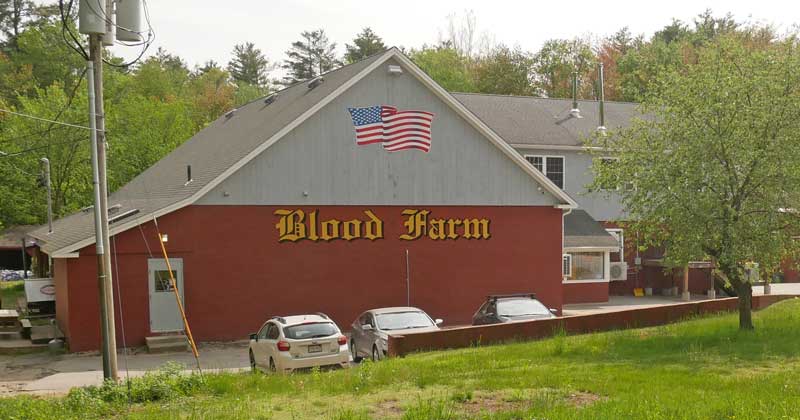
Blood Form in West Groton. (Photo by John Osborn)
Chandler sent her last lamb to Bloods roughly three years ago, but she appreciated their partnership over the years. After spending so much time and energy raising her animals, she could trust the final product that the Bloods delivered.
A legacy that began in 1847
The land has been with the Blood family since the 1720s; it was a dairy farm when Edmund Blood took over in the mid-1800s. While growing this operation, Edmund Blood began helping his neighbors harvest their animals each fall; he recognized the demand for this kind of work and an opportunity for his family.
During the next few decades, Blood Farm transitioned to an official abattoir, another name for a slaughterhouse, and received one of the first state licenses to operate as such in the late 1800s. With this credential, farmers were able to sell their meat within the Boston food scene, such as prepared hogs to Chinatown restaurants.
Edmund Blood’s son took over the operation in 1882, establishing a pattern that would continue in the decades that followed. The business has been consistently run and passed down through the family for more than 200 years, steadily growing as a local legacy.
In 2013, the Bloods’ situation was dramatically altered when a fire burned down their entire operation. The metal roof trapped heat, melting thousands of dollars of equipment and infrastructure, including their retail shop and smokehouse.
The Bloods questioned whether it was feasible to reopen. Retirement was increasingly alluring for Barney Blood, the previous owner of Blood Farm. The consistent and passionate support of the community of West Groton motivated them to rebuild.
Barriers facing local operations
The number of small-scale processors serving local farmers has been steadily declining for decades. Lack of operating capacity, exhausting regulations, administrative barriers, and expensive management costs reduced income and the processing rate of the abattoirs.
There is a high turnover of USDA food inspectors, who oversee all USDA-certified slaughterhouses, making relationship-building a challenge.
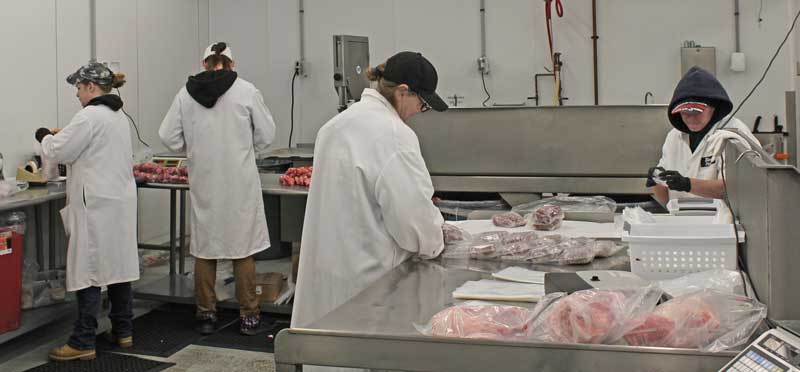
Workers package freshly butchered meat at Blood Farm. (Photo by Grace Fiori)
In the 1990s, the Clinton administration introduced elaborate food safety regulations for meat processors. The regulations and records documenting their adherence are so time-intensive that many small operations were put out of business for lack of trained workers who could manage those processes and lack of money to complete those directives.
Since Blood Farm and Adams Farm in Athol are the only USDA-certified slaughterhouses in the state, some farmers have taken their business to out-of-state commercial slaughterhouses in New York or Pennsylvania.
“Slaughterhouses are booked out a year in advance, so you have to predict how many animals you will have on a specific date,” said Nicole Burton, livestock director for the Stockbridge School of Agriculture at the University of Massachusetts.
All these challenges have affected the Bloods. They said they lack the staffing to meet this demand. Across the industry, there has been a sharp decrease in people working as slaughterhouse butchers, a drastically different job from that of a retail butcher at the supermarket.
“They work in a grocery store, they cut steaks and grind hamburger, but they really don’t [know how] to break an animal apart. So it’s hard for them to keep up with what we’re doing right now,” said business manager Sharon Blood.
She acknowledged the stigma surrounding the position, which has historically low wages and can be physically exhausting, emotionally demanding work. High turnover rates remain a constant threat.
“When I was younger, I thought I could never do it,” said Meghan Blood-Griffin, manager of the kill floor. “But the way I look at it now, my mindset is, if I’m doing it, I know that it’s being done right. I know it’s being done humanely.”
The family business has been able to persevere, Sharon Blood said, because of its community and lasting relationships. The West Groton farm has about 20 staff, the most dependable of whom are family members and those who have essentially become family after 40-plus years of working with the Bloods.
Blood-Griffin has been steadily growing a crew that is eager to learn and down to earth. “You have to be a certain type of person to do it and be in that respectful mindset,” she said. “They’re all animal people,” and they emphasize honoring the animal during their work.
Passing down knowledge from generation to generation—accumulated over decades of active experience—to a seasonal worker is daunting. Matthew Blood said that he learned best from being immersed in the process.
It was only through time spent being actively involved, both in the retail store and wrapping meat, that he was able to understand the work that goes into running the slaughterhouse.
Matthew studied business and returned to work at Blood Farm with a focus on updating old processes and bringing the farm into the 21st century. Decades of hand-written account registers sit in the attic of their barn. Their 100-year-old slaughterhouse has deep historical roots, but its age also limits efforts for modernization and automation.
Despite these limitations, Warner emphasized how much the Bloods’ business has changed over the years, especially their retail operation. “It used to be just a freezer with Margaret and her notebook,” she said.
Small operation, big potential
Local processors have competitive advantages compared to their industrialized counterparts. Burton, who has experience running a small livestock business and producing meat for home consumption, noted that communication is easier and the product more consistent.
In smaller operations, the holding pens are smaller and quieter. The animals are generally moved through quickly, creating a more humane handling experience. “That’s really important to me, as a farmer and as an educator, because I want to make sure that those animals are not sitting in that waiting room for too long,” Burton said.
Family-run local processors are more likely to be community-based and willing to educate. Burton often sees veterans willing to share their generational knowledge and provide new farmers with a support system to navigate the industry. “They’re willing to make the time to actually help people fill out their cut sheets so they’re getting back what they [expect],” Burton said. These are relatively small actions to take, but they help to uplift farmers and manage the burnout that comes with the job, she noted.
An answer to the climate crisis
Blood Farm’s status as a small-scale, community-based slaughterhouse means its business model is inherently alleviating the food system’s negative impact on the environment.
Local slaughterhouses serve local operations, which are more likely to raise their livestock in accordance with principles of regenerative agriculture. These practices include using cover crops to add nutrients, rather than chemical fertilizers, and reducing soil erosion, thus increasing carbon sequestration.
The physical closeness between the farm and the abattoir also means less fossil fuel is used to transport, refrigerate, and store the animal products.
‘Work enough for everybody’
The answer to sprawling industrial feedlots, animals fattened with highly processed feed, and shipping livestock across the country in confined and stressful conditions is found in the generations of wisdom passed down through the Blood family.
The slaughterhouse is already a part of the local food system; SpringDell Farm in Littleton brings its own animals for processing or buys from Blood’s to be distributed through its CSA shares.
The Bloods use all parts of the animal, donating organs and tissue samples to the Museum of Science and Massachusetts General Hospital for research. They also donate to local schools for class dissections. Blood-Griffin recently delivered a lung and heart set to Acton-Boxborough High School. During her visit, she found herself teaching the biology class how to approach a dissection, an experience she remembers fondly.
“We recently went to Adams Farm in Athol,” Blood-Griffin said. “Adams Farm said to us, ‘We’re not in competition. We need you just as much as you need us.’ We’re in this together. We’re not against each other.”
Matthew added, “There’s work enough for everybody.”
Despite dire warnings about climate change and its economic impact on the country’s food system, individuals continue to enter the field of food production. Livestock raising and processing remain in demand, and incoming farmers continue to find success in their locally focused ventures.
Chandler has since retired from raising animals for meat, but she’s finding that other small farmers in Bolton and Acton are entering the field, raising sheep and goats for processing.
“I find that the trend is moving toward not large farms, but small farms,” Burton said. “The older farmers that are getting out of the work, I find that [their successors] are finding more strategic ways to navigate making income, like agritourism … they’re being smart and strategic.”
Grace Fiori, a former Press intern, is a UMass Amherst junior majoring in journalism and sustainable food and farming. She is the incoming managing editor of the Daily Collegian, the campus newspaper.