
When I was in my late teens, my brother Pierre and I both got jobs going door to door selling a consumer review newsletter. This was a profoundly unrewarding job. Neither Pierre nor I lasted more than a couple days, and not much came to us from this experience, aside from my brother finding himself a girlfriend.
I was thinking of this youthful brush with consumer reporting earlier this week, fellow sky walkers, as I sized up the planetary alignment currently featured in the early evening sky. My news aggregator had been abuzz for weeks over a forthcoming alignment of five planets in the same stellar quadrant, and thus did I find myself last week setting up my telescope on the Prospect Hill overlook above Fruitlands. Fellow sky walkers, I’ll be honest: While this alignment features some charming views, if Consumer Reports were to rate planetary alignments, this one doesn’t quite make Best Buy.
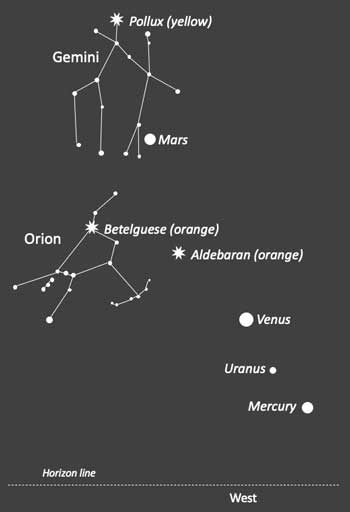
The planetary alignment of April 2023, shown for April 8 at 8 p.m.(Marc Vilain) CLICK TO ENLARGE
Five planets, sort of
The selling point of this planetary moment is that both inner planets (Mercury and Venus) are visible within reasonable proximity of three of their outer brethren (Mars, Jupiter, and Uranus). While my planetarium app confirms that all five planets are technically above the horizon shortly after sunset, being able to observe them is another thing. Mercury and especially Jupiter follow so closely in the sun’s footsteps as to risk being lost in the low-lying haze of New England sunsets. So was it last week when I was at the overlook—both planets were hidden in the haze.
For the weekend of April 8 and 9, I would recommend punting on sun-skimming Jupiter, and waiting until around an hour or so past sunset to look for the remaining planets; the chart in the left figure shows the sky at 8 p.m., as things start to darken. Venus, the brightest object in the sky, is easy to spot above the western horizon. Seen through a telescope, Venus looks like a disc squashed on one side—picture a squeezable stress ball. As with the moon, Venus has waxing, full, and waning phases due to the three-way geometry among sun, Venus, and Earth. Right now, Venus looks like a small craterless version of the waxing moon.
Higher up in the sky is Mars, nestled in a neighborhood of orange stars. Mars is not the same kind of bright beacon as Venus, but it is noticeably brighter than its stellar neighbors and is distinctly red, as opposed to the orange tint of Betelgeuse or Aldebaran.
If you draw a mental arc from Mars to Venus, and continue down to the horizon, Mercury will lie roughly three-quarters of the way down from Venus. From the Prospect Hill overlook, you might just be lucky enough to spot it grazing the mountaintops.
Finding Uranus
Yes, this is the planet whose name has launched a thousand puerile jokes. For the record, the accepted pronunciation is YER-uh-nus, not yer-EY-nus. All tee-hees aside, there is quite a history to this planet’s name, but more on this below.
Uranus is easy to spot in the sky right now, as it lies along that same mental arc graciously provided by Mars, Venus, and Mercury. Last Friday, Uranus was a hair’s width away from Venus, but as the planetary geometry will have shifted by April 8 and 9, Uranus will be roughly a third of the way from Venus to the horizon. Look for it at about the same distance from Venus as Venus is from orange Aldebaran, or alternatively about halfway from Venus to Mercury. Uranus appears light green (though its true color is closer to cyan), so when you sight it, it’s easy to tell it apart from everything else in the sky. At higher magnifications, it is clearly circular, as opposed to the point-like stars.
Technically, Uranus is visible to the naked eye, but good luck with that in our light-polluted skies. As a point of comparison, Uranus is half a magnitude fainter than the faint stars in the bowl of the Little Dipper, so you will want the light-gathering oomph of a telescope or binoculars. With binoculars, hand-held jiggles are an issue, so try a tripod mount, or if you’re at the Prospect Hill loverlook, park near the wall and use the roof of your car to steady your grip.
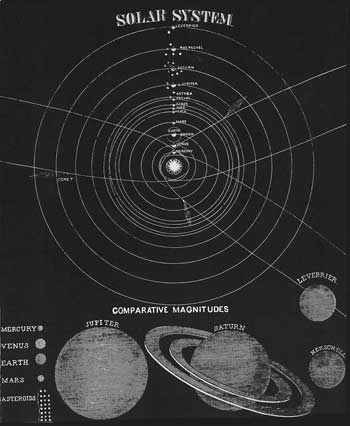
The solar system as shown in an 1854 atlas. CLICK TO ENLARGE
Planet of many names
Credit for the discovery of Uranus goes to British astronomer William Herschel, who first identified its nonstellar nature in 1781. Uranus had been sighted before, possibly even by the ancient Greek astronomer Hipparchus, but had always been understood as a star. With his homemade telescope, Herschel ruled out Uranus being a star, though he initially considered it most likely to be a comet. By 1783, other observations had confirmed Uranus as a planet, and as this was the first planet to be identified since antiquity, then came the question of naming it.
There were those who thought it should be named after Herschel himself; Herschel preferred to call it the Georgian planet, honoring his patron, King George III. Understandably, this was not popular outside of Britain. The name Uranus is due to Johann Bode, the German astronomer who first calculated Uranus’ orbit, thus proving it to be a planet. Uranus was the ancient Greek god of the sky, much more in keeping with the likes of Jupiter, Saturn, and the others.
Bode’s name for Uranus gained widespread acceptance, and so things remained with little controversy until the discovery in 1849 of the planet we now call Neptune. Perturbations in the orbit of Uranus had suggested the existence of an as-yet-unidentified planet, whose orbit was predicted with great accuracy by French astronomer Urbain Le Verrier, leading to Neptune’s discovery. The French were eager to claim the name Le Verrier for this new planet, which prompted them in turn to resurface Herschel as the proper name for Uranus.
This moment in astronomical nomenclature is captured in a map of the solar system I have from an 1854 atlas. The map shows the planets we now call Uranus and Neptune as Herschel and Le Verrier. How this came to be in an English publication from 1854, who knows? By then, the naming controversy had been firmly settled in favor of the gods of antiquity.
One final thought: It is fitting that Uranus and Venus be in proximity in this planetary alignment. Mythology has it that Uranus met with unfortunate circumstances, the upshot of which was that his testicles were cast into the sea, from which emerged Aphrodite, or Venus, the goddess of beauty. The pair reunite in this month’s planetary alignment. Fellow sky walkers, may your nights under the stars be filled with stellar and planetary beauty, much as our home planet fills with the beauty of early spring.
Longtime resident Marc Vilain wanders the roads and fields of Harvard at night to find beauty in the skies.