What would motivate a young couple in Los Angeles to buy an arid, abandoned farm of more than 200 acres? “This all started with a promise we made to a dog,” says documentarian John Chester, the photographer and narrator in his film about how he and his wife Molly did exactly that. “The Biggest Little Farm” chronicles the Chesters’ struggle to realize their dream of building “a meaningful life in perfect harmony with nature, like a traditional farm from the past.”

The documentary will be shown Friday, March 10, at 7 p.m. in Volunteers Hall at the library, sponsored by Harvard’s Climate Initiative Committee. The group was given an educational grant from the Garden Club of Harvard to pay for a license to show the film. Deborah O’Rourke, head of the climate committee’s outreach, said in a phone call that she thought seeing the film on the big screen would be a perfect thing for mid-March as people start thinking about their own lawns and gardens. She said she found the film beautiful and inspirational, with ideas people could apply to their own homes. It’s both funny and heartbreaking, but appropriate for families, she said. The showing will be followed by an informal discussion where audience members can exchange reactions, ideas, and personal experiences.
One of the film’s trailers starts with a scene of smoke billowing over distant mountains. John is on a walkie-talkie, animals are stampeding, and you hear Molly’s cries of, “I can see a lot of smoke out the window. We’re going to get out.” And then John’s voice-over, “I never dreamed we’d get to this point where we had so much to lose. But I was wrong.”
It had taken seven years to get to that point. In 2010 the Chesters were living in a tiny apartment. One day John’s work took him to the home of an animal hoarder where officials were removing 200 dogs, most of them to be euthanized. “And that’s where I met Todd,” says John. Todd, a medium-sized, long-haired black dog with bright, crazed eyes, was easy to train but could not be left alone without barking incessantly. The Chesters tried fancy LA trainers, a collar that sprayed citrus at Todd when he barked, and an anxiety shirt. Those brought only money wasted, an apartment that smelled like citrus, and a shredded carpet. The final straw was Todd’s eviction notice from the landlord. But this dog had filled John and Molly with purpose, and John had promised him his last home would be with them.
This promise to Todd coincided with Molly’s dream. A private chef and blogger, Molly believed that the health of our food is determined by the way it’s farmed, and she had dreamed of owning her own vegetable garden, where she could grow everything she could possibly cook with. So they went looking for a farm, “something out of a children’s book”—a farm where they could live in harmony with nature—and Todd could stop barking.

An aerial view of Apricot Lane Farms, 49 miles north of Los Angeles. (Courtesy photos)
A fully functioning farm
Everyone told them this idea was crazy and could never work, but they drew up a business plan and found investors who believed, with them, that this old way of farming was the future. They purchased the land in Moorpark, California, and renamed it Apricot Lane Farms. Molly planned to grow every kind of fruit—maybe not bananas, but certainly apricots. At a goodbye party, their friends good-naturedly teased them by singing, “John and Molly had a farm, E-I-E-I-O. With an oink, oink here …”
Over time they cleared land, acquired chickens and livestock, some of which were, in fact, pigs, and planted vegetables and flowers. They had kids and got more dogs. Wanting to believe that everything has a purpose, they created a fully functioning farm, a biodiverse habitat for neighboring flora and fauna, where plants, livestock, wildlife, all worked together; even the pests had a role to play. “Our land reawakened, and we saw things we had never seen before”—wild animals, unusual plants, and bizarre insects. “We had a plan, and nature had hers,” but “the hardships we faced made the dream itself feel so much more alive.”
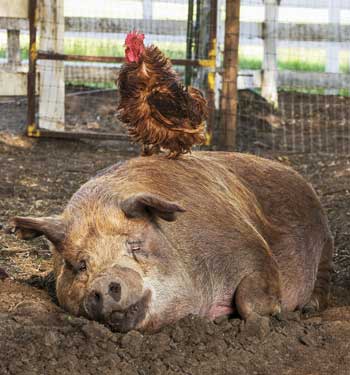
In an improbable turn of events, Greasy, a rooster, befriends a lonely sow named Emma on the farm.
O’Rourke said that even though the film is set in California, there are experiences and ideas, successes and failures, that can apply anywhere. (New Englanders can easily identify with one scene early on, where Molly, standing in an open field, throws down a large rock and says, “This is what we’re fighting.”) It’s really thinking more about biodiversity, said O’Rourke, and it’s about paying attention.
The 2018 film played in a number of festivals and won second runner-up for the People’s Choice award at the Toronto International Film Festival. In an online review, Rotten Tomatoes said of the film: “Uplifting, educational, and entertaining, ‘The Biggest Little Farm’ is an environmental-
advocacy documentary with a satisfying side dish of hope for the future. Watching the Chesters fight past disillusionment to learn the real lessons of harvesting in communion with nature is what gives the movie its rousing, illuminating power.”
It is advisable, but not mandatory, to sign up for the film by going to harvardsclimateinitiative.org/events.