Theme: The U.S. Supreme Court
Round 1: The Supreme Court and the Constitution
1. Which article of the Constitution primarily discusses the judicial branch?
2. The US Supreme Court has the authority to review the decisions of lower courts. According to the Constitution, what is this type of jurisdiction called?
3. Fill in the constitutional blanks: “In all cases affecting ___________, other public Ministers and Consuls, and those in which a ___________ shall be Party, the supreme Court shall have original Jurisdiction.
4. What does the Constitution say about how many Justices should serve on the Court at any one time?
5. Which amendment, ratified in 1795, amended Article III, Section 2 of the Constitution and established the principle of state sovereign immunity?
6. The party a Supreme Court case is being brought against is known as the defendant or respondent. The other party, who has brought the case before the Court, is known as the ___________
7. In “_____v._____” (e.g. Gibbons v. Ogden) the plaintiff (the party who brought the case before the Court) is named before or after the “v.”?
8. Sometimes only eight Justices are involved in a given case. What happens if they tie 4 to 4?
9. A Justice can write, or sign onto, a majority opinion, a concurring opinion, or a ___________ opinion.
10. Name (1 point each) the two parts of the process for choosing new Supreme Court Justices described in Article II, Section 2, Clause 2 of the Constitution.
Round 2. Landmark Supreme Court Cases
1. Which landmark Supreme Court case established the right of judicial review?
2. Which landmark Supreme Court case ruled that the federal government had a right to set up a Federal Bank and that the states did not have the power to tax the federal government?
3. What is the name of the Chief Justice who wrote the majority decision in both Marbury v. Madison and Maryland v. McCullough?

4. This 1857 Supreme Court decision has been described as “hands down the worst ever.” Name the plaintiff in this case, an enslaved man from Missouri, pictured here. Bonus: Which constitutional amendment effectively overturned this decision?
5. Dred Scott sued for his freedom, but the Court ruled against him on two different grounds. Explain one of the two.
6. This 1896 decision, which has also been considered a “supreme failure,” ruled that segregation on the basis of race was constitutional as long as the separate facilities were equal. Name the case.
7. Name the segregated public place that was being challenged in Plessy v. Ferguson.
8. The unanimous decision in this 1954 case held that it was unconstitutional to separate children in public schools on the basis of race, thus overturning Plessy. Name the case.
9. In 1965, students at a public school in Des Moines, Iowa were suspended for participating in a silent protest. Their parents sued. In 1969, the Supreme Court ruled in favor of the students, famously saying that the right to freedom of expression “does not end at the schoolhouse gate.” Name the case. Bonus: What item did the school say caused disruption?
10. Name the 1966 Court ruling which established that suspects in police custody must be informed of their rights. Bonus: This is done to prevent violating a right guaranteed by which constitutional amendment?
Round 3. The Modern Court
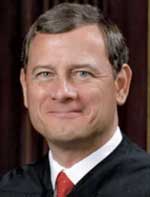
1. Name the Chief Justice pictured here. Bonus: His nomination was originally for Associate Justice, not Chief Justice, but a Chief Justice died and created the opportunity. Which Chief Justice died?
2. For one point each, name the remaining eight Justices. Bonus: Put them in order of seniority.
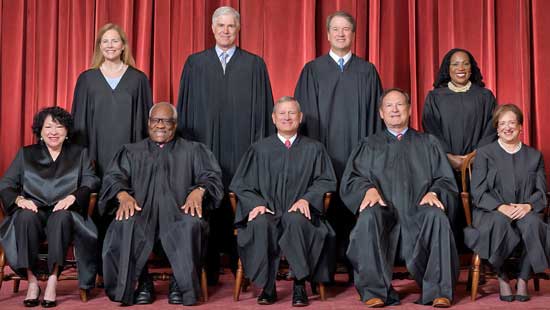
3. Which president in the last 30 years has had the most Supreme Court Justices confirmed?
4. In 2010, the Supreme Court ruled 5-4 in favor of the plaintiff in Citizens United v. Federal Election Commission. The decision holds that limiting political spending from corporations and other collectives is a violation of what specific constitutional right (describe the right; a number is not sufficient)? Bonus: What term describes political spending from an unknown source?
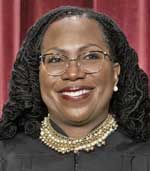
5. In 2022, the US Supreme Court got its first Black female justice. How many years did it take for that to happen? a)150, b)200, c)>200. Bonus: Of the 115 total Justices, how many have been women?
6. In 2022, Dobbs v. Jackson Women’s Health Organization ruled that “The Constitution does not confer a right to _____; _____ and Casey are overruled; and the authority to regulate __________ is returned to the people and their elected representatives.”
7. In 1967, this aptly named case ruled unanimously that it was unconstitutional to prevent people from different races from marrying each another. Give the full name of the case that made interracial marriage legal in all U.S. states.
8. In 2015, the Supreme Court ruled 5-4 in favor of the plaintiff in Obergefell v. Hodges, saying that the fundamental right to marry was guaranteed to __________ couples? Bonus: Which Justice stated in his 2022 Dobbs opinion that “we should reconsider…Obergefell”?
9. In October 2022, the Supreme Court heard arguments in two cases, SFFA v. Harvard and SFFA v. University of North Carolina, about whether a certain factor can be considered in college admissions. What is the admissions factor being challenged? Bonus: What does SFFA stand for?
10. Prior to the 2015 Obergefell decision, same sex marriage was still illegal in 13 states. Which state was the first to legalize same sex marriage? Bonus: What year did that happen?