Monday night’s Special Town Meeting drew a larger crowd than many expected, twice the turnout for the second session of Annual Town Meeting in October. By the close of the two-hour session, voters had approved all four articles on the warrant, including an increase in the community preservation surtax on property taxes from 1.1% to 3% and the borrowing of $4.85 million to connect town center homes, businesses, and municipal buildings to Devens water (see table).
Both the Community Preservation Act surcharge and the money for the town water connection to Devens must be confirmed by majority votes at May Town Election.
Moderator Bill Barton was forced to delay the meeting’s start for 25 minutes to allow a last-minute rush of attendees to register. As late as 7:13 p.m. 60 townspeople were still lined up in the Cronin Auditorium lobby waiting to sign in and collect their day-glo pink voting cards. By the time the meeting got underway, 281 voters had registered for the night’s business, a 6.1% turnout of the town’s 4,635 registered voters, a modest representation but an improvement over October’s showing of 160 citizens.
Right from the beginning, the microphones in Cronin created considerable frustration. Almost every speaker’s comments were punctuated by calls of “Louder” and “We can’t hear you” from the outskirts of the auditorium.
Articles 1 and 4 passed quickly, the latter in barely a minute and with no comment. But discussion of Article 2 lasted about a half-hour, not including the quarter-hour it took the team of counters to tally the 153 in favor of and 114 votes opposed to raising the community preservation surtax. Debate on Article 3, the proposal to connect town center to Devens water, lasted an hour, but this time Barton chose to count the vote himself from the auditorium stage, announcing that two-thirds of the attendees favored the measure, 179-44.
An increase in the CPA surcharge
Select Board member Charles Oliver introduced Article 2, to increase the property tax surcharge under the Community Preservation Act from 1.1% to 3%. Doing so, Oliver said, would increase the pool of CPA funds available each year from about $350,000 to about $1 million for open space, recreation, historical preservation, and affordable housing—“the priorities we value here,” he said.

Sharlene Cronin speaks to Article 2. (Photos by Lisa Aciukewicz)
The measure drew at least a dozen and a half residents to the microphone. First to comment was Billy Salter of Elm Street. Salter noted it was widely assumed that the additional CPA funds would be used for a new complex of athletic fields; he asked if passing the measure would bind the Community Preservation Committee to support that project. “I’m concerned that this would commit a lot of CPC funds far into the future,” Salter said.
Both Barton and Town Administrator Tim Bragan said the CPC would not be legally bound to use the increase for athletic fields—but passing the increase was a necessary first step toward that expected outcome.
Tony Shaw of Prospect Hill Road put opposition to the article most bluntly: “They want to add 2% to your tax bill to spend however they want.”
Bolton Road resident Tim Clark spoke in support of the measure, saying voters should approve the increase “if you believe in the Community Preservation Committee and believe we will have more needs in the future.”
Another supporter, School Committee member Sharlene Cronin, noted that she had served on the Athletic Field Subcommittee, and that the need for new fields had been clear for at least five years.
James O’Leary of Candleberry Lane, the former head of the Harvard Youth Baseball and Softball Association, also spoke in favor of Article 2. He said he had watched the CPC meeting where the committee faced $900,000 in requests, of which it was able to meet only $374,000. “There’s a need in this town for more CPA money. … These fields have been underfunded for years,” he concluded.
The article needed only a simple majority to pass, but the count proved difficult. Three times the team of counters came up with numbers that did not agree, in large part because of problems counting people who were standing or moving during the tally. Finally the moderator ordered everyone to take a seat and stay put.
The count was finally settled at 153 in favor of the surcharge increase, 114 opposed.
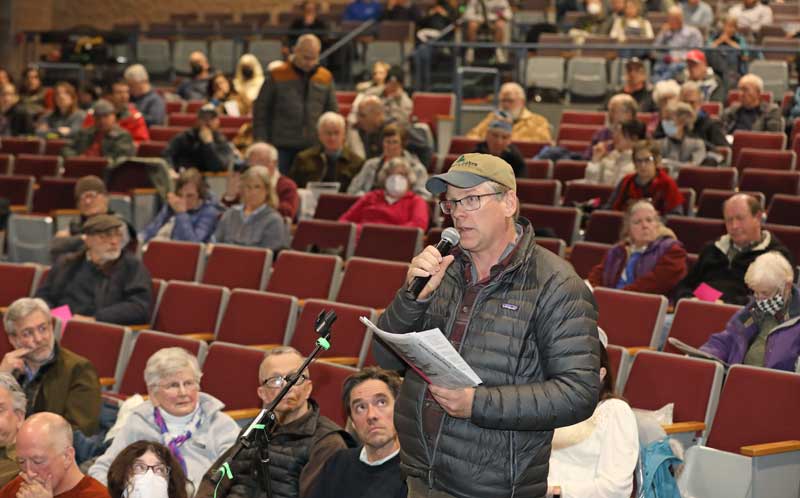
Tim Clark addresses the crowd at a surprisingly well-attended (281 voters) Special Town Meeting, Feb. 13. The question was not about how additional surcharge money should be used, he argued, but whether to increase it. “This is not a vote on athletic fields.”
A water connection to Devens
Select Board member Rich Maiore introduced Article 3, to borrow $4.85 million to design and construct a permanent water connection with Devens to supply the water district in town center. Department of Public Works Director Tim Kilhart explained the problems with the town’s two existing wells, and the benefits of getting water from Devens instead. Devens treats water from all three of its wells for per- and polyfluoroalkyl substances, eliminating the need for the town to build a $1.8 million plant that could be needed to treat its water for PFAS. Levels are currently below state and federal regulations, but stricter limits are expected soon, and new substances could be added to the list of contaminants in the future. Switching to Devens water would also increase the town’s water supply, which would aid in fire protection.
Seventeen people came to the mic to voice their questions, support, or opposition. Several asked what the price per gallon would be for Devens water, and Bragan explained that would be part of the negotiation with MassDevelopment.
Mike Kilian of Candleberry Lane asked if the new water line that would come down Depot Road to Ayer Road would be large enough to serve the proposed apartment complex across from Dunkin’ Donuts. Bragan said it would be a 12-inch pipe to match the size of the existing pipe to which it would connect on Ayer Road. That size pipe, he said, would be capable of supplying water all the way to the Ayer line.
Ben Myers of Westcott Road wanted to know if the estimate had taken into account running the water lines through ledge, which is prevalent in Harvard. Kilhart said the ledge on Depot Road near Under Pin Hill Road was taken into account, but engineers would do borings before putting the job out to bid so there would be no surprises. Should bids for the job run over the amount requested in this article, the town would have to vote more money for the project.
Those who spoke in support included Chris Mitchell, Board of Health chair and Westcott Road resident. Mitchell said the existing wells on Pond Road are not sustainable, and the town is in a unique position to get water from Devens. Nate Finch of Codman Hill Road noted that town water supplies the schools, and water from Devens would be treated for PFAS, a big benefit. He added that the Devens line would allow the town to supply water to the commercial district.
Elm Street resident Salter said that could be a problem—it has implications on where and how fast the town could grow. He said it’s a big, complicated issue with a lot of unknowns, and it’s happening too fast. He urged voting against it for now, but keeping an open mind for the future.
Finance Committee chair and Codman Hill Road resident Jennifer Finch said if this didn’t pass, the town would need to build a $1.8 million treatment plant to put in a full-time chlorination system to replace the emergency system it is currently using. She was mistaken, though; the town has already installed a full-time chlorination system, and is working out the final details of its operation with the Department of Environmental Protection. A treatment plant would be built to treat for PFAS should the town choose to do so or if state or federal regulations changed to require it.
Ed Frost of Finn Road said town water is currently meeting all DEP requirements and there is no crisis that calls for this vote. He questioned whether Harvard would have any say in the changes Devens might make to its water system. He also mentioned the many capital projects the town is facing, including new DPW and fire department buildings, and how taxes have already gone up because housing values have increased in the past several years.
Voters weren’t swayed by that argument, though; the vote was not even close—only 44 of the 281 attendees voted against it.
As voters left the auditorium at 9:18 p.m., they were asked to hand in their voting cards, to be used again at Annual Town Meeting, according to Town Clerk Lynn Kelly. “I don’t like to waste them,” she told the Press.
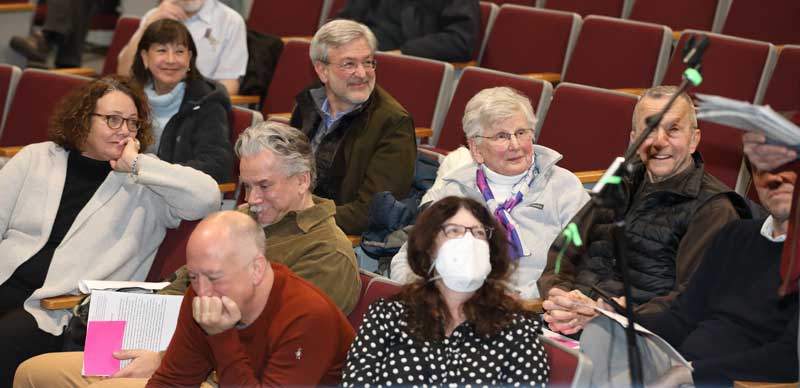
The audience reacts to a joke Paul Green makes about the Capital Committee chair standing behind him in the line to speak, “breathing down my neck.”