Throughout time, many visual artists have been inspired by other artists, contemporary or historical, and the same may be said for poets. It is less common for a painter to be inspired by a poet, and vice versa. But that is what Didi Chadran, a former Harvard resident now living in Lowell, and current resident Colleen Pearce have done. Sometimes it was a poem of Chadran’s that gave inspiration to Pearce, and sometimes it was one of her paintings that led to a poem by Chadran. And even beyond inspiration, the two discovered they have similar views of the world and of the creative process, and that they share a love of nature.
The result of their collaboration is a show called “Hidden Worlds,” which opened at Fivesparks Feb. 1 and runs until March 26, with an artist reception and poetry reading Feb. 12 from 3 to 5 p.m. In their artist statement, Pearce and Chadran say they want viewers to see the collaboration as a “free-flowing, open-ended exchange between equals, each picking up on an element or two in their collaborator’s work and extrapolating from it, building atop it.”
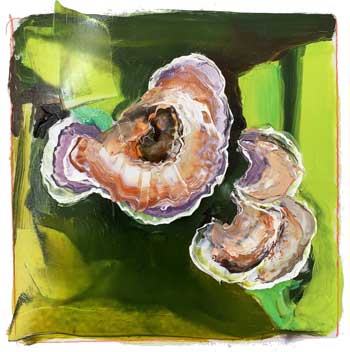
In “Turkey Tails” Colleen Pearce plays off Didi Chadran’s musings on fungal communication. (Courtesy photos)
They forewarn viewers not to look to Pearce’s paintings to illustrate the poems and to resist the urge to seek explanations of her paintings in Chadran’s poems. But warnings often present a challenge, and it may be in the attempt to see the works in these “forbidden” ways that viewers discover the deeper insights of the collaborators. The way color and technique convey the mood of a poem, or a complex idea finds expression in a whimsical shape.
Beyond the immediate visual or linguistic impact and the discovery of an intellectual or emotional meaning of a work is another dimension—understanding the artist’s intention. Viewers/readers—and creators of the work—differ on how much this matters. For me it was an added pleasure to talk to Chadran and Pearce about particular painting-poem pairings and to see my responses in light of the creators’ intentions.
I found Chadran’s poem “Repent” to be haunting, both in imagery and idea. The speaker describes a “fur” thing with sharp teeth near a tree and goes on to suggest the guilt he feels that the land’s original, noble inhabitants have been driven out—clearly alluding to more than this animal. His poignant remorse ends with: “But let us both pray that/We’ll sing together one red moonlit night.” In talking with Chadran, he said the wolf gets such a bad reputation from the “big bad” of fairy tale to a marauding beast, “I thought it was time to do justice to this noble animal.”
When I saw the inspiration—Pearce’s drawing of a wolf facing forward over what looks to be the carcass of a deer—I felt the choice of charcoal effectively captured the primeval aspect of a wolf. I felt the wolf’s gaze was defiantly asserting its right to survive. Pearce’s story about the painting lent intensity to my interpretation. She said she did a number of wolf paintings during the pandemic. In the first few weeks of the lockdown, her daughter-in-law gave an unplanned C-section birth to a daughter. Pearce was not allowed to see her daughter-in-law and it was only through a glass partition that she could see her granddaughter. She was devastated. But she was also overcome with a fierce protectiveness, seeing herself as a barrier between the baby and the terrors of the outside world. She embodied all those feelings in the wolf.
A return to poetry
Both Chadran and Pearce have been working in their particular medium for a long time. Chadran, who said he introduces himself as “a geek with an English major,” started writing poetry in college, back in the ’80s, and had a poem published in a literary journal. He continued to write on and off. His serious reentry to poetry was more than three years ago when organizers of an event in Southborough put out a call for poetry to go with a sculpture exhibit. His poem won first prize. When he happened to reconnect with Pearce, whose work was familiar to him, Chadran shared some of his poetry, and she was impressed with the visual imagery and suggested they “encourage each other’s art.” Chadran spent time in Pearce’s studio, and she in turn pinned some of his poems to the walls of her studio. In time, the idea of a show emerged.

Colleen Pearce’s charcoal, “Primal” was the inspiration for Didi Chadran’s poem titled “Repent.”
Chadran said for him a poem usually begins with an “intellectual challenge” he “throws at himself,” but it isn’t complete until he has “invested emotional content” that comes from a deeply personal place. “I overthink things and poetry is a perfect place for breaking me out of that,” Chadran said. His poem “Ghazal for Lowell” uses this ancient ode form to describe views of the city, and it isn’t until the last line that the poem broadens to become a universal lament. In a more lighthearted way, he responds to Pearce’s painting of a tropical mosquito by narrating, from the insect’s point of view, a potentially deadly flight to deliver a bite on a sweaty arm. The poem “Mycolexicography” springs from the theory that mushrooms communicate. At the end of a “science fantasy,” comes an ironic acknowledgement of human limitations. Pearce’s response is “Turkey Tails,” both realistic and whimsical.
For the exhibit, Chadran’s poems will be printed in large white type on a dark background of 25-inch-wide paper. The “geek” part of him has made recordings of his poems that viewers may access through a QR code.
The magic carpet of art
In nursery school, Pearce drew a giraffe and was delighted at seeing something she had created. From then on art was her “magic carpet,” a “great transporter” on which she could escape conflicts in life. She went on to become an art teacher and just retired from 20 years in the Lincoln elementary school. She said she used to write poetry when her children were young and she would steal a bit of time in the early morning hours. The writing was something she could leave and come back to. She took up painting because she could finish with a painting in a shorter amount of time. In fact it is speed that is an important part of Pearce’s process.
Pearce, who grew up “traipsing about” on a farm in Michigan, fell in love with nature; “Nature is still my inspiration,” she said. In describing her painting of an opium poppy she said she starts by working realistically, expressing how something looks. Then she “lets it express itself in a freer way.” In this case, as well as capturing the beauty of the flower, Pearce’s method allows for the suggestion of the opium’s effect—the loose, somewhat dreamy look of the painting, “Opium Reverie.”
For Pearce, “Color is an entry point.” She loves the “smoosh of oil paint on glass, the way it slides on.” She added that she’s “in love with the paint and lets it go.” And she works with speed: “The ones I love most are ones where I let the material lead me.” She said she is excited to have so much of her work shown together in the whole space at Fivesparks.
Pearce said both she and Chadran use their art to process feelings about what’s happening in the tangible world and in their inner lives. That is what is reflected in the “Hidden Worlds” of the exhibit title. Chadran added that they share “parallel stories that point to a similarity of a creative process that comes from somewhere outside of us.”