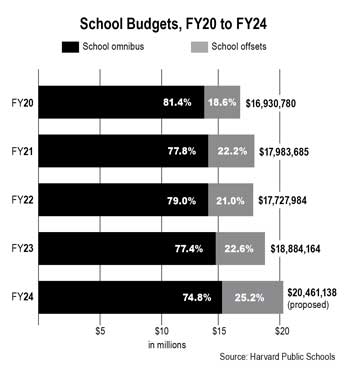
The full School Committee—and the public—got a first look this week at the school district’s recommended budget for fiscal 2024, which school administrators and the budget subcommittee have been working on for weeks. For the first time, the total school budget is edging above $20 million. But more than a quarter of that amount is expected to come from outside sources (called offsets), rather than from the town’s omnibus budget (see graph).
Overall, the proposed fiscal 2024 school budget stands at $20,461,138, up 8.4% from fiscal 2023. The amount the schools are seeking in the town’s omnibus budget—$15,300,758—is up 4.64% over last year, which amounts to $316,661 over the 2.47% increase the Finance Committee approved allocating to the schools.
Superintendent Linda Dwight told the committee that the main budget pressure point this year is not salaries, but contract costs outside the school district’s control. Most strikingly, the state has approved a 14% increase in private school tuition charges for students with special needs that cannot be met by their home school district. In the past, the state has allowed those charges to rise by only 1% to 3% a year. For Harvard, the cost of out-of-district placements could be almost $554,000 higher next year. The total amount budgeted for those placements in fiscal 2024 is $1,680,213.
Contract costs for school transportation are also up. Dwight said only one company bid on the bus contract, and that contract cost is going up $42,000 over last year.
Increased reliance on offsets
The proposed budget relies more heavily on offsets than in previous years. Those outside sources of income include federal grants, state aid, kindergarten and preschool tuitions, and payments from the School Choice program.
By far the most offset money for the schools comes from the Devens fund—the money MassDevelopment pays as tuition to Harvard schools under a contract for the education of students who live in Devens. The fiscal 2024 budget proposes to use more than $2.7 million from the Devens fund. That’s more than half the total amount of offsets.
“This takes the Devens fund down to zero in the next year,” Ingrid Nilsson, the school business manager, told the committee.
Committee member SusanMary Redinger summed up the consequences: “Our buffer is gone.” As a revolving fund, money in the Devens account can be carried over from year to year, so it has been available for the schools to fill unexpected needs. Last year, for example, an unusually large kindergarten enrollment led to the need for an additional teacher, a position that had not been in the budget. The fund has also been used for capital expenses, such as the Bromfield School science lab renovations and for paying down some of the debt for the construction of the new school.
Should School Committee seek an override?
Hildreth Elementary School Principal Rebecca Katsh-Singer told the School Committee there will be only four sections of first grade next year, as one teaching position has been cut. She noted that each section will likely have 20 or 21 students (assuming no additional first-graders move to town). The School Committee’s target number for each first-grade class is 17 to 20 students.
Katsh-Singer said children now in the first and second grades have extra needs, because their whole school experience has been affected by the COVID-19 pandemic. And Redinger agreed, saying the pandemic had created “a nationally recognized crisis in kids’ learning loss and well-being,” which meant schools could not just go back to pre-COVID operating costs.
School Committee members Sharlene Cronin and Suzie Allen argued for keeping five sections for first grade. “We should ask for what we need. … We should present the budget that we need to educate our students,” Allen said, suggesting the committee should consider seeking an override if necessary. But Redinger warned other committee members that passing an override would require a massive effort from now until Town Meeting.