
If all the world’s a stage, Harvard resident Paul Richards is perhaps even more interested in the set design than in the players playing their many parts. As a film art director, he works to execute the director’s aesthetic vision, figuring out what works visually to tell the story.
Richards will explain his craft at the upcoming Warner Free Lecture, 7 p.m. Friday, Jan. 13, in Volunteers Hall. He will explain how he fits into the structure of a film crew, show some slides of locations and specific sets, and tell anecdotes—funny and terrifying—about some scenes in films the audience will likely have seen. What were some of the challenges he and his crew faced, and how did they pull it off?
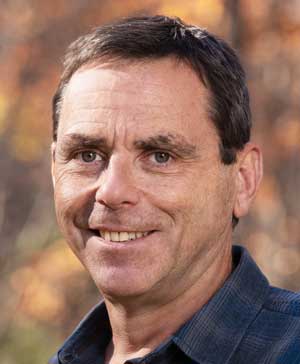
Paul Richards. (Courtesy photo)
In a phone conversation, Richards described how he works with a movie’s location manager and production designer to understand the director’s overall concept, and then he “moves forward to develop the creative stuff.” His job involves both artistic problem-solving and logistics, including how to work within a budget, and he interfaces with all the other departments involved in the production. His work also entails hands-on supervision of the set designs and construction.
It’s a lot about “faking one place to look like another,” said Richards. He talked about his work with locations and sets for the movie “CODA,” in which a teenage girl struggles between her sense of duty to her hearing-impaired parents, running a struggling fishing business, and her own musical aspirations. The director summered in Gloucester, and so she picked that town as the setting for the movie. The house the family lives in (which was actually in Essex) had to be made to look eclectic, furnished like that of a working-class family. And it had to be set up to look like an environment for deaf people. An empty warehouse was made into a fish-processing plant, and part of a shuttered school in Beverly became the school music room. It all had to look authentic and visually interesting.
Inside the frame
“It’s a complete circus outside the frame you see in the movie theater,” said Richards. “The magic is the frame that pulls you out of real life.” Outside the frame, people may be on ladders or behind a machine “faking” what you see. Residents who watched the filming of “Little Women” in Harvard center can relate to what Richards is saying. We had seen the huge trucks with snow-making machines piling up snow in the General Store parking lot and all sorts of crew members hurrying around. But we forgot about that in the theater as we saw only the four girls scuffle through fluffy snow on “Main Street, Concord.”
Richards described the changes in his career over the past 31 years. He was working in Boston as a carpenter when the older brother of a friend, who worked as a property master for Fox, asked him if he wanted to do some set construction on a pilot program for a series called “Against the Law.” Between the pilot and the regular season of the show, which ran for 16 episodes, Richards moved from a job in construction to that of a set dresser in the set decorating department, a position more varied than set construction.
He had to execute the plan of the set decorator, which meant running around to different stores picking up antiques or other props, figuring out how to install appropriate light fixtures. For “A Civil Action,” about a company in Woburn, his task was to show the toxic nature of a leather tannery. In figuring out what could convey that, he went to a number of tanneries (which he was surprised to find in Massachusetts) in order to understand the process. Then he determined what large elements and what details would be visually interesting and expose the toxic nature of the tannery.
From a set dresser, for which, Richards said jokingly, he had experience growing up as his older sister’s set dresser, constantly rearranging her room for her, he became the leadman in the set decorating department. From there, he became an art director in 2010.
To tell a convincing story
There are different paths to becoming an art director, Richards said. Many come to it from a background in architecture and some from production design. Coming from construction, he said he feels as though he had to work harder to advance, “learning as I went.” But what he also had going for him, he said, was his curiosity, the challenge of figuring out how something works. And he has always liked “visual stuff,” intrigued by photography when he was growing up. He liked the art of composing a frame, exactly the challenge an art director faces: How can I get this to tell a convincing story?
After working mostly in Massachusetts during the ’90s, in 2001 Richards was asked by a friend, a production designer, to work with him on the film “Ocean’s Eleven.” The movie was shot mostly in Las Vegas, but Richards handled scenes on the East Coast, largely in New Jersey. That started a lot of travel for him. He joined the trade union, International Alliance of Theatrical Stage Employees, which positioned him for jobs across the country. Along the way he moved from operating with a beeper on his belt to a cell phone glued to his ear.
One of the most interesting parts of the job is that he gets a “backstage tour” of places. He toured the M.I.T. artificial intelligence lab and was thinking all the time about how he might copy it. He went to the customs lab in Detroit, which keeps samples of bizarre stuff agents have confiscated in order to be able to match a similar item suspected of being smuggled through customs. “It was visually stunning,” said Richards.
Many people want to leave their work at the office, but Richards is always on the job—“I walk through life noticing.” He takes lots of photos of “cool stuff” he can use for reference, like a weathered building he might need to duplicate someday. For Richards, the world is full of potential set designs.