As I turned into the driveway off Poor Farm Road, I noticed the high wire fencing on my left, but my eyes were more drawn to the colorful flock of chickens on the right. I continued down the driveway to where the Mui family was waiting for me. I was there to learn about why someone in Harvard would be raising a mob of emus.

Jessica Mui and her daughter, Mia, pose with Boldie the emu. (Courtesy photos)
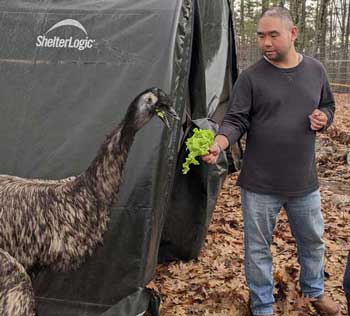
Nelson Mui offers lettuce to an emu eager for a snack.
The emus had gained some notoriety in a July police log in the Press when one was reported on the loose and allegedly had a confrontation with a police officer. Jessica Mui told me the story, with help from her 9-year-old daughter, Mia, whom her mom has dubbed “the emu whisperer.” Jessica had been walking the dog in the early morning when she saw what looked like an emu in the neighbors’ back yard. Realizing the neighbors had probably not acquired one of these huge birds of their own, she went into the yard and herded her animal back to its paddock. So she was surprised a while later to see a police officer at the door inquiring about a loose emu. She explained that it was all settled. But no, it turned out that while Jessica was returning one emu, another had slipped out. Putting a pillowcase over its eyes helps to make an emu more compliant, she said.
But how had they come to have six of these more than 5 feet tall, prehistoric-looking, flightless birds, who run 35 miles an hour for sustained times, preferably by themselves, mostly in Australia? “On a lark,” was Nelson Mui’s explanation. “And I said ‘no’ at first,” Jessica quickly interjected. The family had a flock of chickens where they lived in Framingham and bought a new flock after they moved to Harvard six years ago. Nelson had gotten curious about emus and was exploring them online. He found a group of emu owners and through them found an “emu guy” in western Massachusetts who was incubating them. It turns out, emus do well in New England weather.
And the Muis had the room—an expanse of flat, shady area up by the road and along their driveway. Although they knew people ate emu meat, their only intention was to have them as backyard pets. Jessica explained her acquiescence by saying, “I don’t want to be one of those people who go to the grave thinking, ‘Wouldn’t that have been fun.’”
Naming the emus
The emus arrived about 18 months ago and were kept in a brooder box in the garage until big enough to go into the paddock with its 6-foot fence and shelter structures. Jessica said determining the sex of an emu, especially before any start laying eggs, is difficult without DNA testing through a feather. But she and Mia have given their emus identities based on their behavior. Boldie is so named because he would come to them when they entered the garage, unlike the other five who ran away. The other potential boy is BF (Boldie’s Friend). Biggie Smalls, named after the late rapper, is the oldest by a month and probably a girl. AE (Aggressive Eater) is probably also a girl. She seems to eat more rapidly and comically than the others, although they all eat “like Muppets,” said Jessica—gulping food, spilling half of it. The boys make a grunting noise and the girls make a drumming sound through an air sac at the base of their neck—but it’s hard to be sure what sounds are coming from which emu. “And everybody hisses when they’re mad.” These four live in one fenced area.
In a separate paddock are two emus named after characters on “The Simpsons,” Rob and Todd (or maybe Robina and Toddina), isolated because of the “attempted murder.” Last summer the Muis discovered that these two were being picked on, to the point where Rod especially had very serious wounds. It was an ordeal to get the two separated from the rest of the mob, and it took all three Muis to finally succeed. There’s no clear answer as to why these two were bullied. Jessica believes the two dominant females led the assault; Nelson thinks maybe the two are meeker and therefore vulnerable. But the event was too traumatizing—to the humans as well as the victims—to try putting all the mob together again.
A pleasant discovery
“So, do you want to go meet them?” asked Jessica. But before we started up the driveway, Nelson exclaimed that he had something to show me. He disappeared for a moment and came back grinning over a green oval object cradled in both hands. He had just found this first egg that morning, surprised and delighted because he hadn’t expected the emus would start laying until they were older. I had read online that an emu egg is like an avocado. This one was much larger, smoother, and a beautiful emerald green. “Omelet tomorrow morning,” Nelson announced.
We got to the paddock, and though I have seen pictures of emus, they didn’t really prepare me for the real thing. They are so much bigger when they are right there in front of you; their legs are skinnier, the three-toed feet more lethal-looking, their necks longer, thinner, and in constant motion, and their small eyes beadier. Jessica had suggested I wear boots so I really had no excuse when invited inside the paddock, but I was happy the family was a buffer. Jessica had told me earlier that you never run from an emu—or a rooster—“just puff up, make yourself bigger, and look intimidating.” Sounded like great advice but I wondered if I could do it if put to the test.
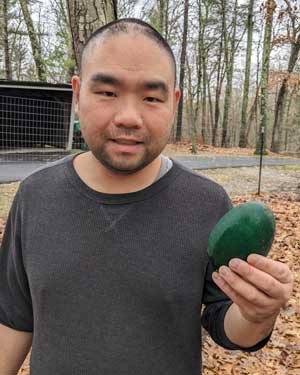
Nelson Mui holds up an emerald-colored egg, the first the emus have had.
The emus did not run at us en masse, as they had in my worst-case scenario. Instead, they strolled over and then seemed rather indifferent to our presence. Except for Boldie, who stayed with us and allowed Mia to hug him—she had to stretch up a bit to get her arm around him. Jessica said for some reason he likes his neck to be stroked, and she reached up and circled her hands around Boldie’s neck and showed me how flexible it is. Mia explained how she could tell the others apart. I could see the slight variations in their gray and brown plumage, and that one was taller, but I couldn’t keep them straight.
Puzzling behaviors
Nelson pointed out how the feathers on Boldie’s backside extend beyond his body in a clump of dry, dense, plumage—almost like the bustle under the skirt of a Victorian lady. The feathers on the back are much softer, in very dense layers. It’s easy to see how emus can keep warm in winter, except that the small head, covered in a fuzzy crew cut, seems more vulnerable. Jessica said that despite the fact they don’t like each other very much, they sleep cuddled up together.
Nelson feeds the emus in the morning. He said emus, unlike chickens, are very picky eaters and prefer chicken feed to almost everything else he has offered. He had brought a head of lettuce, though not the romaine that they favor. Boldie had a few messy pecks, and the others meandered over for a few chomps before moving away again. Jessica, aided by Mia, seems to be the emu psychoanalyst—an imperfect science. She predicted that the two probably dominant females would give Boldie a hard time for hanging out with us. Sure enough, when he wandered off, two of the group went after him, not touching him, but snaking their necks up and down, seemingly expressing their disapproval.
As we left the paddock, Rod and Todd were up against the fence, adjacent to the mob, and it was puzzling why they would choose to be anywhere near the bullies who had wanted to kill them. Now and then Boldie would approach them. Maybe he wants to make friends, Jessica theorized. But another—maybe BF—puffing and posturing, seemed clearly intent on intimidating the two. And then Todd, perhaps tired of it all, sat down, his long skinny legs sticking straight out from his body’s heap of feathers.
I had arrived at the Muis wondering why on earth this family was raising emus; I left understanding the endless fascination they hold and how one could become attached to a friendly emu like Boldie.