The other day on the Holy Hill conservation land I ran into Wendy Sisson, Peter von Conta, and Brian McClain, members of the Land Stewardship Subcommittee of the Harvard Conservation Commission.
They were carrying chainsaws, a pair of loppers, a pruning saw, and clippers and were busy clearing small white pines along Maple Lane, off Shaker Road in the historic village, so that the views of old stone walls and grasses in the fields beyond wouldn’t be obscured. They also moved some downed limbs from the ancient sugar maple trees out of the walkway and removed some invasive glossy buckthorn.
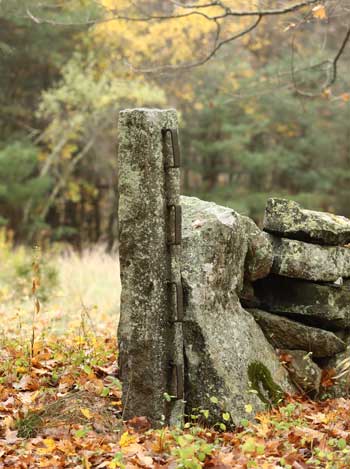
Part of a stone gate marks the entrance to an abandoned pasture. (Photos by Lisa Aciukewicz)
Sisson reminded me that the stewardship subcommittee was sprucing up in anticipation of conducting a guided loop walk on the Holy Hill conservation land on Saturday afternoon, Nov. 5, which will start at the trailhead on South Shaker Road and circle through Maple Lane toward the end of the walk.
In addition to providing access to agricultural fields and long-gone buildings, the lane was a processional aisle from the village to the outdoor worship area known as the “Holy Hill of Zion,” constructed for the joyous dancing and singing that the Shakers were known for.
In 1842-43 the Shakers created the Holy Hill by carving a flat area out of a drumlin, a glacially formed hill of clay, sand, and broken rock (till). Then they fenced in the area, surrounded it with maple trees, and consecrated it by installing a stone called the Lord’s Stone, now missing. By 1852 outdoor worship was discontinued and membership numbers dropped. In 1918 the lands and buildings were sold, and the remaining Shaker sisters resettled elsewhere.
The Holy Hill and surrounding conservation lands provide examples of the Shakers’ prodigious energy and fervent dedication to altering the landscape for their religious and communal purposes. Existing examples include the stone work of building foundations, walls, and a bridge over Bennetts Brook; the straightening and redirection of that same brook through the village; the construction of distinctive buildings of pleasing proportions; and the lands cleared and drained for agriculture.
As they walk the trails, people may sense that they are in a special place. Perhaps that is due to the Shakers’ conscious use of agreeable proportions throughout the conservation land. The dimensions of the fields and rectangular spaces, the symmetry and placement of stone blocks, and even the spacing of the grand old sugar maples reflect the Shakers’ innate sense of simple proportions and balance, famously seen in their buildings and furniture.
Today Holy Hill has returned to a forest of mixed hardwoods and pines, where trees and limbs downed by storms and old age are allowed to remain lying and enrich the forest floor, and where the occasional deer, fox, and other wildlife wander. The maple trees are still tapped, and sheep still graze in fields of grass, although cattle are no longer grazed or housed in barns that were once supported by massive stone foundations, some of which can still be detected.
Walking trails criss-cross the ridge and run through fields, along and over Bennetts Brook, up and down hills. Doomed and stunted American chestnut trees along the ridge now struggle to grow beyond 10 feet. The distinctive leaves of a sassafras tree lie on the ground. Scraggly witch hazel flowers are blooming. The sounds of hammering pileated woodpeckers and the screech of raptors and jays are heard, as well as the tunes of songbirds. Glacial outcrops and boulders are scattered about, including a few particularly impressive ones beside the trail.
True to its name, the trail to Holy Hill can be hilly with a few steep but short sections, and due to its glacial till, it is a bit rocky, but most of the trails are moderate and smooth. The full length of the walk will include a road walk from which a view of Holy Hill can be seen in the distance and a walk down Maple Lane before returning to the parking lot on South Shaker Road.
On Nov. 5, walkers should gather at the parking area on South Shaker Road by 1:30 p.m. The entire walk will take two to two-and-a-half hours over about 3¼ miles. An option to abbreviate the walk halfway may be possible for those who need to do so. Attractive and informative signs about the site are located at the trailhead and at the dancing ground. Rain will cause the walk to be canceled, but drizzles or flurries will not cancel it.
Margaret Kusner is a retired middle school art teacher, a lifelong artist, and a walker who considers herself to be a part of nature.
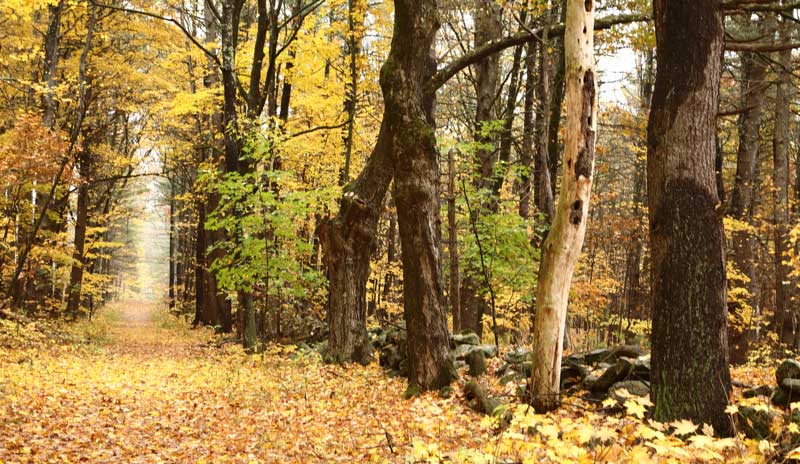
A wide dirt road is a remainder of the Shakers’ path to an outdoor worship site at Holy Hill.