Tuesday’s much-needed rain was certainly good for Harvard’s forests, fields, and gardens, but it may have kept some voters away from the polls. According to the official results posted on the town website, just 1,359 of Harvard’s 4,567 registered voters cast ballots in this year’s state primary election. That vote total includes both those who voted in person at the Bromfield School and those who voted early or through absentee or mail-in ballots.
This year’s 29.8% turnout was down slightly from 2018, the last state primary in a nonpresidential election year, when 33.1% of the town’s registered voters took part. But this year’s turnout was still better than the town’s dismal 21% showing in 2014.
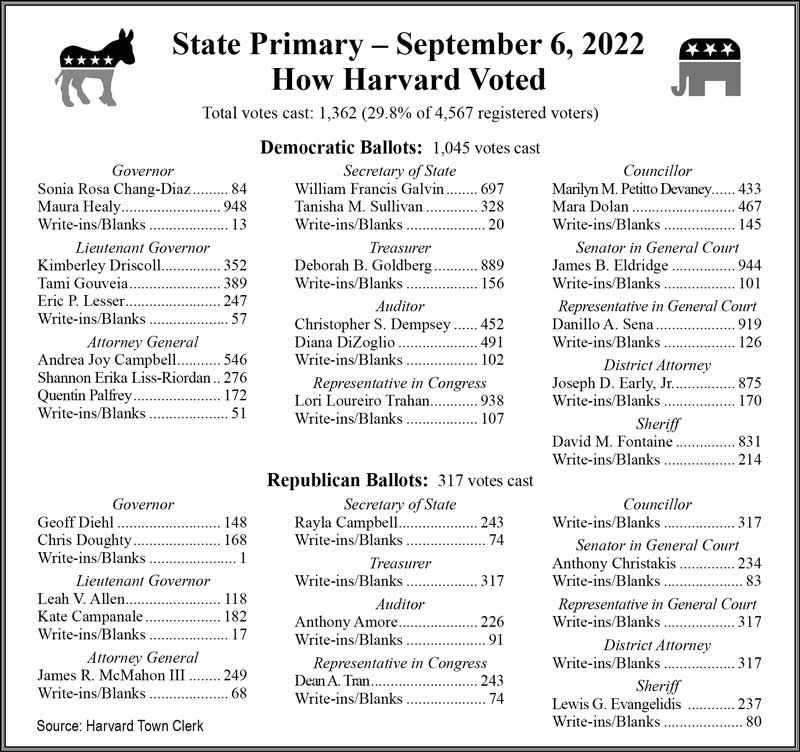
Harvard Democrats cast their ballots overwhelmingly for Maura Healey, as did Democratic voters statewide. Healey captured 70% of the Democratic votes in Harvard and won across the state with an even larger share of 85.5%.
The GOP gubernatorial race was much tighter, both in Harvard and in the state. Harvard voters preferred Chris Doughty over Geoff Diehl by 53% to 47%. But statewide Diehl won 55% to 45%.
In the three-way lieutenant governor’s race, Harvard Democrats showed a narrow preference for Tami Gouveia, but she was trounced statewide by Kimberley Driscoll. Harvard Republicans, too, saw their preferred candidate—Kate Campanale—lose statewide to Leah Allen.
For Harvard’s full results, see the table below. (Results are not certified by the state until a couple of weeks after the election.)
Some are party loyalists while others ‘keep options open’
About three-quarters (77%) of this year’s Harvard voters took a Democratic ballot, either because they were already registered as Democrats and could vote only in that party’s primary, or because they were not enrolled in either party and could choose which ballot to take. About a quarter of local voters (23%) took a Republican ballot.
The party primary system came as a bit of a surprise to at least one early-morning voter who stopped to talk with the Press on his way into Bromfield. Asked if he was registered with a party, the man wondered whether he would have the chance to choose from the full slate of candidates in both parties. Told he would have to choose one party ballot or the other, he explained he had recently come from California, which uses a different system.
Since 2011 California has had an “open primary” for most offices except the presidency. All the competing candidates—regardless of party—appear on a single primary ballot. The two who get the most votes, even if they are from the same party, then run against each other in the November general election.
Several Harvard voters from both parties, when asked, said it was the governor’s race that drew them to the polls. One woman said she had long been an independent voter but had recently decided to register as a Republican, explaining, “It was time to take a stand.” She planned to vote for Diehl.
Another independent voter said he would pick the Democratic ballot this year. “I tend to vote Democratic, but I keep my options open,” he said.
“I choose the ballot where I think there’s a contest,” another independent voter explained, “and that’s the Democrats this year.” But the friend he was talking with took a different approach. That friend said he was at the polls to cast a vote for Republican congressional candidate Dean Tran, even though Tran was running unopposed. “I like Tran because he’s from Fitchburg,” the second voter said.