Turning in at 122 Old Ayer Road in Groton, one catches only a glimpse of the building on top of the hill. The long tarred driveway curves up and around and then opens into an expansive parking area. But one’s eye is immediately drawn to the impressive building that is the Groton Hill Music Center, new home of Indian Hill Music, opened to the region Sept. 6.

The exterior of Meadow Hall contrasts with the main spine of classroom and office space seen on the right. (Photos by Lisa Aciukewicz)
The two-level structure, designed by Epstein Joslin Architects of Cambridge, spreads out on both sides of its entrance, the facade a series of alternating stone columns and windows, topped by a story twice as high of rusty-red siding and a row of V-shaped white beams. The undulating roofline gives an illusion of fluidity, with a suggestion of trellising or pickets. Hardly visible from the front is a gleaming scooped roof at the west end, almost like a circus tent. This 126,000-square-foot edifice looks both overwhelming and welcoming at the same time. One can imagine music streaming out of the building, filling the air of the 75 acres of preserved open space that surround it.
Dave Leary, marketing director, told the Press that the architects’ vision was that, seen from a height of 1,000 feet, the building would mirror a farm property with red barns and silos, nestled in farmland and orchards that have been there for generations. With this in mind, one can now see the beams as old apple tree branches, the facade a stretch of barn doors, and the “circus tents” as huge silos.
For the interior, this translates to two performance centers in the east “silo” and a series of 35 classrooms, lobbies, and rehearsal spaces connecting to the large “silo” at the west end. The west-end Concert Hall is patterned after Epstein Joslin’s main concert hall at Tanglewood in Western Mass. It seats 1,000, and one wall opens up to a lawn that can accommodate another 1,000 people. The hall will be completed in early January.

Meadow Hall, a 300-person concert hall, is washed in natural light from large windows above and behind the stage.
The nonprofit Groton Hill Music School offers a wide variety of music classes for all ages at all stages of learning. Meadow Hall, one of its venues for professional musicians, has a full schedule of performances—from chamber music to jazz to bluegrass to global styles—throughout this fall. The in-house Vista Philharmonic Orchestra (formerly Orchestra of Indian Hill), conducted by Bruce Hangen, will perform an opening concert Oct. 21 and 23. The orchestra will start its regular program series in January when Concert Hall and the adjacent restaurant open. A free-class day event is scheduled for Oct. 1 and 2.
Continuity of mission
Groton Hill Music Center is the reiteration of Indian Hill Music, which was started on Indian Hill Road in Groton in 1985 by a group of musicians who wanted a community for themselves and one to extend to all ages, abilities, and backgrounds. They used space in instructors’ homes and church halls before renting two rooms in a Littleton school. Word spread and there was steady growth. In the late ’90s the school moved to a refurbished barn in Littleton, using various venues for performances. The organization had aspirations to expand the facility, always keeping the spirit of its founders—community first, then musical excellence, education, and performance—and it steadily fundraised for many years.
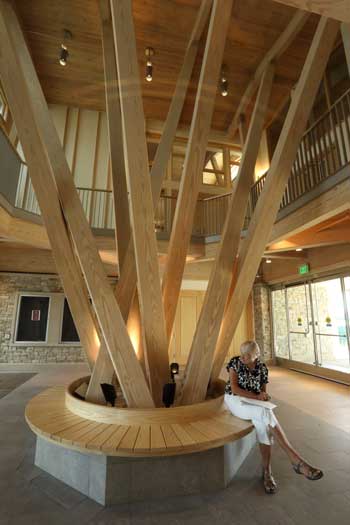
The writer, Carlene Phillips, takes in the lobby beneath a support structure designed to mimic an apple tree.
The turning point came in 2014, when anonymous donors offered to pay for a site and building that would meet the group’s vision. The gift was restricted to the facility itself. It took a year to find the land, which is where rocker J. Geils lived, musician and onetime leader of the J. Geils Band.The “vision” is a music center with 20 full-time staff and 75 part-time teachers in a state-of-the-art facility. Pete Robbins, director of education and non-orchestral performance programming, said, “It’s the same mission with the same good people.” That stated mission is to “share the transformative power of music through teaching and performing and giving music generously where there is need.”

Heat registers under each seat allow for soundless heating.
A transformative power
The building is charged with a transformative power of its own. The high, pergola-like entrance opens to a lobby at the center of which is a circular bench around a group of vertical posts, criss-crossed at their bases and reaching two stories up. Despite their bulk, they branch out in a way that uplifts the viewer. Leary said most people are at a loss for words, describing the building simply as awe-inspiring.
The yellow pine of the lobby posts is used throughout the building, and smaller groups of branched posts are used structurally in the halls and open spaces, which give the building’s interior a continuity of lightness in color and a connection to nature. Unique chandeliers, looking like a modern version of old lanterns, hang throughout the building.
Education and performance
There are multiple places to share music in many different ways. The building is oriented east-west separated by the main lobby. The east end is devoted to education and performances other than orchestral. In Meadow Hall, a professional performance venue, the walls and ceilings are of curved yellow pine, and two curved railings focus the front, where one looks down over the 300 seats to the stage. The curves give a sense of fluidity and at the same time a cozy, settled feeling. Out the wall of windows behind the stage, one sees a stretch of field and a white farmhouse and red barn in the distance, still part of the property. On the stage is a Steinway concert grand piano that was donated to the organization years ago by Paul Matisse and kept in a gallery in Groton center, from which it had to be removed out a second-story window to be housed in its new location.
Everything in the room supports the acoustics. Robbins pointed out a round circular vent under each seat and said the HVAC system moves air slowly up through those vents so as to make the room devoid of extraneous noise. “It’s a world-class listening space for world-class performers,” he said. One of those performers scheduled before the end of the year is Brian O’Donovan of “Celtic Sojourn” fame. A guitarist and vocalist from Mozambique and a cuatro player, singer, and ensemble from Puerto Rico will appear in an October program. Robbins said the hall can also be used for student performances.
A series of studios line a hallway, each one with a window and a brightly colored rug. One room has two pianos for duet practice or teaching, and there is also a digital piano lab. In all, there are 35 rehearsal and teaching spaces.

Pete Robbins, director of education and non-orchestral performance programming at Groton Hill.
Robbins said the education program enrolls 1,200 students a year, “from babies to seniors.” He himself was a pupil at Indian Hill Music at age 13 and became an employee of the organization in 2016. He is a saxophonist and composer. Groton Hill has a youth chorus for preschool through middle school; a youth orchestra; and a youth wind ensemble. Each has three tiers, and Robbins said all students who wish to may find placement in one of these groups. There are four practice rooms for ensembles. The Orchard Room is a smaller room than Meadow Hall, with 60 seats, and is perfect for student recitals where, said Robbins, players may feel more comfortable and less intimidated. Robbins said the advantage of the large music center is that “kids have a chance to rub elbows with world-class players.”
Down a wide corridor, with open gathering spaces, one crosses over the lobby, past what Robbins refers to as the “octotree” and into the west wing. The Skyview Room is a flexible space that can be set up as a flat floor or with a stage and used for performances and also rented out for lectures, seminars, or other functions. The largest space on this side—and in the entire building—is Concert Hall, which will open at the beginning of next year. It will seat 1,000, only 200 fewer than Seiji Ozawa Hall at Tanglewood, and open to additional lawn seating. Robbins said the hope is to have a day- or weekend-long festival next summer and for this kind of themed festival to become a regular event. A cafe and restaurant are adjacent to the hall, open when there is a concert. A much smaller cafe is on the east side of the building, open only at certain times of the day.
A gift to the community
Robbins talked about community, the third aspect of Groton Hill in addition to education and concerts. “We’re the same community-facing organization we have always been,” he said. In addition to the students and performers who make up a community, Robbins said Groton Hill wants to embody a greater community—not just the town where it is located but the 70 surrounding towns and even beyond, a regional music center accessible to everyone, with its excellent teachers and top performers. He said an important part of that community-building is to reach out to those who might not otherwise be able to participate. Groton Hill partners with public schools in Leominster, Fitchburg, Lowell, Lawrence, and Clinton and asks, “What do you wish you could do but can’t afford?” Then Groton Hill responds by sending teachers to these communities to offer music instruction in band, string, and electronic music. Robbins said that with the new building, students from these communities “can now be invited here.” Grants and donations support this outreach.
The center will continue to hold free concerts for older community members (the Harvard Council on Aging used to run a van trip to Littleton), offer need-based scholarships, and support the Threshold Singers, who sing at the bedside of those in hospice.
As education director, Robbins said his vision is to create more synergy between learners and performers. One way is to invite an artist to come earlier on performance day, or on a different day, to be with the kids. A visiting musician might go to an ensemble rehearsal, hold a Q&A, give a lesson, or invite students to attend a soundcheck.
Robbins calls Groton Hill Music Center “a gift to the community” and said, “We are going to keep doing the same good work—only now we can do more.” For more information go to grotonhill.org.