The weekly cartoon in the Harvard Press is probably for many readers one of the paper’s highlights—tied, perhaps, with the Police Log. Cartoonist Hakan Sahin has become an institution. So it was a surprise a few weeks ago when a distinctly different kind of cartoon stood in for his. Suzy Becker has filled in for the month while Sahin has been abroad, and this week marks her final, for now, Press appearance. I heard that Becker’s work has appeared in The New Yorker, and I admit it was partly this prestigious distinction that prompted me to find out more about her.

Cia Boynton, who does layout for the Press, is the one responsible for Becker’s appearance. She and Becker are friends, and she has designed a couple of Becker’s books. In an email exchange, Becker said she would have some time to talk on the phone before heading off to Peaks Island, Maine, for a vacation and weeklong workshop for teenagers in Portland. Meanwhile, she suggested I look on her website.
Parker School founder
Less than a minute on “The World of Suzy” had me laughing. And I quickly learned how much more there is to admire about Becker than her New Yorker connection. But Becker doesn’t start with a list of accomplishments—like writing an international bestseller, “All I Need to Know I Learned From My Cat,” at the age of 28 or helping to found one of the first charter schools in Massachusetts, Parker Charter Essential School in Devens, where she taught arts and humanities before leaving to do full-time writing and illustrating. Instead, she starts with a list of the three things most important to her: friends and family; making people laugh; making a difference.
Becker divides her “About Suzy” page into “For Kids” and “For Grownups,” and she has Fun Facts and FAQs in both sections. In her FAQ answers she refers to herself in the third person. She conveys her love of reading from an early age and how she wanted to write books since she was 8 and really wanted to see her name “on the cover of a book someone loves as much as she loved her favorites.” (“Harriet the Spy” tops the list.) For grownups she adds, “She’s had a soft spot for loneliness her whole life. Suzy writes to connect with others.”
In the “For Kids” section, Becker says she can make a four-leaf clover with her tongue and she’s allergic to shellfish and mean people. An FAQ is the classic “Where did you grow up?” The answer: “That’s a tricky question! She never did.” Then she admits it was outside of Philadelphia. She says most of Suzy’s ideas come from real life, like her dog or cat or daughter. She keeps an idea book. (She’s on her “thirty-somethingth one.”) Sometimes people ask her to write about a certain topic, like ghosts, and “while she’s trying to write about those things, her brain tells her what it really wants to write about, like opossums.”
Through the pages of the website, full of photos and graphics, a continually morphing yellow blob, and a signature little yellow bird, are sprinkled the many things there are to admire about Becker. Four years after she graduated from Brown University, she started her own greeting card company, The Widget Factory, which also sponsored a biannual Ride for AIDS Resources. Becker’s latest book continues to evidence her sense of social responsibility. “Kids Make It Better” is a write-in, draw-in world-problem-solving journal for 6- to 10-year-olds to create their own solutions.
Books too
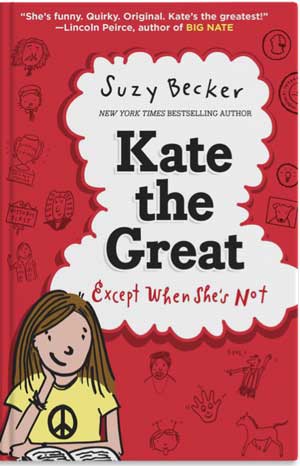
And this is to say nothing of the 11 books she has written and illustrated, mostly for children, like “Kate the Great Except When She’s Not.” Her cartoons have been in numerous exhibits, and her work is part of the permanent collection at the Museum of Comic and Cartoon Art. An online source says that for three weeks in June 2008 Becker created a daily cartoon for “Rhymes with Orange” while its creator Hilary Price was on vacation. (I won’t state the obvious parallel—well, minus the national syndication part.)
The website talks about her art and writing workshops whose motto is, “There are no rules—except to have fun and make mistakes. Because that’s where true creativity comes from.” So it makes sense that the workshops are for all sorts of combinations of writers, artists, wannabes, “whoever I left out, except for people with too much confidence.” She also makes school visits, and she gives talks on what she loves, including “How to live life like your hair is on fire.”
On the phone, Becker said there were times she felt the pressure to “find a brand” for her cartooning, but she was “building a life not a brand” and would not “be put in a box.”
She said she loves the discipline of cartooning and spends the first hour of every day drawing. She has a “pile of homeless cartoons,” a couple of which have come close to seeing print in The New Yorker. She has had success with the quarterly Alta, which she says is The New Yorker of the West. Often she sends a cartoon to friends, sharing her “super power to reframe something ordinary to make people laugh.”
The latest in Becker’s busy, innovative life is writing an “autobiographical fiction” for adults and pioneering in graphic medicine—giving workshops where people create narratives of their caretaking, illness, health, and recovery through writing and drawing. There is no emphasis on a finished product; it’s about process and people bonding with one another. She said writing their own stories can be important to the mental health of medical students and fourth-graders alike.
I asked if this meant she was going in a different direction. “I’m going in my direction,” she replied. What she’s no longer determined to do is read “Ulysses,” go scuba diving, or learn to do a back flip.