Editor’s note: This is the third and final column in a series of columns describing the Durrants’ birdwatching trip to Peru.
Day 7: Zapote River buffer reservation, El Dorado River Natural Reserve
The guides were determined to find a spectacled owl. They had seen the owl in this area two years earlier, before COVID eliminated their trips. We went up a small tributary off the Ucayali and then floated into the flooded forest. One of the naturalists had to stand on the bow and hack our way through the vegetation with a machete until we got to a more open area. We floated silently for a few minutes until Doris, one of our expert guides from Peru, said in a hushed voice that she had spotted an owl not 80 feet away, high up in a tree. There it was, a spectacular spectacled owl, just sitting there on a branch enabling us to get great views of it and some good photos.
Although spectacled owls are fairly common, they are threatened by habitat destruction and are notoriously hard to find. The owl is 30 to 36 inches tall, has a creamy white chest, black head, and white feathers surrounding its bright yellow eyes, giving it the appearance of wearing spectacles—hence its name.
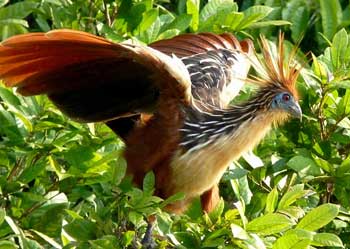
The prehistoric-looking hoatzin has an orange mohawk, blue facial skin, and
a stubby bill. (Courtesy photo)
Minutes later David spotted the brilliant blue, plum-throated cotinga perched on a branch above us. Black-and-white hawk eagles were among the several other species we saw, the most interesting of which was the hoatzin, a target bird for many of our fellow travelers. This prehistoric-looking bird has an orange mohawk, blue facial skin, a stubby bill, and is somewhat larger than a chicken. The hoatzin belongs to the family Opisthocomidae and the order Opisthocomiformes. It’s the only member of its genus, family, and order—truly a unique and much sought-after bird.
Not to be forgotten in the excitement of the cotinga and owl was the surprise sighting of a magnolia in bloom. This species is native only to the Amazon basin tropical forest in Peru and Ecuador, and seeing it was a special treat for Pam.
Day 8: Iquitos Creek, Maranon River
Another morning was spent exploring the flooded forest, this time up the Iquitos Creek, a small tributary of the Maranon River. We were lucky to get astonishing views of the diminutive (but gigantic in the birding world) American pygmy kingfisher. This kingfisher is only about 5 inches tall, making it extremely hard to find, but we were lucky enough to see two of them darting along the river and perching low on branches overhanging the creek.
White-fronted nunbird, many-banded aracari, silvered antbird, and point-tailed palmcreeper were among the more than 80 species we would see this day. Again, the boatman excelled in his spotting ability and found a Lafresnaye’s piculet in a nest hole. This is one of the world’s smallest woodpeckers, only 3 to 5 inches long. Although we had seen one briefly in Ecuador years ago, it was great to get close-up views of this little bird with pale yellow underparts with extensive black barring, golden brown back, and black crown with white spots.
Probably the highlight of the day for most of us was not a bird but the pygmy marmoset. A guide had noticed some movement in a tree about 20 feet away and, as we sat quietly in the skiff, this smallest monkey in the world, measuring around 6 inches, soon appeared. It was one of those “wow” moments.
Day 9: Return to Iquitos
We made our way slowly downriver and stopped just upstream of Iquitos for a final skiff outing to an Itaya River island, in the hope of finding some river island specialists. The first birds we saw were a pair of Parker’s spinetails flitting around in the grasses. This small brown bird, a little larger than a wren, with a long tail befitting its name, is indeed one of those island specialists.
Yellow-hooded blackbirds were the most prevalent of the 45 birds we identified on this two-and-a-half-hour trip, but the most exciting sighting was when we were returning to the Zafiro. Andy (an excellent British ornithologist now living in Brazil) spotted “something” about 200 yards away in some tall trees. Pushing slowly through the dense floodplain vegetation, we were able to get a closer look, and indeed there it was, a striped owl. When scanning the area, we found another—obviously a pair. This large owl has ear tufts similar to our great horned owl. In a magnificent way, this was a fitting end to our unforgettable journey to the greatest biome on earth.
Day 10: Return home
With no access to world news or cell service and surrounded by wildlife, the days had peacefully passed as if we had entered a different dimension. We were soon to be jolted back to the reality of COVID testing, a day later; all tested negative.
All told, we spent eight days with the group, traveled 770-plus miles of river, creek, and flooded forest. The group saw 330 species of birds, unusual mammals, snakes, insects, and the famous pink river dolphins. What makes our trips most enjoyable is not purely the focus on birds, animals, and flora; it is exploring different environments, experiencing different cultures, and meeting people from around the world.
The only unfortunate part of this trip was that due to COVID, we were not able to personally visit with the local communities who have agreed to protect their forest, the Pacaya-Samirian Reserve, in exchange for an entrance fee. What was heartening, though, was the reaction of the crew of the Zafiro and our naturalists. We were the first guests they had had in more than two years, and they were grateful that we had made the trip to their wonderful country.
David and Pam Durrant live and work at Micheldever Farm on East Bare Hill Road.