
As a streaming service subscriber, Harvard resident Paul Richards missed last week’s live broadcast of the 2022 Academy Awards ceremony where “CODA,” the Massachusetts-based film he worked on, won three Oscars. Through text messages, his family and friends told him the exciting news. But Richards, an experienced art director of about 12 years, was not surprised.
“The nature of the story, a sort of positive, coming-of-age challenge for a young person, for me was refreshing, given the news of the world at this point,” said Richards. A private screening of “CODA” for cast and crew left him feeling immensely happy, he said, with a sense of pride and enjoyment for a project he has worked on that is rare.
“CODA” was nominated for three Oscars and took them all home—best picture, best adapted screenplay for director Siân Heder, and best supporting actor for Troy Kotsur, who became the first deaf actor to win this award.
Set in the coastal town of Gloucester, “CODA” features a predominantly deaf cast in leading roles. Ruby Rossi, played by Emilia Jones, is the hearing child of deaf adults, otherwise known as a CODA. While she serves as an interpreter for her family as they work at the local harbor catching and selling fish, Rossi decides to enroll in her high school choir to pursue her passion for singing. Rossi’s choir teacher soon recognizes her undeniable talent, which her family will never hear, and urges her to apply to Berklee College of Music. She then finds her life to be a balancing act as she takes singing lessons and works as an interpreter for her family’s struggling fish business.
Art director Richards helped realize the vision for the film’s design and set work, while ensuring other departments, such as construction, paint, and decorating, completed their work as planned.
“I really enjoyed getting ready for the boat and harbor stuff since I love the ocean in general,” said Richards, adding that as a low-budget film of about $10 million, more locations were needed for shots since sets could not be built for every scene. Richards said another highlight for him was shooting scenes at an unused school in Beverly. “A number of school sets were done there. That was fun pulling that together, back from vacant, filthy rooms.”
Richards began his career in the arts using the skills he learned as a carpenter in the ’80s. His first venture was on the pilot episode of the ’90s television show “Against the Law,” where he later moved into the set decorating department. He was leadman—the set decoration department member responsible for the props and set dressing on a film set—for about ten years on such films as “Good Will Hunting,” “8 Mile,” and “The Departed.” Now he works predominantly as an art director.
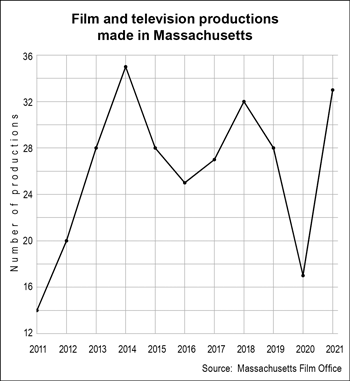
Richards said he looks forward to working on movies that are made locally in Massachusetts because the state has a variety of different looks. “You can get to the ocean, the mountains, and the country’s not too far away,” said Richards. “I’ve even shot some fairly contained stuff that is supposed to be the exteriors and interiors of Paris, France.”
Another draw for filmmakers to work in Massachusetts is the tax incentives. According to the Massachusetts Film Office, any production that spends more than $50,000 in the state qualifies for a 25% payroll credit. In addition, if more than 75% of the total budget or principal photography days are completed in state, filmmakers also qualify for a 25% production credit and sales tax exemption.
“One of the things I think is great about the tax credit is that it is spread throughout the state, as opposed to some tax credits, which might be concentrated a lot of times in Boston,” said Richards.
Despite these incentives, Richards said there is still a shortage of local people working in the film industry. He would like to see a mentorship program created for people coming out of skilled trades, which could involve taking people that build houses and teaching them how to build scenery. “There’s a learning curve because it has to look how it has to look, but it doesn’t have to function or last.”
Richards attributed the success of “CODA” to the director, who grew up in Cambridge but spent her childhood summers visiting Gloucester. To him, that made a huge difference in how the film was approached—from a localized perspective. “I could tell from the beginning that she had her finger on the pulse of Gloucester and had high hopes,” said Richards. “But often the end result doesn’t end up, certainly, with an Oscar.”