
Having your book reviewed in The New York Times gives an author bragging rights. On Sunday, April 3, at 4 p.m., Fivesparks will host Erica Ferencik, whose newly released third novel, “Girl on Ice,” has earned her those rights. She will read a brief selection from the book, talk about its setting and how she got the idea for it, and describe her writing process.

Author Erica Ferencik. (Courtesy photo)
In a recent phone conversation, Ferencik told me the story of how it happened that she is speaking in Harvard. She and her husband, who live in MetroWest Boston, like to explore new places to walk, and they enjoy coming to Harvard and stopping at the General Store. On one of their visits, they struck up a conversation with Jared Wollaston, who invited them into his home on Elm Street. Learning she is a writer, Wollaston told Ferencik about Fivesparks and encouraged her to contact board president Mark Mikitarian and AnaMaria Nanra, events manager. Ferencik said she has been working seven days a week, 12 hours a day promoting her book, so she was happy to schedule a talk at Fivesparks and to have her book for sale at the event through The Silver Unicorn Bookstore in Acton.
A hallmark of Ferencik’s novels is the forbidding setting in which the action takes place and the way in which nature becomes another character in the book. Ferencik travels to the places in which she sets her story and completely immerses herself in the beauty and dangers each has to offer. Her first book, “The River at Night,” takes place in the remote Allagash Territory of northern Maine, sparsely populated, mostly by men living off the grid, she said. The Peruvian jungle provides an exotic setting with deadly dangers for “Into the Jungle.”
For “Girl in Ice,” Ferencik spent a month in Greenland, which informed the real and compelling descriptions of the environment in what she has called her best book. The protagonist, Val Chesterfield, describes the “Enormity … a vast ice field where black mountains jutted up against the horizon like cresting waves frozen in place.” There are “stories-high icebergs, each a sculpture carved by a madman,” and under the ocean, “the inverse mountain, unbearably exquisite and strange.”
Ferencik said she has always had an affinity for those places that no one who hasn’t been there could imagine. She wants to bring nature to people in all its beautiful and amazing wonder. “But,” she said, laughing, “I’m not a travel guide.” She said it is these extreme environments that “bring out who you really are.”
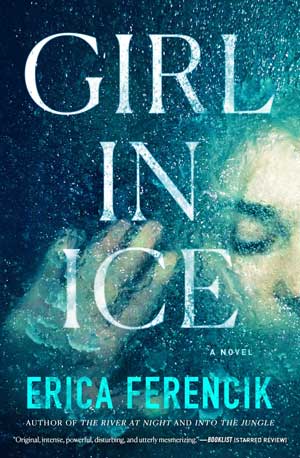
In “Girl in Ice” a small group of scientists is working at a climate research station on an uninhabited island off the northwest coast of Greenland, where temperatures fall well below zero and “the wind voiced its rage, the building rattling like a toy.” They are shut up together, all with their own griefs, ambitions, and secrets. As one character says, “Nobody normal comes here. This place is just natural selection for people who want to leap off the edge of the world.”
A girl has been found frozen in ice, her legs in running position, “her eyes frozen open in terror.” They cut her out of the glacier, and when her body thaws, she is alive, but no one can understand her speech. Clearly she is traumatized. The sister of one of the scientists—a man who was found frozen to death outside the station one morning—is a linguist, and the head scientist asks her to come decipher the girl’s language—and the reason for her terror. Val takes medication for severe anxiety, but she wants to help and that, in addition to her desire to find out more about her twin brother’s death, compels her to go despite her fears.
Ferencik’s novels have mystery and suspense and are often described as “thrillers.” She said she’s not trying to break the mold, “I’m just trying to write the best story I can.” She prefers to classify her books as thriller literature, because, she said, always “it’s the human story.” In a written interview online, one of her pieces of advice to writers is, “Don’t shy away from painful situations or emotions,” and another, “Love or have empathy for all your characters.” In “Girl in Ice” suspicions, loss, desires, and guilt create tensions among the characters, and Val, despite her knowledge of many languages, including old Norse, is increasingly frustrated by her inability to understand the girl, Sigrid.
Ferencik explained her advice to writers to “keep the dread going” by saying that we all live in dread every day. Stories help us survive it. We see a character living in dread, and how that character deals with it helps the reader to deal with their own. For those at the station, it is a dread of the dangers in the environment and the race against time. Every day brings fewer hours of light, and it will soon be polar night with temperatures 60 below, and they will need to get out. For Val, the dread is that she will fail, she will not find Sigrid’s secret in time.
A dread of climate change
Ferencik’s dread about climate change has a presence in the book. She sees a fine line between what is real and not real. Howling winds off the glaciers cause severe drops in temperature. Was there a time—and will there be again—when icy winds, even in different parts of our own country, could freeze a person to death in a matter of a minute?

Erica Ferencik on a research trip to Greenland. (Courtesy photo)
Story comes first
Ferencik talked about her process as a writer. First comes an idea; she has to vet it to see if it “has legs” and secondly to ask if she can be passionate about it for the years it will take to develop it. Elsewhere she has said that the power of observation is most important to a writer—and to a stand-up comic, which she was for 10 years. (There’s no place for real humor in “Girl in Ice,” but a couple of Val’s understatements make for some comic relief.) It was an observation she made one bitterly cold winter day while walking in woods near her home that led her to the idea for “Girl in Ice.” She saw something remarkable, and her imagination went from there.
She has also said she thinks the idea for “Girl in Ice” had been lurking in her subconscious ever since seeing the movie “Frankenstein.” We agreed on the phone that the near-last scene where, across a vast stretch of frozen Arctic sea, the monster, beaten and bloodied, heads north, is an unforgettably sad and haunting image. She said that began her fascination with Nordic stories.
Once she has the idea, she begins the “scaffolding,” methodically making a very detailed outline of the entire story and then, over a period of about six months working full time, a first draft. She has to have the story first, so that when she goes to the setting where the action will happen, she can be selective in what she looks for. Although she has the story set before she experiences the river or jungle or ice, she said she leaves herself open to “wonder and surprise.” She reads a lot of books and has to be careful not to get carried away with the research. In “Girl in Ice,” just the right amount of fascinating information on language comes out in Val’s work with Sigrid. (Greenlandic has 170 words for “ice” and two dozen for “fear.”)
Ferencik scoffed at the idea that a writer can get redirected by a character in their book. “Characters don’t come alive,” she said. “I made them up. The writer is in charge.” She said while some writers may have sudden inspirations, she writes a book as one would build a house—everything is planned ahead. The ending is the hardest—it has to be “surprising and inevitable.” The climax of “Girl in Ice” is both of those, and the dread is palpable.