Roksolana Mykhaylyk was born in Uladivka, Ukraine, a small town in the Vinnytsia region of the country. After earning a Bachelor of Arts degree at Vinnytsia Pedagogical University and teaching Ukrainian at a local school for two years, Roksolana moved to eastern Ukraine to teach at the University of Slovyansk and completed her Ph.D. in Ukrainian Philology at the National Academy of Sciences in Kyiv. She moved to France for four years and came to the U.S., where she earned another Ph.D. in linguistics from Stony Brook University in New York. Relocating to Norway for four years and then coming back to the U.S., she and her two daughters eventually settled in Harvard in 2016 with her future husband and Harvard resident Eric Prouty. After many years in academia, Roksolana serves as a senior manager for Alexa Voice at Amazon. After Russia’s invasion of Ukraine on Feb. 24, Roksolana shared her insights and reflections on the current conflict.
I’ve always felt a strong love of Ukraine and my Ukrainian heritage. Technically, I was born in the Soviet Union, but my family and everyone I knew always spoke Ukrainian.
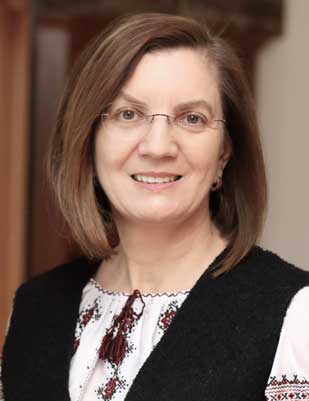
Roksolana Mykhaylyk. (Courtesy photo)
Ukraine is a unique country with a long, proud history. While sometimes conquered and occupied by other nations, the unique Ukrainian identity has always remained. Even when we were part of the Soviet Union, we remained Ukrainian first because that was part of my family history, values, and beliefs. I’ve heard the same belief from many Ukrainians in the different places I’ve lived. That is why regardless of the misinformation coming from the leadership of Russia denying our right to exist, we have always had a culture and language distinct from Russia. Even if we shared some part of the history a while ago, it does not mean that we are not unique. We became independent from the Soviet Union over 30 years ago, yet our history stretches back over a millennium.
‘Living in a Nightmare’
Here in the U.S., we heard a lot of warnings that the Russian invasion was coming a month or two before it actually happened. My husband and I tried to share these warnings with my family to prepare. While thankfully my parents prepared themselves, we know of many instances where people did not believe an invasion would actually happen until the missiles and bombs started to fall. Even my brother, who is a teacher and a writer, who could read news in English, didn’t believe in the full-scale invasion until it actually happened. When I texted him my thoughts, two days before the invasion, he said, “You are panicking too much. Nothing will happen.”
Therefore, for them the invasion was a shock. It was very shocking to me as well. I woke up at 4 a.m. to check the news, and there I saw that all the major cities in Ukraine had been bombed. I felt that I was living in a nightmare.
I worry about my parents a lot. I worry about my extended family as well. I have friends who are in Kyiv and other regions where the situation is much worse. My parents live in the city of Vinnytsia, southwest of Kyiv, and it’s a relatively quiet area. We have only one military base nearby. So far, there has only been bombing of that one particular military base. My parents, especially my father who survived World War II, are terrified to hear the bombing. They hear sirens, they prepared their cellar basement as a shelter to hide from the bombs, and they have stocked a lot of food and all they could could get in that basement. So far, they’re relatively safe. It can change any moment.
My brother was writing his book until the day before the invasion and didn’t want to hear any warning because he was so focused on his writing. He signed up for the defense forces on the first day of the invasion, took a gun, and went to defend his city. His son wants to join the army. But there are so many people who want to join the army that he is still in line. He has checked for the last five days, but his term has not come yet. My niece and her mother ended up as refugees in France. The rest of the family is hiding in cellars or have joined the defense forces.
I usually call my family on weekends with Skype or video calls. We are lucky that there is still good internet connection in that area. I’m not in good contact with my brother anymore because he is not allowed to use his phone. It’s very difficult for my parents and for me to know where he is and if he is still alive, but from time to time he tries to text and say, “I’m OK.”
People try their best to do whatever they can: going on the streets, taking guns, joining the army. In many cities in Ukraine, people just go there and stand in front of tanks. They are ready to fight. However, we cannot fight a modern war with empty hands. The situation is especially scary when Russia threatens to use modern weapons such as missiles.
What Ukraine is begging for these days is to close the sky. Unfortunately, NATO does not want to directly intervene in this war. If Russia decides to use more advanced missiles, Ukraine is not well equipped to protect its land. Ukraine can fight on the ground, but the sky needs a shield. So, while people still keep their strength and optimism in the country, on the global scale, I think it’s a very dangerous situation.
I try to help in some ways. On the second day of the invasion, one of my former co-workers texted me that her sister and her family with three young children were trying to flee from eastern Ukraine to Poland. They had already been on the road for two days, and they needed to stop because it was too much for the youngest child, who is just 2 years old. So immediately, in a few hours, I was able to arrange for them to shelter with my parents for one night. They were very grateful for that. It’s a very moving moment when you feel like you can at least help someone else’s family. That’s how I feel these days: If I can do something useful, I feel much better.
Remaining optimistic
If you would like to help Ukraine, you can do what Ukrainian people do: You can support us and stand with Ukraine. It does not matter what your nationality is. It does not matter which language you speak. If you understand this humanitarian catastrophe is not the way for humanity to live, then you have to stand up. How? There’s social media, where people are free to express their opinions and condemn the war. There are petitions that people can sign that go to the government of the country they live in. There are many organizations that collect donations for causes, such as the military, medical services, or refugees.
I try to be optimistic. The same about my parents: They are very optimistic because they see that everyone is standing up. Even when I mentioned to them that maybe they could leave and come here, they didn’t want to listen. They said they will win this war. They said to me, “We hope that you will come and visit us when it’s all over.”
Editor’s Note: The day after this interview, the airport near Vinnytsia was bombed and completely destroyed.
This is the fourth in a series of interviews with Harvard residents conducted by Bromfield senior Olivia Ren in fulfillment of the school’s community service requirement. For details, please see the series mission statement at right. The text of the interview has been edited for clarity and length.
About Harvard Voices
Although Harvard is a predominantly white and middle-class community, we still have so many different types of people here with diverse identities, backgrounds, experiences, and more. My hope is that my project will amplify the voices of the residents of our town who are less heard or have intriguing stories to tell. The series will interview a diverse array of people—perhaps an immigrant, a small-business owner, or even a neighbor from across the street. By publishing their stories I hope to dispel stereotypes, build unity, and demonstrate that everyone, from neighbors to complete strangers, has an interesting story to tell. No matter who it is, each resident here has something to contribute to the community, and we all have something we can learn from them.
—Olivia Ren
How to help Ukraine
- Sunflower of Peace is a Boston-based non profit that works with other established organizations to help the people of Ukraine affected by the Russian invasion (www.sunflowerofpeace.com).
- Razom is a nonprofit organization that works with a network of volunteers and other established organizations to “unlock the potential of Ukraine.” It is currently focused on an emergency response to the invasion, with a focus on providing medical supplies (razomforukraine.org).
- The National Bank of Ukraine is accepting donations to support the armed forces of Ukraine and the people affected by the invasion (bank.gov.ua/en/).