For the second year in a row, the Finance Committee is recommending that the town use free cash, money left unspent from the prior fiscal year, to balance the upcoming fiscal 2023 budget.
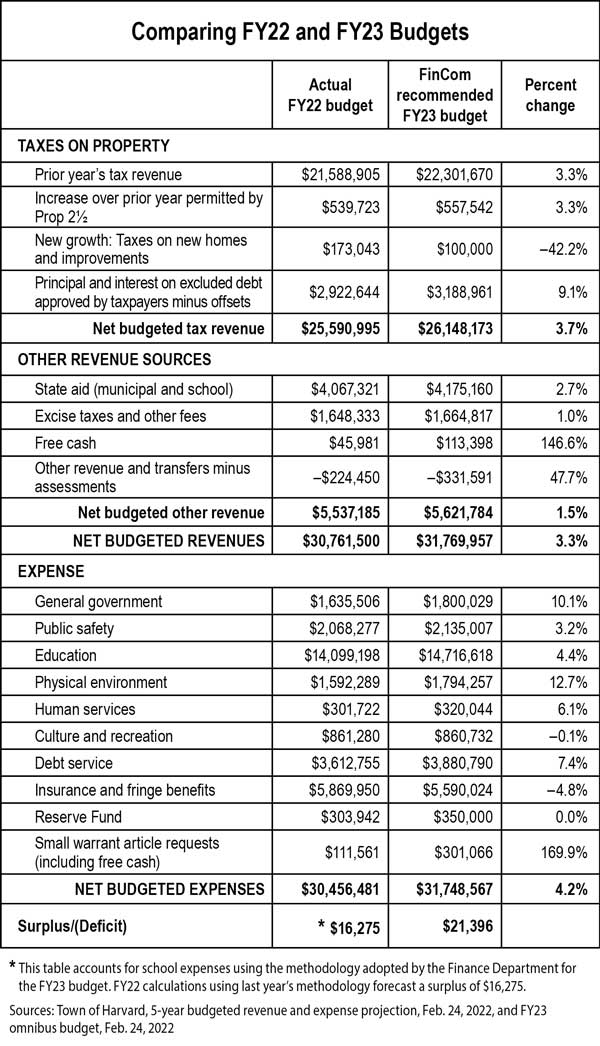
The committee made its recommendation to the Select Board Tuesday night, part of its plan to pay for a $31.7 million post-pandemic budget. That amount is a nearly $1.1 million increase (3.9%) over the previous year and required few adjustments to the budget requests submitted by department heads and committee chairs in the fall. But while the FinCom plan projects a modest surplus for the coming year, it forecasts a growing annual deficit that could reach $1.6 million by fiscal 2026.
“Really, it looks like we’re in a good position,” declared FinCom Chair Jennifer Finch.“It’s nice to begin in the black.” However, she cautioned, the committee’s draft is based on estimates for state aid and other income and expenses that will change between now and May Town Meeting.
FinCom’s proposed budget—now in the hands of the Select Board for debate and revision—benefits from two one-time developments. The first is the availability of extra taxing capacity in the amount of $225,940 that the town chose not to raise this year. State law allows that amount to be added to next year’s levy on taxpayers, increasing total income. The second is the nearly $300,000 the town expects to save when it switches health insurance providers in fiscal 2023
In spite of those extra dollars, however, FinCom members had to make room in the budget for an estimated $90,000 increase in the wages paid to the town’s Department of Public Works employees and police officers. New contracts were approved by the Select Board in executive session late Tuesday night (see story).
Before presenting their budget to the Select Board, FinCom members made a number of adjustments. Most significant was their decision to pay for five fiscal 2023 expenditures with $113,398 of the free cash that remains from fiscal 2021 spending. The committee recommends that the bulk of this money be used to cover the retroactive pay that will be owed DPW workers and two capital items, a bagger mower and solar-powered towable speed signs. Chair Finch said the retroactive pay could be considered an unpaid bill from a prior year, and therefore use of free cash to pay for it was justified. She said the two capital items would have been paid for with money from the Capital Stabilization and Investment Fund, which itself is replenished each year with free cash. For a summary of recommended free cash items, see the table below.
In addition to its decision to draw on free cash for only the second time in recent memory, FinCom made other adjustments to expense lines within the budget. The committee recommends that $66,000 previously allocated to the Parks and Recreation Commission for seasonal labor and field maintenance materials be moved to DPW. The move has the backing of DPW Director Tim Kilhart and Parks and Rec Chair Bob O’Shea. Later in the meeting, however, O’Shea asked that DPW’s obligations regarding maintenance of the fields be documented in a signed memo of understanding between Town Administrator Tim Bragan and Kilhart.
Other changes recommended by Finch include a $25,000 increase in the amount appropriated for maintenance of public buildings, and a shift in responsibility for paying the Public Safety Building’s $26,000 in utility bills from the Police Department to Town Hall.
For a summary of FinCom’s recommendations and a comparison of fiscal 2022 and 2023 income and spending, see the table below. The table shows estimated revenues and expenses as of Feb. 24 —but these are bound to change.
It’s now up to the Select Board to review FinCom’s recommendations and respond with suggestions of its own. The board will meet to deliberate on March 16 and one member—and former FinCom chair—Alice von Loesecke has already hinted at changes to come.
“When you say we’re in good shape for this year, I would agree with that,” she commented following FinCom’s presentation. “Are we in good shape overall? I would not agree with that.” She said that in reviewing projections for coming years she had never seen such a rapid buildup of deficit. Although there were substantial savings in the benefits line of the budget, FinCom had used it all in adding more people to the town’s payroll. Their wages and benefits will grow faster than 2½ percent, she said. “We have taken our structural deficit and just made it a lot worse.”