As it prepares to start construction next month, NOW Communities, the developer of the Emerson Green neighborhood at Devens, has asked to increase the number of rental apartments in its long-delayed multifamily building at Grant Road and Marshall Street. The additional units would not only help alleviate a shortage of such housing in central Massachusetts, but would also increase Harvard’s own inventory of affordable housing.
Paperwork filed with the Devens Enterprise Commission in February proposes that the original permit for the building be amended to allow the addition of six basement units, raising the total number of apartments from 40 to 46, and increasing the total size of the Emerson Green development from 124 to 130 homes.
On a tour of the neighborhood last week, NOW Communities CEO Dan Gainsboro confirmed that 25% of the 46 units (12) will be affordable to low-income families—families that earn less than 80% of the area’s median income of $120,800. Similarly, 50% of the homes will remain affordable at either 80% or at 100% of AMI, meeting the project’s commitment to increase so-called workforce housing at Devens. The remainder will be offered at prevailing market rates.
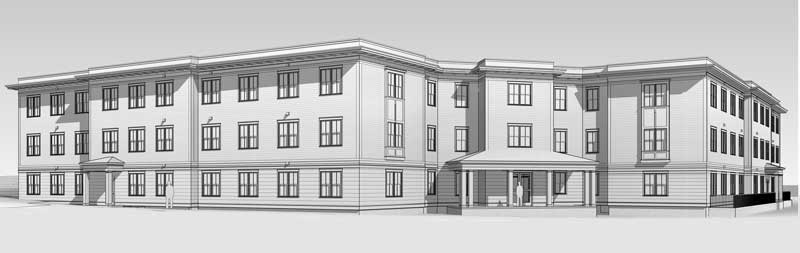
An architectural rendering of the building’s exterior. (Courtesy Union Studio Architecture and Community Design)
Because the building is located within the historical boundaries of Harvard, the town would gain two more affordable units than the 10 included in the original plan. However, a quirk in state law says that if the rents of 25% of a building’s units are affordable—as they are, in this case—then all of its units can be added to a town’s affordable housing stock. For Harvard, that means an unexpected gain of six for a total of 46 affordable units, all of which will be added to Harvard’s subsidized housing inventory
In its application to the DEC, NOW Communities says the six apartments will be added to the basement of the Marshall Street wing of the two-building structure. That wing faces Central Park, a shared community space at the heart of the neighborhood. Sunken enclosures, or areaways, will be added to the perimeter of the Marshall Street building to provide access to the new units.
In an email to the Press, Gainsboro said the two wings would provide renters a mixture of options: 40% of the units are planned to be one-bedroom apartments, 50% two-bedroom, and 10% three-bedroom. The number of parking spaces behind the complex will remain at 60 spaces. The overall availability of parking is more than adequate, the application says, and reflects that this is a project “more about people than about cars.”

In addition to increasing the number of rental apartments at Emerson Green, the application proposes to cap the three-story building with a flat roof, reducing the overall height of the complex from 44 feet to approximately 33 feet. Because the original permit expired last summer, the updated design incorporates changes to the International Building Code used by the DEC that took effect during the intervening months. But because there is no change to the building’s footprint, existing plans for water management and mitigation can remain in place. Gainsboro says the project is considering the addition of electric vehicle charging stations at the site and the installation of photovoltaic cells on the roof.
If the NOW Communities’ application is approved this month and construction begins in April, Gainsboro said he estimates it will take 13 to 16 months to finish the project, “assuming we do not experience any disruption to our supply chain.”
Before building can get underway, however, NOW Communities must first complete a purchase and sale agreement for the site with MassDevelopment, the owner of the land, and the DEC must approve NOW Communities’ application to amend its permit.
The land purchase will be completed soon, according to MassDevelopment’s Land Planning and Permitting Director Ed Starzec. As for the application, DEC officials determined it was complete on Feb. 7 and distributed its contents to the neighboring towns of Harvard, Ayer, and Shirley the next day. Stakeholders have 30 days to comment.
A virtual public hearing is scheduled for March 29 at 6:45 p.m. Peter Lowitt, DEC’s director, says he expects the commission will vote to approve the application at its first meeting in April.