The School Committee and administration have requested $14,622,343 for the school operating budget in fiscal 2023, which is 4.41% larger than its fiscal 2022 request. The school appropriation in the town’s omnibus budget comes from property tax revenue, so that request is the number taxpayers often look at first.
But the whole school budget is substantially larger than that. For fiscal 2023, the full budget totals $18,884,164, or 6.52% more than this year, according to school business manager Ingrid Nilsson.
The requested 4.41% increase didn’t seem to raise any eyebrows at the Finance Committee meeting on Feb. 9, because that increase basically covered not one but two years. For fiscal 2022 FinCom told the schools (and other town departments) to keep their budget requests at fiscal 2021 levels, in case the COVID-19 pandemic led to sharp drops in state and local revenue.
The full $18.9 million request and its 6.52 % increase, however, did spark discussion with FinCom members.
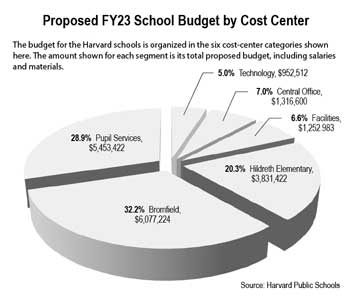
The gap between the actual cost of running the schools and the amount they get from the town’s omnibus budget is filled by money known as offsets. Offsets include state and federal aid, tuition payments from several sources, and other outside sources of income for the schools. By far the largest of these outside sources is the money MassDevelopment pays Harvard as tuition for students who live in Devens.
The schools’ reliance on offsets—especially the Devens money—has increased, especially during the COVID-19 pandemic. FinCom member Eric Ward focused on that growing reliance, saying, “The offset sources are drying up.”
The School Committee and administration are well aware of that problem. For many years, the committee has tried to keep a substantial balance in the Devens fund as a cushion against emergencies. But this year the committee presented a chart showing the balance would be exhausted by fiscal 2025 at the current rate of use.
Business manager Nilsson cited several major impacts leading to the upswing in the fiscal 2023 school budget. The largest single impact was $506,527 for increased academic costs, including three new teaching positions, tutors, curriculum materials, and a proposed new administrator. A second factor was a $444,516 increase in contractual obligations—mainly the coming year’s teacher contract, but also the contract for school bus transportation.
Besides increased reliance on the Devens fund, during the pandemic the schools have also relied on state and federal aid. Harvard schools have received more than a million dollars in federal emergency relief funds, mostly in ESSER grants—Elementary and Secondary School Emergency Relief.
Some of those ESSER funds have gone for additional school personnel: a reading tutor, a math tutor, a health teacher, an additional custodian, and adjustment counselors. Finance Committee Chair Jennifer Finch asked which of those positions would be kept when they are no longer funded by the ESSER grants. Superintendent Linda Dwight said students would probably still need the extra help provided by those tutors and counselors over the next few years.
Finance Committee members raised comparatively few questions about the school budget at the Feb. 9 meeting, partly because FinCom had already sent 86 written questions to school officials. In turn school officials responded with 25 pages of answers.
Among many other topics, FinCom asked about the number of expected retirements among teachers. Retirements often lead to some savings in salary costs, because new teachers come in at a lower point in the pay scale. In this case, Superintendent Dwight said five teachers, a staff member, and an administrator have announced their retirements, with a possible salary savings of about $200,000.
Another FinCom question asked how the student-to-staff ratio in the Harvard school system compares to other schools in the area. According to the school response, Harvard has 11.4 students per staff member. Among 10 other schools in the region, the lowest ratio is 9.8 students per staff member in the Manchester-Essex district; the highest was 13.2 students per staff member in Littleton.