After presenting my vaccination card to the ticket collector stationed at the doors of Coolidge Corner Theatre in Brookline, I made my way to the main theater, packed with masked patrons. Mark Anastasio, the program manager and director of special programming, approached a microphone at the front of the screen before the advertisements started. “The French Dispatch” was sold out, he said, and I would have to shift to the empty seat between me and a stranger to make room for the moviegoers arriving late.
I consider myself a Wes Anderson fan, so naturally I consumed every news article about the movie before attending. I read an article in The Washington Post that morning (See: “The movie business may be struggling, but you wouldn’t know it at these thriving independent theaters,” Oct. 21, 2021) about independent theaters that have held their ground during the pandemic. Coolidge Corner was mentioned as a flourishing theater, and “The French Dispatch” was referred to as the big-name movie these theaters have been waiting for.
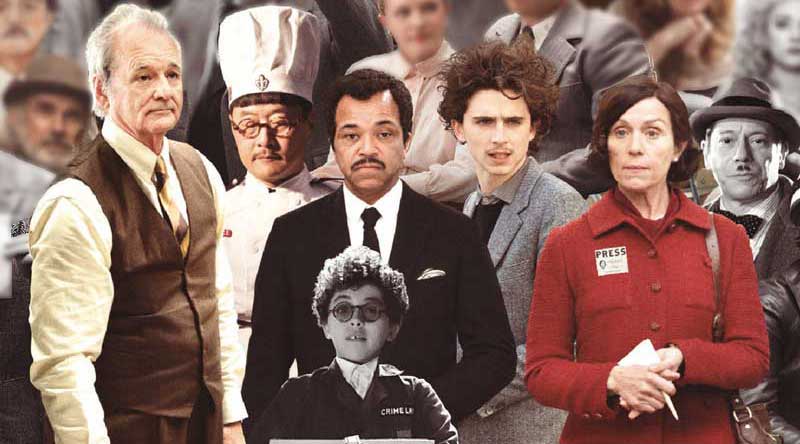
From left: Bill Murray, Stephen Park, Jeffrey Wright, Winsen Ait Hellal (in front of Wright), Timothée Chalamet, Frances McDormand, and Mathieu Amalric are part of a large ensemble cast in Wes Anderson’s “The French Dispatch.” (Courtesy photo)
“The French Dispatch” is an assemblage of fast-paced narratives, quirky characters, and unconventional backdrops that unmistakably reflect Anderson’s cinematic idiom. At times, the plot is convoluted as Anderson pulls every trick in his book—a cartoon car chase, scenes that switch between color and black-and-white, and dialogue too poetic to mimic realistic conversation. But Anderson always seems to deliver movies enriched with experimental elements that defy traditional film practices. His relentless use of symmetrical shots and vibrant colors distinguishes his style from other directors, and his ability to tell a story with different mediums was achieved in the stop-motion animation “Fantastic Mr. Fox.”

Wes Anderson. (Courtesy photo)
Anderson employs a cast of familiar faces, including Bill Murray and Adrien Brody, but brings in new talent, Timothée Chalamet and Benicio Del Toro, who had never appeared in one of his films before. Set in a fictional French town Ennui-sur-Blasé, the movie is an anthology segmented into a travelogue, three feature articles, and an obituary, for the fictional magazine The French Dispatch of the Liberty, Kansas, Evening Sun. Following the death of their editor, Arthur Howitzer Jr. (Bill Murray, “Ghostbusters”), the magazine’s contributors put together a final issue and recount the stories within it.
The movie underscores the highs and lows of the journalism industry while paying tribute to The New Yorker, a world-renowned publication that has circulated since 1925. Herbsaint Sazerac (Owen Wilson, “Midnight in Paris”) kicks off the movie in his segment “The Cycling Reporter,” for the magazine’s travel section. Instead of depicting Ennui as a hospitable city, Sazerac exposes everything that is wrong—violence, unruly youth, and bodies in the river. When Howitzer asks Sazerac in a flashback, why he did not include any pleasant details, like the city’s flower shops, Sazerac simply says he does not like flowers.
Three feature stories from the magazine are threaded throughout the remainder of the movie. The first is a profile about an imprisoned murderer, Moses Rosenthaler (Benicio Del Toro, “Sicario”), who falls in love with his prison guard and paints abstract portraits of her. Anderson presents this feature story, “The Concrete Masterpiece,” as a lecture by historian J.K.L. Berensen (Tilda Swinton, “Snowpiercer”), with intermittent scenes depicting what happened when Rosenthaler’s paintings became an international sensation.
A commentary on forced creativity and a seemingly corrupt incarceration system, this feature story is the most straightforward. As soon as Rosenthaler’s talent for modern art is recognized by art dealer Julien Cadazio (Adrien Brody, “King Kong”), he is convinced by Cadazio to continue to create in confinement. While other art collectors misunderstand Rosenthaler’s works, Cadazio says modern art has no objective meaning, which is why it is appealing to the public.
The movie abruptly segues into the second feature story, “Revisions to a Manifesto,” which follows journalist Lucinda Krementz (Frances McDormand, “Nomadland”) as she reports on student uprisings in the city. Zeffirelli (Timothée Chalamet, “Call Me By Your Name”) serves as the leader of the students and demands that men should be allowed in the women’s dorms.
Anderson uses this feature to poke at the idea of journalistic neutrality, or the lack thereof. When Krementz and Zeffirelli’s relationship becomes romantic rather than professional, she helps proofread and finish Zeffirelli’s manifesto. However, while Anderson could have explored neutrality with a different plot point, it seems that he fell into the cliché of the female reporter falling in love with her subject.
The movie wraps up with the third and most chaotic of the feature stories, “The Private Dining Room of the Police Commissioner.” In a series of cartoon scenes and live-action shots, Roebuck Wright (Jeffrey Wright, “Westworld”) recalls the time he was supposed to be reporting on a police commissioner’s chef, but the police commissioner’s son was kidnapped.
While “The French Dispatch” requires attention to every single detail, that is to be expected of any Anderson film. And with stories that take unpredictable turns, Anderson seems to hit the nail on the head regarding journalism: You never know where the story will go.
Amanda LaRiviere, a movie buff, is a journalism major at Northeastern University and a Harvard Press intern.