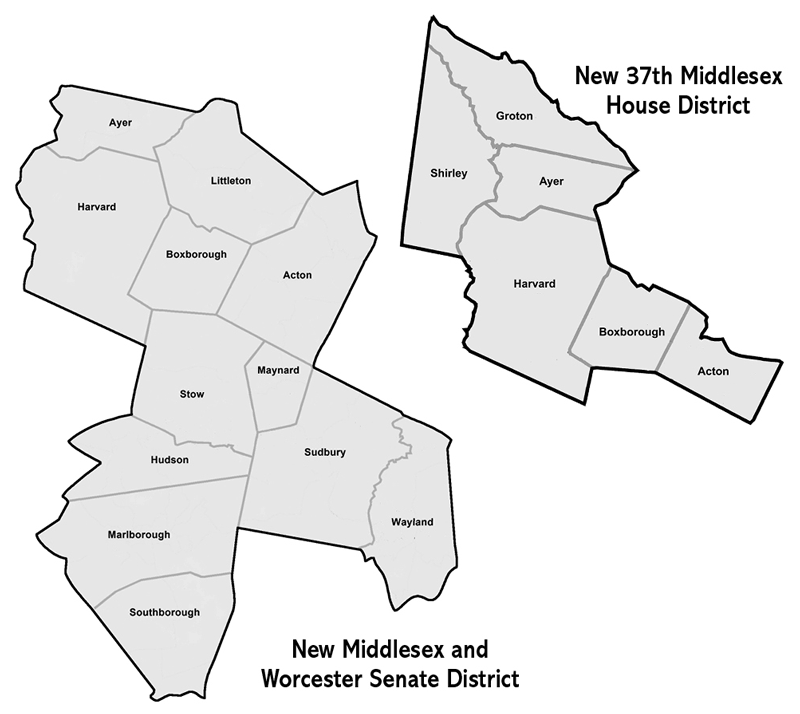
Legislation signed into law by Gov. Charlie Baker last week will shift the boundaries of Harvard’s House and Senate districts to the east, but with little immediate impact on the town’s representation in the state Legislature.
In the new map, the town of Harvard remains on the western edge of the Senate’s Middlesex and Worcester district, currently represented by state Sen. Jamie Eldridge, and at the center of the House of Representatives’ 37th Middlesex district represented by state Rep. Dan Sena. Both districts will lose towns to the west while gaining others to the east (see maps on page 7).
These changes reflect the findings of the 2020 census, which reports a 7% increase in the state’s population, much of it concentrated in eastern cities and counties and driven by the growth of Asian, Latino heritage, and Black populations. The redrawn maps consolidate western districts that have lost residents and create new majority-minority districts that reflect the state’s growing diversity. But those changes won’t be felt until next year. Prior to the general election of November 2022, the current boundaries of the Middlesex and Worcester Senate district and the 37th Middlesex House district will remain in place, even as incumbent senators and representatives begin to reach out to their new constituents and launch their campaigns for reelection.
Eldridge finds changes ‘disappointing’
In an interview with the Press, Sen. Jamie Eldridge said he was “disappointed” with coming changes to the Middlesex and Worcester district (District 12). While he supported efforts by the Joint House and Senate Redistricting Committee to encourage a greater diversity among 160 representatives and 40 senators of the Legislature, he had hoped his district would remain intact. Instead, the new map adds Sudbury and Wayland to the east, but lops off the towns of Westborough, Northborough (Precinct 3), and Shirley to the west.
With the loss of Shirley, Eldridge said, he will no longer represent the town where he got his start as a state representative, and he will no longer represent all three towns—Harvard, Ayer, and Shirley—that have a shared interest in the future of the Devens Regional Enterprise Zone, currently managed by MassDevelopment. “If you think about the Nashoba Valley area,” he said, “Ayer and Shirley are towns very closely tied together. And Ayer, Shirley, and Harvard all have political boundaries that go through Devens.”
Shirley is more of a working-
class community, having some percentage of rural poverty, Eldridge said, and he has devoted time to issues of food insecurity, affordable housing, and championing the Shirley Meadows senior affordable housing project. With the addition of Wayland and all of Sudbury, Eldridge said his district “is becoming a bit more of a middle- to upper middle-class district.” But poverty and a lack of affordable housing remain issues throughout the region, most recently in Ayer, where occupants of the Devenscrest Apartments face eviction.
Shirley is also the location of the state’s minimum-medium security MCI Shirley prison, and the state’s maximum security Souza-Baranowski Correctional Center lies next door in Lancaster. Concerns about both have drawn Eldridge to advocate for prison reform and co-sponsor legislation in the current session. After the 2022 election, however, the Shirley prison will be represented by whomever wins the Worcester and Middlesex Senate district, a seat currently held by state Sen. John Cronin. And because the Shirley Meadows project falls within the historical boundaries of Shirley at Devens, Eldridge will no longer represent the residents living there. “I will continue to do my advocacy for prisons,” he said, “but I am sad that I will no longer represent Shirley because of those institutions or because of that work.”
‘Not a dramatic change,’ says Sena
Like other house districts, the boundaries of the 37th Middlesex to which Harvard belongs—population 44,000—have also shifted eastward. Rep. Sena is losing Lunenburg to the west, while gaining a Groton precinct and all of Ayer. He will continue to represent the towns of Shirley and Boxborough and a precinct in the town of Acton. “I’m just glad that the district, quite frankly, has remained the same,” Sena told the Press in a phone interview. “I was pleased to see that it wasn’t a dramatic change.”
While the new district lines are unlikely to have much impact on Harvard, they do affect Devens voters, who will all be represented after the 2022 election by Sena. Representative Sheila Harrington of 1st Middlesex—or a successor—will lose Ayer’s Precinct 1, which is that district’s current political link to the redevelopment zone.
Sena said that while representing the southern portion of Groton and the rest of Ayer would be a new experience, he did not foresee a change in his priorities. “I feel like we’re all dealing with the same issues: climate change, education, housing,” he said. “I’ve been advocating for universal pre-K. That’s something that a lot of parents were asking me when I was doing door-to-door campaigning. And so that’s a promise that I want to keep.”
While both Sena and Eldridge cited housing as a major issue for the region, Eldridge singled out transportation as another that’s becoming critical. “You’re seeing a lot of development in the district. … It’s not just that western Mass. districts are declining in population, it’s that MetroWest continues to grow.” The region has great schools, is attractive to companies, and has a terrific quality of life, he said. “And that’s why people continue to move to all the communities in my district.”
Although state redistricting is complete, the changes in representation won’t be felt until candidates begin their 2022 general election campaign. Sena and Eldridge both say they intend to run for election in the redrawn districts, but until then will continue to represent the towns that lie in their current districts. Then, when the next legislature is seated in January 2023, they will become fully accountable to their new constituents.
“I’d be the first to say the redistricting process can be fairly opaque and a little confusing,” Eldridge said in his most recent interview with the Press. “It is a reminder to me, and hopefully all my constituents, that who [you choose as] your state representative, senator, or congressperson is very important.” These redistricting decisions, he continued, have a major impact on everything from “who represents you” to whether there is more competition in elections or a Legislature that reflects the increasing diversity of the state. “That’s why it’s so important for people to get involved in elections, to run for office, and to stay civically engaged.”