This story was updated Oct. 29 at 3:15 p.m.
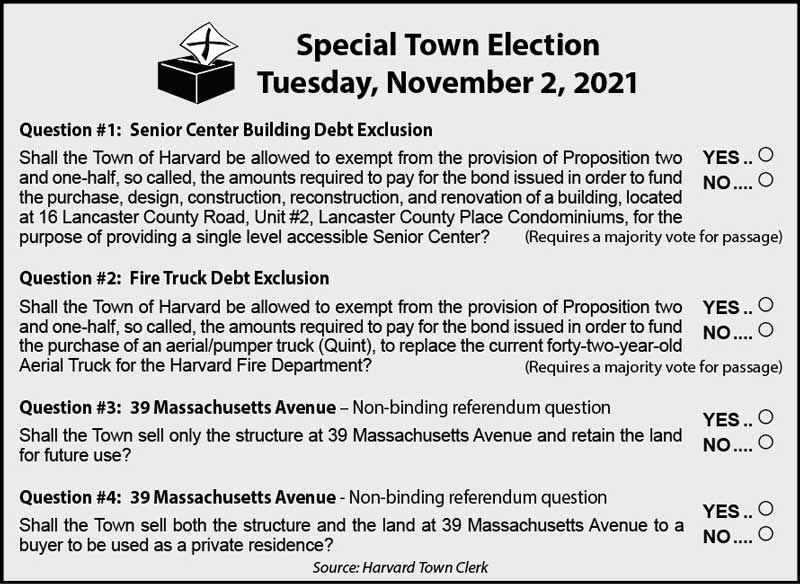
With no town offices to be filled and only four questions on the ballot, it might be easy to forget there is a Special Town Election next Tuesday, Nov. 2. Though the number of questions is small, however, their impact on the town is likely to be large. A new senior center, a fire engine, and two possible outcomes for Bromfield House are all at issue.
Voting hours next week will be shorter than usual—from 3 to 8 p.m. only, at the Bromfield School cafeteria. Early voting is not available for this election, and the deadline to request ballots by mail has already passed. It’s getting late to return ballots by mail, but voters can drop them off at the box beside the front doors at Town Hall. Whichever return method a voter chooses, the ballot is due by 8 p.m. Tuesday. A ballot should be safely sealed and returned in the envelope provided, says Town Clerk Marlene Kenney; it should never be scanned or emailed.
Money for senior center, fire engine
Question 1 on Tuesday’s ballot asks voters whether the town should borrow $2.64 million to purchase a one-story, wheelchair-accessible building at 16 Lancaster County Road and renovate it for use as a senior center. This building is spacious enough to hold events and meals for up to 90 people, as well as the offices for the Council on Aging staff, at a lower price than any of the past expansion plans for Hildreth House.
For the past decade, attempts to enlarge Hildreth House to provide services for Harvard’s growing population of older residents have failed. If Question 1 fails to win a majority, the Council on Aging will need to make do with Hildreth House as it is or come up with yet another plan for a larger senior center.
An article authorizing the town to borrow the amount to buy the Lancaster County Road building won with no debate at Town Meeting Oct. 16, easily garnering the two-thirds vote needed for passage. But it also requires a majority at Town Election.
Question 2 also asks voters to authorize the town to borrow money, in this case about $965,000 for a new fire engine, and it also passed handily at Town Meeting by a two-thirds vote.
The proposed engine would be a combination aerial/pumper firetruck to replace the 42-year-old aerial truck the town bought used in 2015. Fire Chief Rick Sicard has said buying a combination truck would also allow the town to avoid buying a new pumper truck in three years, as is currently scheduled.
The actual cost of the new truck might be as high as $1.7 million, but the Fire Department has been awarded a federal grant for $762,000 toward the purchase. The grant can be used only for a new engine, not for another used one. Sicard has been evaluating various models of firetrucks. If he finds a less expensive model that is suitable, the town could borrow a smaller amount.
These first two questions require voters’ approval at both Town Meeting and Town Election because they call for excluded debt—that is, borrowing that is excluded from the levy limitations set by Proposition 2½.
If a majority of voters approve Question 1, Finance Committee Chair Jennifer Finch said before Town Meeting that the debt will raise taxes on a median-priced Harvard house ($633,000) by about $110, which would decrease year by year over the 20-year term of the loan. Likewise, approval of Question 2 would add about $56 on that same house’s tax bill next year and decrease over the loan’s 15-year term.
A referendum on Bromfield House
Questions 3 and 4 on Tuesday’s ballot are two sides of the same coin. Again, the issue is the future of Bromfield House, the building at 39 Mass. Ave. that for years held the school district administration’s offices. Select Board members have said this nonbinding referendum will give them a better sense of the town’s wishes than the two votes at recent Town Meetings. Neither of those votes supported the board’s preferred outcome.
Question 3 asks voters to say yea or nay on selling the house itself but keeping the land where it stands for future use by the town. The Select Board has said the house could be sold separately and removed to another location. If no buyer came forward, as a last resort the house might be demolished to save the town the cost of its upkeep. This is substantially the same proposal the Select Board put forward at last May’s Town Meeting. It failed to receive the two-thirds majority required for the sale of town property and appeared not even to have a simple majority, though no count was taken.
Question 4 basically repeats a question that was asked at Fall Town Meeting two weeks ago: Shall the town sell the Bromfield House property—house and land together—as a private residence? In the warrant for the Oct. 16 Town Meeting, an article put forward by a citizen petition asked voters to direct the Select Board to preserve the house in its current location by selling it as a private home within a historic district. That measure passed with more than two-thirds of the votes.
The Select Board sought this referendum in hopes that it would reflect the preference of more voters than the 300 or 400 who attended this year’s Town Meetings. However, voter turnout at Town Elections has fluctuated wildly. The past two spring elections have drawn more than 1,000 voters: 1,030 in 2021 and 1,177 in 2020. But the last fall Town Election was in 2019 and drew only 474 people to the polls—a mere 11% of Harvard’s registered voters. Turnouts are much higher when state and national offices are also on the ballot.
Editor's note: An earlier version of this story stated that voters may scan and send an image of their ballot by email to the Town Clerk. That is incorrect. A ballot should be returned in the envelope provided.