
Many of us have wished to know more about our ancestors, what their lives were like, how they may have influenced the course of history, and what characteristics we may have inherited from them. For some, the exploration is successful; others lose interest or hit a dead end early on in the research. Joseph (Joe) Ralph Theriault of Tahanto Trail has dedicated his retirement years to documenting his family’s Acadian (Canada) genealogy and history. Even before retirement, he founded the Terriot Acadian Family Society and continues to direct that society of about 120 volunteer family members dedicated to research for the Jehan and Perrine Terriot Archive. Theriault’s commitment and research are both daunting and inspirational.

Author Joe Theriault. (Courtesy photo)
Theriault has just published two volumes of a second book and recently published a new edition of an earlier biography about his third-generation great-grandfather, Charles Terriault. The books contain a wealth of information not only about the genealogy of hundreds of descendants and details of the lives of some of those individuals but also about the history and culture of Acadia and how the Acadian experience affected later generations. Accompanying the text are maps, documents, and photos. The works are all the more impressive because they are bilingual, with an English and French version side by side on each page. Theriault grew up in northern Maine, in the French-speaking parish of Saint Luce in Upper Frenchville.
In a talk with the Press, he said that a few years ago, “a huge discovery of family history” prompted him to write a second edition of “Destination: Madawaska,” originally published in 2009. He explained that his cousin Bob, living in Saint-Jacques, New Brunswick, had an acquaintance who insisted he was a relative, but Bob kept brushing him off. Finally, it turned out the man was indeed a relative, and more than that, he was in touch with two descendants of Pélagie Therriault Morneault, sister of Theriault’s great-grandfather, and they were in possession of their great-grandmother’s album of rare old family pictures.The women allowed Theriault to make copies of the photos, and they became a significant addition to the family story and to his publications.
Tracing Acadian roots
In the book, Theriault traces his lineage to Jehan Terriot, who was an early settler of the French colony Acadia (1604), a region that comprised the Gaspé Peninsula, New Brunswick, Nova Scotia, Prince Edward Isle, Cape Breton, and the eastern third of present-day Maine. He describes how the other French colony, Quebec, continued a feudal culture, but Acadia’s settlers formed a representative government, owned their land, and engaged in trade.
In 1713 the French ceded the Acadian peninsula (New Brunswick) to the English, retaining Quebec and the rest of the Acadian colony. Tension built between the Acadians and the English, and in 1746, Joseph Terriot, fifth-generation grandson of Jehan, moved closer to the border of New Brunswick, where escape would be possible. It was a fortuitous move, as in 1755 the English began the expulsion of thousands of Acadians in what Theriault calls an “ethnic cleansing in North America.” (The story of L’Acadie—the expulsion and its connection to Harvard families—is the subject of a talk he will give at the Historical Society on Oct. 8.)
Joseph Terriot then took his family to Quebec. It is Joseph’s son Charles, Theriault’s third-generation great-grandfather, who is the main focus of “Destination: Madawaska.” Charles would have heard his grandparents tell stories about old Acadia and how some Acadians had fled to Madawaska, until 1842 a no-man’s territory comprising the northern third of Maine and western New Brunswick. In 1823 Charles, age 25, went south with his wife.
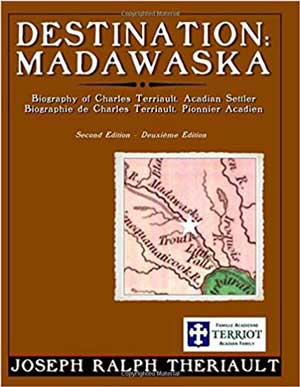
In the book’s acknowledgements, Theriault describes a visit to his cousin Bob, who lived on the Madawaska River and was a source of information and support. He writes that as the two men stood at the window, Theriault imagined their third great-grandfather, Charles Terriault, canoeing down the river right in front of them as he looked for a place to settle with his new bride. The spot he selected turned out to be less than 5 miles down the river from where the two men stood. “What challenge! What courage!—to be the first to settle a new frontier,” Theriault later wrote of Charles.
Theriault was particularly interested in finding evidence to prove that the first francophone (French speaker) to settle in present-day Saint-Jacques in Madawaska County, New Brunswick, was Charles Terriault [62]. (Theriault explains that there are so many branches of the family and repetition of names that each person is assigned a record identifier number, put in brackets after the name.) An 1831 survey shows Charles living on 30 acres of cultivated land whose corner was formed by the west bank of the Madawaska River and the north bank of the Trout River. As it would have taken at least six years to cultivate that much acreage, the survey supports other documentation of Charles’ leaving lower Canada in 1823 to settle in Madawaska. Two other francophones are shown on the survey, but they had arrived later than 1823. Theriault writes, “Charles stood on the threshold of the Industrial Revolution.” And he and his descendants built mills that helped “industrialize the world by providing the lumber necessary to build it.”
Family mills
The family mills are the subject of the two volumes of Theriault’s recently published second book, “The Mills of Madawaska.” The first volume tells the stories of several family mills, and the second volume is an inventory of 250 mills along a 75-mile strip of land between the U.S. and New Brunswick along the St. John River. Theriault said he had become intrigued by the fact that though illiterate, his ancestors built mills. How did they know how to do that, he wondered. He also wanted to learn more about his grandfather Joachim Theriault, great-grandson of Charles, born in Saint-Jacques in 1886. He and men like him dedicated themselves to their communities as providers of lumber for their buildings, flour for their meals, and carded wool for their clothing. As a result of all his research, he said, “I really understood what my grandfather’s life was like.”
Theriault writes that he was inspired by a quote in one of the history books he used as a source: “These ancient mills reflect the lives of our predecessors. We must study and pass on that history to all because a society must remain proud of its past.” Clearly, Joe Theriault is justifiably proud of his.
“Destination: Madawaska” (336 pages) and “The Mills of Madawaska” (534 pages) are published through the Terriot Acadian Family Society and are available through Amazon.