During the last three weeks of August, the state reported 21 new COVID-19 cases in Harvard, nearly 13% of the town’s total cases since the pandemic began. Meanwhile, the number of fully vaccinated residents has barely moved over the past month, hovering around 79% of the eligible population. But one other number has also barely moved recently—the number of people who are partially vaccinated, those who have received only one dose of a two-dose vaccine.
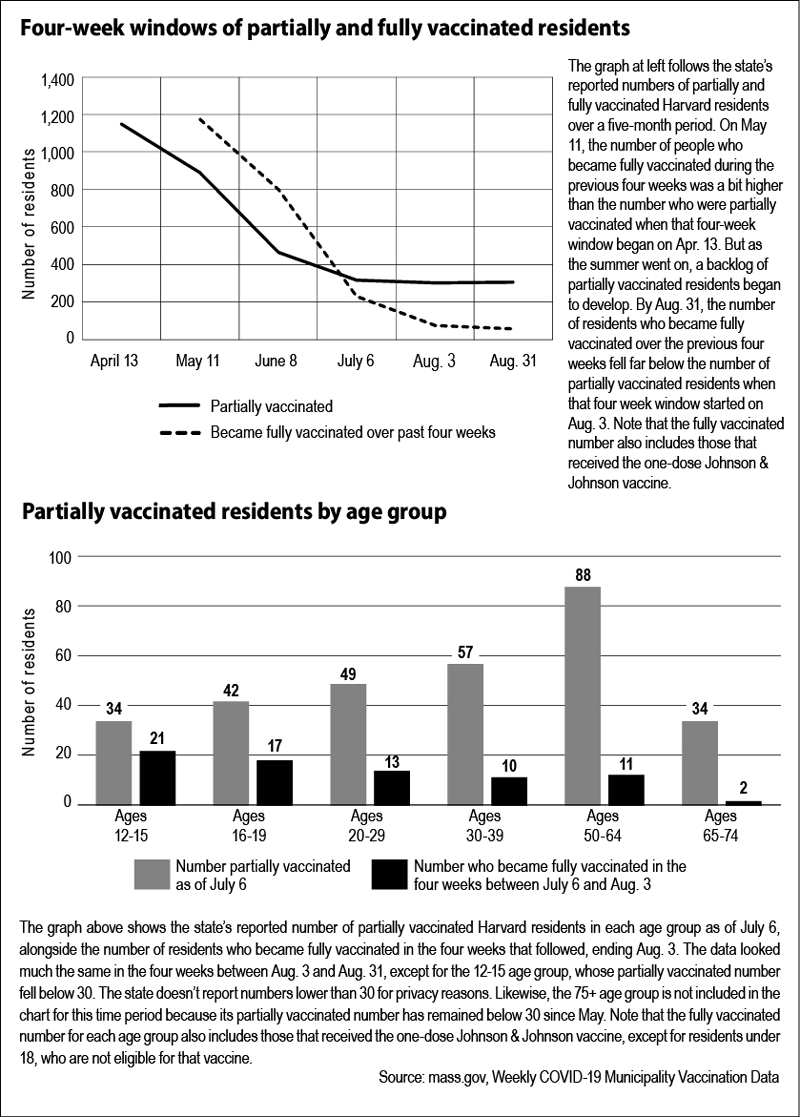
The recommended time between doses for the Pfizer vaccine is three weeks; for Moderna, four weeks. In a perfect world, the number of fully vaccinated people should increase each month by at least the number of those who received their first dose the previous month. That was happening in April (see chart below), but a backlog of first-dose-only people began to build in the following months.
The number of partially vaccinated Harvard residents has been sitting stubbornly at around 300 since early July, while the number who became fully vaccinated each month has continued to wane. The backlog is likely higher than the data shows, since the state’s “fully vaccinated” number includes people who received the one-dose Johnson & Johnson vaccine.
National and state numbers show the same trend. According to the Washington Post, the Centers for Disease Control and Prevention reported in early July that 15 million Americans did not receive the second of a two-dose vaccine in the recommended window of time. Statewide, in early July about 475,000 people had received only one dose of a two-dose vaccine. In the four weeks that followed, only about a quarter of that number became fully vaccinated. Those numbers remained nearly the same over the next four-week period.
The Food and Drug Administration released a statement on the importance of following the authorized vaccine dosing schedules on Jan. 4, 2021. In that statement, the agency said it had been following discussions and news reports about reducing the number of doses or extending the length of time between doses in an effort to get more vaccine to the public. Its response was that “the available data continue to support the use of two specified doses of each authorized vaccine at specified intervals.” It added that in the absence of data supporting dosing changes, “we run a significant risk of placing public health at risk, undermining the historic effort to protect the population from COVID-19.”
Since that time, “delta” has become the predominant variant of the virus in the U.S. On Aug. 12, the New England Journal of Medicine published the results of a study funded by Public Health England, which concluded that two doses of the Pfizer vaccine were 88% effective against the delta variant, while one dose was only about 31% effective. The Moderna vaccine was not included in the study.
Who’s not getting the second dose?
Data is scarce when it comes to the reasons why people appear to be avoiding the second dose. Some may still believe that one dose is sufficient protection against the virus, despite the admonition of the FDA and the recent delta variant study. Side effects may also be an issue for some people. According to the CDC, side effects after the second shot can be more intense, but “should go away in a few days.” Typical side effects include fatigue, muscle pain, headaches, chills, and fever.
Harvard’s middle-aged residents account for the highest partially vaccinated numbers, with the 50-64 age group coming out on top (see chart below). The youngest residents are moving the most quickly from partially to fully vaccinated. By August, fewer than 30 of the 12-15 age group had one more dose to go. The actual number is not available in the state’s municipal vaccination data–—when there are fewer than 30 people in a category, the state does not report the actual number, citing privacy concerns in less populated areas. Only the two-dose Pfizer vaccine is available for this age group, as well as for 16- and 17-year-olds.
The same is true on the other end of the age spectrum. The number of Harvard residents over 75 who are partially vaccinated has not been reported since April because there are fewer than 30 in that group.
What if you missed your second shot?
According to the CDC, people should get their second shot as close to the three-week or four-week interval as possible, but the second dose may be given up to six weeks after the first dose if necessary. The agency has limited data on the effectiveness of receiving a second shot after a six-week interval, but it says that people do not need to restart the vaccine series even if it has been more than 42 days since their first dose. It cautions, though, that “This guidance might be updated as more information becomes available.”
Board of Health member Sharon McCarthy told the Press that for people who contract the delta variant, “being fully vaccinated is the only way to reduce the severity” of the disease. She said vaccinations are available at Acton Pharmacy and Ayer Family Pharmacy. Appointments may be necessary. CVS Pharmacy is also offering the vaccine, and walk-ins are sometimes accepted.