
For the past 10 years, Joy Bahniuk has moved her horse and human clients to Wellington, Florida, for the winter. There, Bahniuk and her clients trained and competed until mid-April. Bahniuk manages Cadence Farm, a dressage training facility in Harvard. When the COVID-19 restrictions on travel were imposed in March 2020, Bahniuk asked her clients whether they wanted to travel to Florida or remain in Harvard. Her clients chose to remain in Harvard. “No one wanted to put themselves at risk,” Bahniuk told the Press in a May interview.
For Bahniuk’s clients, this was their first time training in wind and snow. She said she was concerned as to how she would keep a stable full of dressage horses fit and safe throughout the New England winter. Cadence Farm’s all-weather dressage ring allowed Bahniuk and her clients to train until the first big snowstorm arrived in February 2021. After the first snowstorm, Bahniuk and her clients worked her horses in the knee-deep snow. When the ring became too slippery and icy, they exercised the horses on surrounding trails. Bahniuk said both her horses and clients “came through stronger and more confident having worked outdoors in the wind, snow, and very cold weather.” Despite staying in Harvard and riding in the snow, business continued as usual.
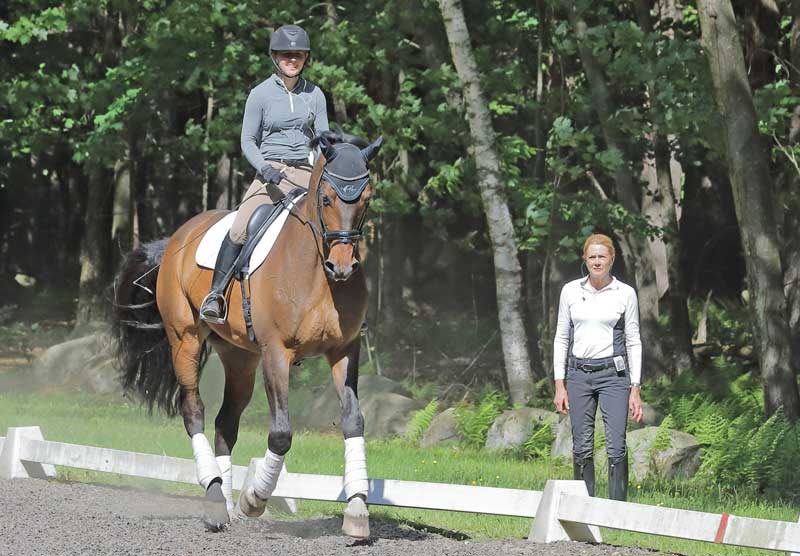
Joy Bahniuk (right), owner and trainer of Cadence Farm, keeps a keen eye on Karateg and his rider, Sarah Listzwan, a high school junior preparing to compete in the North American Youth Championship for dressage. (Photos by Lisa Aciukewicz)
Like Bahniuk, owners and managers of horse training programs, boarding facilities, and riding schools had to adapt their programs to meet both the CDC and United States Equine Federation guidelines.
While the CDC guidelines for horse farms required the provision of hand sanitizing stations, horse farm managers found it challenging to keep surfaces, such as gates and stall doors, clean during the pandemic, because sanitizer and other cleaning products were not widely available. Guidelines that affected the majority of farms in Harvard included limiting access to the barn to essential personnel, prohibiting the sharing of barn items, and limiting the working hours of nonessential veterinary clinics.
In a bulletin dated March 25, 2020, the Massachusetts Department of Agricultural Resources Division of Animal Health told boarding stables providing full board to set their own policies regarding access to the stables, and advised stables offering partial board to schedule and stagger visits.
Different businesses, different needs
Horse business owners typically followed whichever guidelines were strictest. They also had to consider the needs and expectations of their clients, which differed depending on whether the business operated primarily as a training/boarding facility or a riding school. There are over a dozen horse farms in Harvard and most are boarding and training stables. The riding schools generally consist of small lesson programs with four or five horses.
Dunroven Farm, a boarding facility and riding school on Old Mill Road; Cadence Farm, a dressage training facility on Bolton Road; and Eureka Farm Dressage on Littleton Road were some of the horse businesses that found ways to adapt. During the pandemic, only one trainer worked with all of the horses at Eureka Farm, which has both a small barn with two stalls and a larger main barn with an indoor ring, 15 stalls, and spaces for grooming. In March of 2020, all 21 stalls were full and there were 11 employees. Betsy Moeller-Sally, the barn manager, said she had to be extra protective of the staff working and people boarding horses at the farm because some had preexisting conditions that made them vulnerable to COVID-19. “Several members of my staff were extremely alarmed at the prospect of getting sick,” she said.
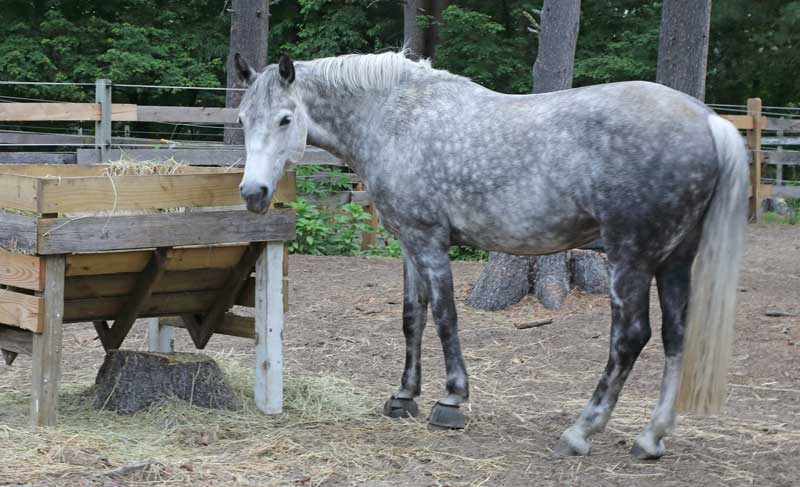
A boarded Connemara pony, Ani, looks up from her hay. Boarding was essential to keeping Dunroven in business during the pandemic.
Other concerns during the shutdown included the availability of supplies, such as hay and shavings, and ensuring that the boarding horses received enough exercise. Moeller-Sally stocked up on supplies at the end of March 2020 and says she did not struggle to obtain supplies during the pandemic.
On March 19, 2020, shortly following the state’s declaration of a state of emergency, Moeller-Sally closed the farm to anyone not responsible for essential horse care. This change was made after an employee became ill and COVID-19 testing was not yet available to confirm a COVID-19 diagnosis. Once testing became more widely available, the number of “scares” decreased, Moeller-Sally said.
Moeller-Sally commissioned a woman who repaired blankets at Eureka Farms to make the first set of masks. Everyone at Eureka Farms now wears masks, but Moeller-Sally has changed the rules slightly for those who have been fully vaccinated.
On April 17, 2020, Moeller-Sally reached out to her boarders and told them that they could return to the farm twice a week for two hours. Then, on May 20, 2020, she resumed boarder lessons.
During the summer of 2020, new mirrors were installed and new footing added to the indoor ring. This summer, Moeller-Sally plans to re-side the front face of the big barn but has struggled to obtain lumber for the project. Another change that occurred as a result of the pandemic was the loss of some boarders. Managing “all of the complex human emotions the pandemic has aroused in everyone,” has been a challenge, Moeller-Sally said.
Changes worth keeping
At Cadence Farm, a facility consisting of a barn with eight large stalls, a tack room, a lounge, and paddocks, fewer changes were required. According to the farm’s website, the facility has access to hundreds of acres of woods and trails, so Bahniuk and her clients kept the horses moving and worked cautiously. When asked if there were any changes to her program that she wanted to keep, Bahniuk said she wanted to keep Zoom-oriented education, having attended several Zoom groups about horse education and management.
Regarding competitions, the USEF, or United States Equine Federation, canceled events when the pandemic first began and restarted these competitions when restrictions were lifted in July of 2020. Attendance decreased sharply from pre-pandemic levels when the events first resumed, Bahniuk said. Now that more people are being vaccinated, she feels more comfortable traveling and competing.
Laura McGovern, the owner of Dunroven Farms, said that even though her four-horse riding school temporarily shut down, it was only a small part of her business. Dunroven Farms consists of 26 acres of land and a 24-stall barn. Turnout consists of run-out sheds and riders have access to an indoor riding ring, a standard outdoor dressage ring, a jumping field, and a galloping track. McGovern still had training, selling, and boarding to rely on during the pandemic. She said she wanted to keep the people boarding horses and staff safe, but found it stressful to keep up with Gov. Baker’s and the CDC’s policy changes.
At the start of the pandemic, McGovern traveled from store to store to buy cleaning supplies and provided boarders with a sign-in/sign-out book for visits to the barn. While no one directly associated with Dunroven was diagnosed with COVID-19, one of her clients’ spouses did become ill. Only one of her students left during the pandemic.
During the pandemic, McGovern took away the indoor cross ties, or ropes that can be attached to a horse’s halter to keep them centered for grooming purposes, and built outdoor cross ties to replace indoor ones. The Dunroven summer program was held outside this way last summer, with four students at a time, and socially distanced tables and tents. Students filled out a questionnaire each day about possible exposure, travel plans, and their health. This summer, McGovern stated that the academy program will be held outside with tents, social distancing, and mask-wearing, like last summer.
McGovern resumed lessons at Dunroven Farms and now allows one guest to visit as long as they sign in and out.
One pandemic-related change McGovern plans to keep is the virtual show. Virtual shows were started by professional horsemen and horsewomen who became bored during the pandemic. To combat their boredom they created Facebook groups where people posted videos and ideas for classes. To enter a virtual show, riders submit videotapes of themselves riding and are judged by professionals. Like in an in-person show, riders compete for prizes, and riders are expected to dress professionally. These virtual shows help introduce people to showing and reduce the anxiety associated with competing in front of a crowd. If a student struggles with memorizing a dressage test or makes a mistake, then they can just start over, McGovern said.
As for showing, McGovern said the USEF is not allowing some horses to stay overnight and enforces mask-wearing. She said that small Harvard riding schools have “done a great job of muddling through it.” McGovern is trying to figure out what will happen next. She said she does not want to be in the position of demanding that clients get vaccinated, but fears she may have to. On May 29, Gov. Baker rescinded COVID-19 restrictions and declared that the state of emergency would be terminated on June 15. As a result, fully vaccinated people will no longer be required to wear face coverings on the farm and more horse shows will be held with spectators, a welcome step back to the camaraderie of the pre-pandemic shows.