Could the commercial district be reimagined so as to preserve the town’s character, expand the tax base, and rewrite the zoning bylaw so elegantly as to avoid unintended consequences? Should bylaws be updated before the utilities needed to support development are in place, or even designed?
According to the Planning Board and the town’s director of community and economic development, Chris Ryan, the answer is “yes,” and the time to act is now. Several owners and a broker of commercial land say change is overdue, an assertion backed up by repeated recommendations, spanning 50 years, in Harvard’s four master plans. Still, some residents who attended a webinar to learn about the plan were wary of added traffic and of overdevelopment.
According to Ryan, escalating demand for homes here, coupled with a tax base that is about 93% residential, means Harvard relies too heavily on residential property taxes to sustain its municipal budget. If the commercial district isn’t improved enough to create a larger share of tax revenue, the so-called structural deficit—where residential taxes make up too much of the tax base—will persist, squeezing delivery of schools and town services. With the renovation of Route 110 scheduled to begin in 2026 or 2027, Ryan says changes to the zoning must begin now to “integrate any development project that could emerge” into the road’s renovation. The time to present a plan to provide water and sewer for new or redeveloped businesses, however, is after the zoning is updated, Ryan said.
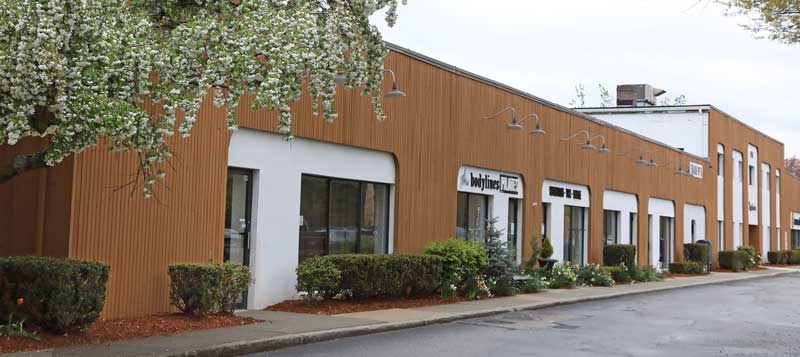
The Appleworks building at 325 Ayer Road, first built in 1954 as a regional warehouse and distribution hub for apples, is now home to at least 19 businesses. (Photo by Lisa Aciukewicz)
The solution recommended by Ryan and the Planning Board is a market study with citizen input, an analysis of how re- or newly developed commercial property would affect tax revenue, and—if the market and fiscal reports signal a benefit from development considered acceptable to most residents—a rewrite of the commercial district’s bylaws. (See story on 1.)
The bylaws would need to be accepted by a two-thirds vote of town meeting before they could go into effect, but some commercial landowners and brokers say change can’t come soon enough.
“It’s a dysfunctional commercial strip,” said Eric O’Brien, cofounder of O’Brien Commercial Properties and a resident of Harvard. Unlike Ryan, O’Brien thinks the first thing to do is build sewer and water systems, “a gravity system,” he said, and not a low-capacity system like the one that serves town center. His firm represents the seller of Harvard Lanes, which closed last summer after its owner died. To add the liquor and snack bars he says a modern bowling alley requires to attract a buyer, sprinklers are necessary, and they work best on a town water system, O’Brien told the Press. The need for sprinklers would be triggered in such cases, according to Building Commissioner Jeff Hayes.
Robert Hirsch, who owns the shopping plaza that backs up to Devens, and also an adjacent vacant lot, owns enough land to significantly redevelop, if he chose to. Hirsch said he would favor more flexible regulations in general, but wondered if the population could support more business. Aside from the lack of utilities, he said, “The problem is too few rooftops.”
Water and traffic are concerns
Whether Devens would consider playing a part in bringing utilities to Ayer Road has been a matter of speculation for some years, including in a 2016 water study report, which estimated a cost of $2.7 million to tap into Devens’ systems. But the speculation is one-sided for now. “We cannot consider where hypothetical utility connections might be made unless and until we receive a formal request [from Harvard],” a spokesperson for MassDevelopment Vice President Jessica Strunkin told the Press. Also in question is whether chemical contamination (PFAS) recently found in a Devens well could drive up the cost of its water. In any case, landowners are concerned that unfavorable results could jeopardize financing and otherwise complicate property sales. A spokesperson said MassDevelopment would confine testing to its own municipal facilities.
Traffic, particularly the tractor-trailers coming from the direction of Devens and the new truck stop at the Ayer rotary, was a worry for several residents who attended the Planning Board webinar about the study. One noted that Alltown Fresh generated traffic for Harvard, and tax revenue for Ayer. Ryan said commuters and haulers will continue to use Harvard’s roads as a cut-through, but the market study could determine the kinds of businesses likely to capitalize on the inevitable commuter stream. So-called traffic-calming measures, such as signals and radar speed signs, can be considered, but speed bumps aren’t allowed on Route 110.
Ayer Road has indeed grown busier over the past 20 years. Data from the Massachusetts Department of Transportation shows a daily average count of 4,928 vehicles in 1998 and 5,757 in 2018—the only interruption in the upward trend was a 12% decrease in trips in the pandemic year of 2020.
Leading up to the vote on the study at the May 15 Town Meeting, residents and business owners alike can read about the proposed study on the town website, Departments, Community and Economic Development, at harvard.ma.us.
Nick Deane, owner of Appleworks, said he has looked at the proposal and likes what he sees. He said he hopes the study will “unblock commercial and multifamily development.” That is the hope for some, and the fear of others.