The vote to approve a budget for the coming fiscal year is arguably the main event of Spring Town Meeting. It’s when voters decide how their tax dollars and other town revenue will be spent to provide the services they expect and need, from classrooms and snowplows to roads and buildings, from police and teachers to librarians and senior outreach workers.
The omnibus budget proposal for fiscal 2022, written as the town emerges from a year of pandemic, appears on this year’s town meeting warrant as Article 3 and, once amended by the Select Board Saturday morning, will ask the town to appropriate just over $34 million to pay for town and school operations, approximately $1.5 million (4.6%) more than will be spent in the current year. Add six one-time expenditures recommended by the Select Board and Finance Committee—sometimes referred to as small warrant articles—and the bill grows to $34.2 million.
But the omnibus budget is not the full story. That’s to be found in the five-year budgeted revenue and expense projection, sometimes referred to as the “recap,” that appears on page 16 of the Finance Committee report in the warrant booklet. That statement, prepared each year by the Finance Department—a best-guess forecast, really—summarizes the income and expenses expected for fiscal 2022 and the four years that follow.
The top portion of the forecast shows the town’s sources of income in some detail, divided between the levy—the amount charged to taxpayers—and other sources, such as state aid, local excise taxes, fees, and grants. The bottom quarter of the forecast summarizes anticipated expenditures, divided into three categories: town and school expense, debt expense (lines 57 through 60 of the omnibus budget), and the six small warrant articles that round out total spending from the General Fund.
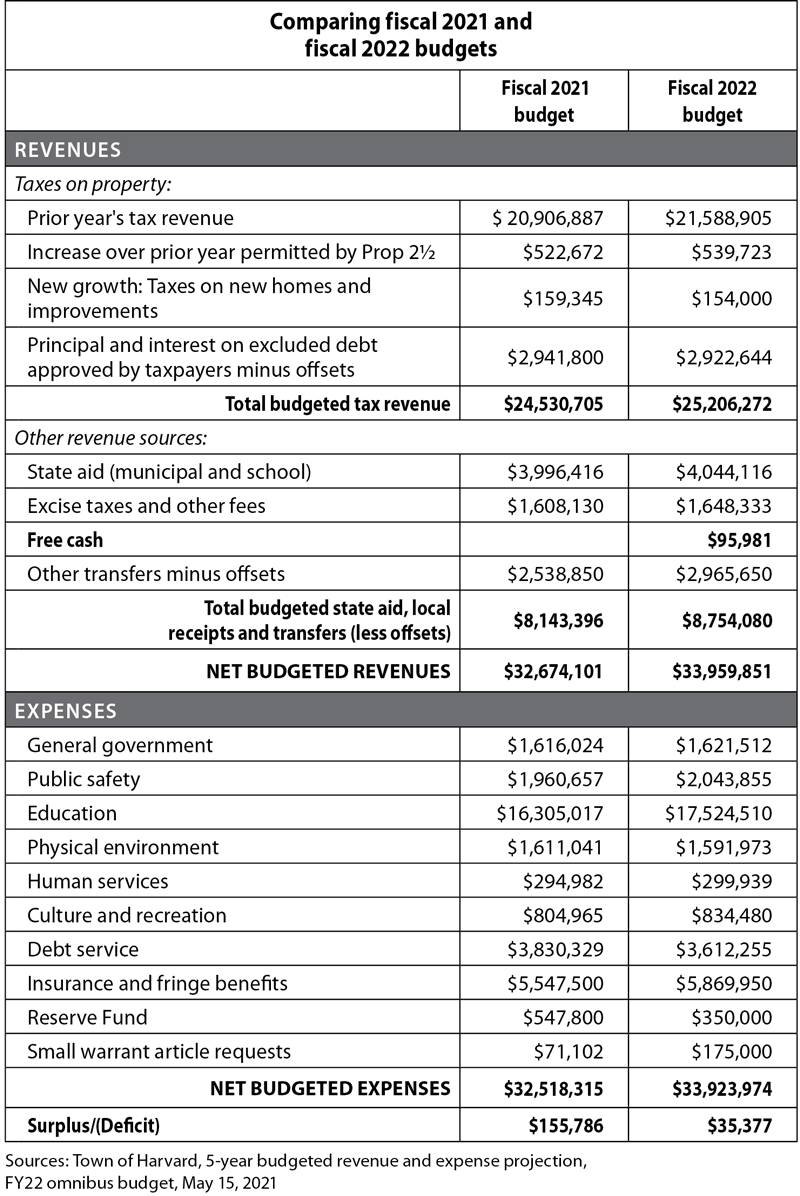
Harvard taxpayers will contribute $25.2 million (74%) toward next year’s budget, with state aid, local receipts, free cash, and other sources of revenue making up the difference. Unlike the budget presented to last year’s Town Meeting, the fiscal 2022 budget balances. If estimates are correct, there’s even a small surplus of $35,376 that can be used to cover unexpected expenses.
The Press has prepared a simplified view of the recap that integrates some of the detail found in the omnibus budget with that of the five-year projections (see table below). You might call this document the town’s balance sheet, though its inner workings can boggle a layman’s mind. The project, aka recap, aka balance sheet, is a fiscal contrivance whose inner workings, wheels within wheels, can seem as complex as a Swiss timepiece.
Wheels within wheels
Take the budget for schools, for example, a clockwork within a clockwork. You’ll find the budgeted appropriation for running Harvard’s schools next year on page 34 (line 9) of the 2021 Town Meeting warrant. But there’s more there than meets the eye. For the details behind that number and the six cost centers that drive it, you’ll need a copy of the 45-page Harvard Public Schools budget book, available until Town Meeting online only.
At its Monday night meeting this week, the School Committee approved a budget of $17,707,984, a substantial increase (8.6%) over last year’s. What’s hidden from view, however, is how much taxpayers will contribute to that number. The answer? $14 million, an amount nearly identical to last year’s contribution, in compliance with the Select Board’s request for a level-funded budget. The $3.7 million difference will be made up from the more than a dozen other income sources available to the schools, including the Devens fund—the money MassDevelopment pays Harvard schools to educate children who live in Devens—and federal and state grants. (Not included in this accounting are the additional costs of insurance and benefits.)
Some of these transfers must be voted by Town Meeting, but you won’t find them listed in the warrant. Instead, listen carefully when a member of the Select Board or Finance Committee steps forward to move adoption of the omnibus budget (Article 3). As the motion is read, you’ll hear a long list of funding sources, including a $2.1 million transfer from the Devens fund and a half-dozen others. A majority vote for the motion acknowledges the use of those funds, but does not determine how they are allocated within the school budget.
Confused? There’s more. While grants to the schools, such as the federal Elementary and Secondary School Emergency Relief program, appear as “local schools grants not voted” on the balance sheet and help defray the school budget, they’re nowhere to be seen in the omnibus budget and they won’t be mentioned in the motion to accept it. In an email to the Press, School Committee Chair SusanMary Redinger said the committee believes both funds are under its direction and should not need new votes by the Finance Committee, the Select Board, or Town Meeting.
A year of pandemic
Getting to a balanced budget for the coming fiscal year was not easy. The pandemic added unexpected spending to town and school accounts, an estimated $740,000 thus far in direct costs, according to the town Finance Department. And there is more to come, say town and school officials.
The schools’ portion of these costs were covered by Elementary and Secondary School Emergency Fund Relief (ESSER) grants totaling $340,000, and additional money is expected in the coming year. Town officials expect nonschool expenses will be covered by Federal Emergency Management Agency and federal Coronavirus Aid, Relief, and Economic Security Act money, but those reimbursements will take time.
The greatest fear as the budget season got underway in October was that Massachusetts revenues would collapse and state aid to towns would be cut, forcing Draconian cutbacks to Harvard’s budget. That didn’t happen, but there’s pain in the budget numbers nevertheless. Not knowing how much state aid would materialize, department and committee heads were asked by the Select Board and FinCom to submit level-spending budgets—budgets that would have to absorb any cost increases by cutting services or finding new sources of revenue.
The schools, which, according to the warrant booklet, account for an estimated 72.5% of the fiscal 2022 town budget, were hit hard by the level-funding constraint. At a March 26 hearing, school business manager Ingrid Nilsson said increases in certain fixed costs, coupled with declines in Title I and Title IV grant money, had added $419,458 to the school budget in fiscal 2022. Ratification of a new teacher contract in May added another $197,640 to cover the 2% cost-of-living increases. The schools have been able to level-fund the coming year only by drawing more deeply on the Devens fund and eliminating four teaching positions and one reading specialist. School officials have warned continued level funding will threaten the high quality of the education offered by Harvard’s schools.
But there is some good news in the fiscal 2022 budget. Unlike the fiscal 2021 budget presented to Town Meeting last June, no tax override—a vote to increase the property tax limit allowed under Proposition 2½—is needed to balance it. State aid is unchanged from last year, a key source of revenue for the town. That and the austerity of town departments made it possible to add cost-of-living adjustments and merit pay to the salaries of noncontractual, nonschool employees; add overtime pay to the police budget; increase spending to maintain the town’s athletic fields; and cut more roadside trees. Finally, by drawing on the $1.5 million in free cash left over from fiscal 2020, the town can pay for an architect to evaluate an alternative site for a senior center, should one be identified, and pay to remediate the site of Bromfield House, should it be sold and moved.
The past year has been a challenge, as the Finance Committee acknowledged in choosing to spotlight the impact of the COVID-19 pandemic in the final pages of its report. “Keeping the town running smoothly is challenging under normal circumstances and the last year has been anything but normal,” the report said. “Whether the numbers of this [report] resonate with you or not, we ask only this: Next time you see a member of our town’s [government] and departments, please take a moment to recognize them for all they do.”
Unfinished business: Town and schools must reconcile nominal budget discrepancies
This week, with the May 15 Town Meeting warrant already printed, the School Committee voted unanimously to approve a revised fiscal 2022 budget. Although the new budget was unveiled 2½ weeks ago in a public hearing, it has yet to be reviewed in public session by either the Finance Committee or Select Board. And the committee’s new numbers are at odds with the fiscal 2022 omnibus budget, which will need to be adjusted at Town Meeting.
The precipitating event was the April 26 ratification of a new one-year contract with Harvard’s teachers. The new contract, which includes a 2% cost-of-living adjustment, combined with increases to other personnel costs, has added $277,749 to the total cost of running Harvard schools in fiscal 2022 and pushed the district’s budget from the $17.4 million the School Committee approved in February to $17.7 million. In a unanimous vote, the School Committee approved the new number at its Monday night meeting.
School Committee Chair SusanMary Redinger asserted in an email Tuesday that the new number does not change the actual cost to taxpayers once offsets from the Devens fund and federal grant money are included. “[The request] was $13,984,923 and remains so,” she wrote.
However, the latest schools’ number no longer matches the numbers in the warrant booklet, and Town Meeting will have to adjust them Saturday.
Redinger maintains that because the increase to the school budget will be offset by money from the Devens fund and the ESSER grant, no vote is required. But the town’s budget policy requires the schools to first submit their changes to FinCom and then to the Select Board for their approval. Final approval is up to Town Meeting. Both committees are scheduled to meet at 11:30 Saturday morning. If Fincom and the Select Board accept the last-minute changes, the motion to approve Article 3 will need to increase the omnibus budget education line of the warrant (see page 34, line 29) and omnibus budget grand total to align with the schools’ new budget.
Town Administrator Tim Bragan criticized the School Committee for voting its changes a week before Town Meeting and for bypassing FinCom and the Select Board. “This is a total disservice to the budget process to do it this late in the game,” he said in a Monday Press meeting to review the warrant. Bragan said he was working with Town Counsel Mark Lanza to draft motions to reconcile the omnibus and school budgets, but that these would need to be approved by the Select Board on Saturday.
In an email to the Press, Redinger reiterated the School Committee’s position that because there is no change to the amount requested of the town, there should be no need for a vote to approve it. Redinger said, “We remain committed to working in partnership with the Finance Committee and the Select Board and are always open to considering ways to improve the process.”
—John Osborn