Empty bottles and cans and the garlic mustard herb are undesirable invasives that proliferate annually along Harvard’s roads. Halting their advance is the job of the dozens of volunteers who join the town’s spring trash cleanup and garlic mustard pull, which begins April 29 this year and ends May 2 when Harvard DPW will pick up the trash bags.
Most road trash lands within an arm’s throw of a moving car and consists mainly of alcohol bottles and cans. Although much of it can be found at the side of the road, some ends up in the woods but within eyesight, where it can persist for years. Following a cleanup, the improvement in the appearance of the roadside is noticeable, but it doesn’t take long for new bottles and cans to appear, spreading like an unwanted plant.
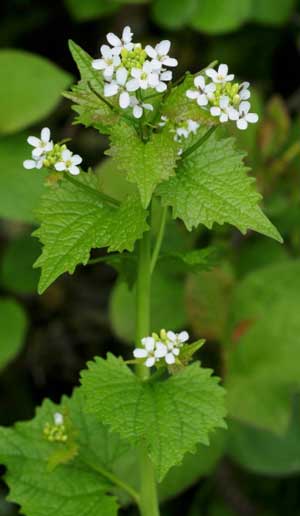
Garlic mustard. (Courtesy photo)
The garlic mustard herb, unlike bottles and cans, can work its way deeper into the woods and colonize once-native areas. The plant is not unsightly (it is actually rather attractive when in flower), but does threaten native plants and species by dominating their habitats.
According to references including “A Guide to Invasive Plants in Massachusetts,” garlic mustard can grow in full sun or shade. The herb produces thousands of tiny seeds that are propagated by flooding, wind, and the foot traffic of humans and animals. The seeds are viable for as long as five years in the soil. The plant is thought to produce a toxin that inhibits the growth of other plants, in a phenomenon known as allelopathy. Wildlife, such as deer, don’t eat it, but humans can. These characteristics enable garlic mustard to threaten the propagation of native plant species. Butterflies are also threatened because garlic mustard out-competes the native host plants that butterfly species rely on for egg-laying and larval feeding.
In late April the plants are in flower and easy to recognize. They pull out with a gentle tug by grabbing the stem at the base. Once pulled, they should be placed in a plastic bag for disposal.
Of course, the garlic mustard plant can be pulled before the townwide cleanup days. According to the guide, in the first year of its biennial life it appears as a basal rosette; its round leaves remain green throughout the winter and when crushed emit the odor of garlic. In the early spring of its second year, flowers appear, and by early summer long thin pods full of tiny seeds develop. The stalk of the flowering plant eventually dries out, but seedpods can retain seed throughout the winter. Pulling out the plants after seeds develop runs the risk of actually dispersing the seeds.
Eliminating garlic mustard plants requires vigilance and determination, as does keeping the roadsides free of litter. The annual cleanup is part of that effort. To participate, sign up for a time and area at tinyurl.com/v4vh8etz. That site also tells you where and when to pick up supplies: Westward Orchards parking lot on Wednesday, April 28, 2 to 4 p.m. and Saturday, May 1, 8 a.m. to noon. Questions about the cleanup can be sent to harvard.cleanup@gmail.com. Questions about garlic mustard can be sent to garlicmustard.harvard@gmail.com.
For more information
- “A Guide to Invasive Plants in Massachusetts,” at grownative mass.org.
- The website for the Cooperative Invasive Species Management Area provides a wealth of information about invasive plants. Go to cisma-suasco.org/invasive/garlic-mustard.
- Sudbury Valley Trustees has an excellent three-minute video on Vimeo showing how to identify garlic mustard. Access the video by Googling “Sudbury Valley Trustees Garlic Mustard Videos.”
Garlic Mustard Pesto
Note: Always be 100% certain of your plant identification before eating any wild plant.
¼ cup walnuts or pine nuts
1 teaspoon clove garlic, peeled
1 cup garlic mustard leaves, washed
1 cup fresh parsley leaves
1 cup extra-virgin olive oil
¼ cup grated Parmesan or Romano cheese
Salt to taste
Blend in a food processor until it is of a consistency suitable for tossing with pasta or serving as a dipping sauce for bread.