Larry Spotted Crow Mann, who presented “We Are the Story, We Are the Land’’ at the Jan. 15 Warner Free Lecture, is a citizen of the Nipmuc tribe of Massachusetts, and he took about 200 viewers on “A Journey Into Nipmuc Land.” A cultural educator and acclaimed writer who works with Indigenous youth, Mann was speaking from the Ohketeau Cultural Center in Ashland. He is dedicated to regaining both the land and the culture that his people have lost and to erasing “the cultural lies” and to “changing the story.” He believes that, “Where community is to be formed, common memory must be created.”

Larry Spotted Crow Mann. (Courtesy photo)
In these times of turmoil in the country, it is important to connect with what’s been passed down, said Mann. He spoke in his original language and then translated: “Our ancestors walk with us, sharing our breath, our life force, sharing our words in a healing way.” On a drum from his grandfather, he played a Nipmuc healing song for these troubled times. The drum is the heartbeat, he said. “Everyone is the same inside; our heartbeats are just alike.” Speaking of the importance of song, he said, “The drum centers us; it is the heartbeat of Mother Earth.”
“Nipmuc” means “people of the fresh water.” Accompanying his words with a rattle, Mann sang the Nipmuc Paddle Song: “Rivers were our highways/We live for the water/The water lives for us/Paddle on, warriors, paddle on.” “So much has been lost,” he said. “It is important to know where we’ve come from, who we are.”
His ancestors shared stories, especially in wintertime. Stories have been passed down that “inform us who we were as a people.” Mann told the Nipmuc creation myth, saying that all tribes have a similar story, though they may differ in location and dialect, and all of them show man’s connection to all other living things. His story, involving a turtle (Mother Earth) fashioned out of the darkness, and sky people who brought plants, animals, and humans, is similar to the creation myth Robin Kimmerer, who was raised in upstate New York and is a member of the Citizen Potawatomi Nation, tells in her bestselling book, “Braiding Sweetgrass.” “We all know each other’s stories,” Mann said, and there have not been religious wars. An important part of the Nipmuc myth is the idea of a journey that starts in the East and offers wisdom at each of the other three cardinal points of the Earth.
The lived experience of Indigenous people is different from the founding myth of America, said Mann. A military veteran himself, he spoke of great-great-grandfathers who fought in the Civil War but had their pensions taken from them. Children disappeared into boarding schools where they were stripped of every aspect of their Native culture (a practice begun in 1860 that ended only in the 1970s). It was an ancestral trauma, said Mann.
Mann said his parents grew up as farming people in a rural area; he is the first in his family to grow up in a city. In school during the “difficult times” of the 1980s, he was taught he was a nobody, that he and his people were “less than.” They were never told of all the contributions of Indigenous people, and they suffered because they didn’t know “the good story.” The years 2013 and ’14 saw an opioid and suicide crisis among Indigenous youth.
‘Healing information’ for kids
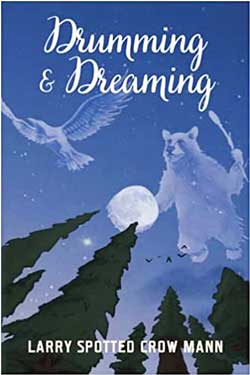
Mann said he offers “healing information for kids.” He has written for middle school curricula; one of his three books, “A Circle Tied to Mother Earth,” is a collection of poems and stories of place. One of the stories in his latest book, “Drumming & Dreaming,” is that of the three sisters. The sisters were very different from one another—one tall, with silky yellow hair, a shorter one with brown hair, and the shortest of all with black hair. They fought constantly, and one day their mother made them sit close together and twisted their hair into one braid. She told them they must stay until they made peace, until they found beauty not only in themselves but in one another. The braid went into the ground and made corn, beans, and squash, which thrive together as they nourish and support one another. Mann said the story gives a positive view of Indigenous women, unity, polyculture, and intelligence.
Mann has been working with young people for 30 years, and his teaching has taken him all over the world. The cultural center, whose name Ohketeau means “a place for something to grow,” is a haven for the Indigenous community, a place to learn and socialize. The center offers workshops in traditional arts like weaving and drum-making, and hosts performances, talks, and panels on Native American subjects.
In a question-and-answer period, Mann said things are changing—there has been some reconciliation, though the U.S. government has never apologized to the Indigenous people for the wrongs they suffered; some names demeaning to Native Americans are being changed; and land is being returned. The Nipmucs are spread out over Massachusetts, Connecticut, Rhode Island, and New Hampshire, about 3,000 in all, living in clusters. The tribe has been recognized by the state but not the federal government. The federal government is inconsistent, said Mann, which he finds frustrating because, while “recognition doesn’t solve things,” it brings land and monetary opportunities. Mann hopes Indigenous people will be asked to participate in efforts to deal with climate change because of their successful experience with controlled burning and polyculture.
Mann can be reached at whisperingbasket.com.