Harvard resident Jen Sundeen, a wife, mom, spiritual healer, poet, activist, yoga instructor, and founder of various community organizations, is now also an author. Her scholarly and inspirational work, “Lalla Unveiled: The Naked Voice of the Feminine,” is illustrated with watercolors by Harvard artist Linda Hoffman. The book comprises Sundeen’s new translations of 109 verses by the 14th-century Kashmiri mystic, Lalla; background information on Lalla and the cultural and religious traditions that shaped her; and a preface in which Sundeen describes how this book came about. The book itself is a perfect size—6-by-8-inches—with each four-line verse on a separate page. The cover by Hoffman suggests the elements of Earth in its swath of purple, river of blue, and touches of green and tan. Sundeen’s purpose in writing the book is the same as that of Lalla in composing the original poems: to offer freedom from discontent through an understanding of the interconnectedness of all things, the knowing that we are each a part of something greater than ourselves. Many of Lalla’s poems give instructions for how to achieve that understanding, mostly through meditation. Her mantra “I Am That” expresses the merging of the self with all other things, past and present, seen and unseen. In experiencing the interconnectedness of all living things we become impelled to treat everyone and everything with reverence and love.
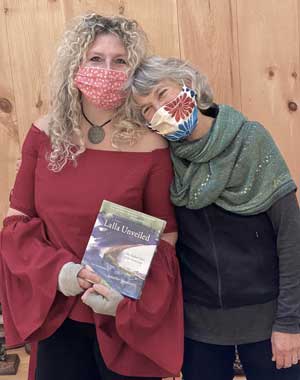
Author Jen Sundeen (left) poses with illustrator Linda Hoffman. (Courtesy Photo)
Lalla’s verses inspire not because they appeal to the intellect but because they speak in the language of the people, and they recount Lalla’s emotional journey from despair to a state of enlightenment. By making Lalla’s verses accessible, Sundeen opens the way for readers to identify with Lalla’s disillusions and to follow her teachings to find their own inner truth. Sundeen believes Lalla’s poems transcend time, culture, and place, and that now—amid climate change and so much human conflict—is a perfect time to find a kind of anchor in Lalla’s words.
Moment of crisis
As the preface relates, Sundeen discovered Lalla as a consequence of a terrible accident. She describes how, in the moment of crisis, she felt a certain freeing, a knowing that she was part of something far greater than herself. That feeling stayed with her, even as other things returned to more normal, and she continued to experience “a deeper insight into the Divine Love” which she saw manifest in all moments and places of her life. A few months later she read some poems that a friend had given her shortly after the accident. She says her world once again changed as she found a deep affinity with the poet of 700 years ago; she felt that in Lalla’s verses were the poems of her own heart.
Kashmiri language and culture
After a while, Sundeen was anxious to translate Lalla’s verses for herself. Over a five-year period, she worked from a 1920 edition of the poems and used a Kashmiri-English dictionary to translate the verses word for word and to give her own interpretation of several of them. She tried to keep the original form and meter—four lines with four stresses per line. The verses are called vakhs, which translates to “speech”; Lalla is believed to be the first to write in this particular style. The subtitle “The Naked Voice of the Feminine” suggests the verses are the honest expressions, stripped of any pretense, speaking of emotions in feminine images and metaphors of domesticity and nature.
Sundeen gives the history of Kashmir—which is complex—and some of what is known about Lalla herself. Fourteenth-century Kashmir was a mix of ideologies—Hindu, Islamic, Buddhist, all influencing one another. Lalla’s upper-class family would have followed the philosophy of Shaivism, which focuses on the deity Shiva, the life principle, and would have adhered to certain traditions and rituals. As was the custom, Lalla was married off at age 12 and lived with her in-laws, where she was abused and nearly starved. Whether she was turned out or left of her own choice, she became estranged from her family. She studied with a yogi and after that was on her own, wandering the streets of Kashmir, singing her vakhs.
She gained attention because it was extraordinary at that time for a woman to renounce tradition and conventions and seek her own spiritual path. Her lifestyle and her words appealed to the masses who suffered from the inequality of the caste system and were seeking inner spirituality and an accessible faith. Stories of performing incredible feats became attached to Lalla and made her a kind of deity.
Stages in the journey
Sundeen chose to arrange the verses to show Lalla’s personal journey, beginning in suffering. The verses of “Despair” are often direct statements of her desperation: “Take away my sickness/This disease of existence,” and “Where in Lalla’s lake have I anchored?” She begins to realize the reason for her feeling of isolation: “Goddess, I have not known myself nor you/I have caused my body continual pain/I did not know that you are me and I am you/Even to ask, ‘Who are you? Who am I?’ is the doubt that keeps us separate.” She grasps the truth that there is a greater something in her and of which she is a part.
In “Wisdom” she begins to see a path from earthly attachments to her own inner truth through meditation. In verse after verse, using different metaphors, she tells us that worldly possessions do not bring happiness. “Fame and fortune are water in a basket.” She offers a way to enlightenment: “Join the mind and the breath and begin your sacred building”; “When one meditates and realizes the one true Source/One will see that all things are just merely ashes.”
In the last section, “Nectar,” Lalla celebrates the end of her journey, her merging with the Divine Mystery. “It does not matter whether householder or hermit/On the great wheel of time if your desires dissolve/If you come to know the Beloved within/Then You will become One with That.”
The book will have enormous appeal for those who already practice meditation or have studied yoga and eastern philosophy. And the fact that the spiritualist is a woman makes it of particular interest to many. Others may be drawn to the Kashmiri history, culture, and language.
There is beauty and wisdom in the poems, and some might find in Lalla’s teachings a new spiritual understanding. “Open one each morning and see what greets your new day,” writes Sundeen.
“Lalla Unveiled” is available at Amazon, or go to jennifersundeen.com/poetry/ and click on Lalla Unveiled.
An interview with author Jen Sundeen and illustrator Linda Hoffman
I met recently with Jen Sundeen and Linda Hoffman in the latter’s studio at Old Frog Pond Farm to learn more about their collaboration on “Lalla Unveiled.” The enthusiasm and kinship that both women feel for their subject was palpable. They believe if people could experience Lalla’s message about the connectedness of all things, they would see the world differently. People would have reverence for all other living beings; walls would come down; and only love would be left.
Sundeen noted that so much of the wisdom of our ancient grandmothers is gone, their voices lost or silenced, which made it important that she share the ancient wisdom she found in the verses of Lalla. Both she and Hoffman commented how amazing it is that Lalla’s poems survived. They believe it is because she spoke in the language of the people; there was no need for a middle person to interpret her words. Lalla believed that finding the authentic self is how one connects with all other things. She was a free spirit who broke boundaries, a spiritual seeker who felt a physical compulsion to get her words out to others. “Just like I do,” Sundeen laughed.
Sundeen said she didn’t look at other translations of Lalla’s poems until she was finished with hers. When she did compare, she noticed definite differences in tone and imagery, and she thinks her word choices capture a softness and vulnerability that the other translations don’t. The dictionary she used listed several English definitions for most Kashmiri words, and in Sundeen’s choices lie the nuances of language that distinguish her translations. While other editions arrange the verses in no particular order, Sundeen saw the poems as falling into different states of mind and emotion, and she arranged them to reflect three stages in Lalla’s journey to enlightenment.
Hoffman said the book cover was actually inspired by the pond right outside her studio window; it was perfect, she said, because Lalla writes so much about water. Hoffman said she was very moved when Sundeen asked her to be part of the project, and she finds it so exciting because it’s the first time a woman has translated these poems. “Jen is living them,” she said, implying that Sundeen has the sensibilities to understand the verses differently from a man. She believes Sundeen’s arrangement of the verses shows a path; a reader can feel that others have walked this way in their own spiritual journey.
In speaking of her illustrations, Hoffman said she knew they couldn’t be literal; they had to be emotive but at the same time give some indication of the substance of the poems in each section. Her approach was to just “take in” the poem. The shapes and colors for the section “Despair” suggest turbulence and confusion. The feeling of lostness is suggested by a lone figure in a small boat in a wash of blue. The poems in “Wisdom” are introduced by broader strokes of color in more orderly lines, and in the final section, “Nectar,” the colors form a swirling sphere, mirroring the connectedness of all things that is the culmination of Lalla’s spiritual journey.
—Carlene Phillips