In spite of COVID-19 and the availability of mail-in and early voting, many Harvard voters turned out to cast their ballots in person Tuesday at the Bromfield School.
The morning started strong with nearly three dozen voters waiting to enter when the doors to the polls opened at 7 a.m., according to Town Clerk Marlene Kenney. Election official Dennis Bradley estimated the line reached between 50 and 60 people at its morning peak. With voters spaced 6 feet apart, it stretched through the school’s hallway and into the parking lot outside.
Lines moved quickly, however. Those who arrived when polls opened waited about 20 minutes to reach the booths. By 8 p.m., when the polls closed, the lines were gone, the booths were empty, and there was no sign of last-minute voters rushing to make the in-person deadline. Kenney said that her office received over 3,000 requests for ballots and, of those requests, 90% were returned. This meant that about 74% of all registered voters voted prior to Nov. 3. “We’ve never seen numbers like that before,” said Kenney. (For more detail see Election 2020 story.)
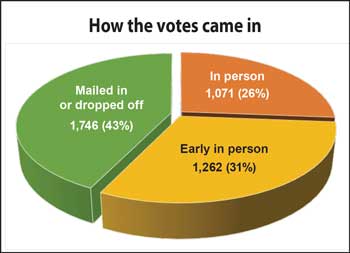
Throughout the day, poll workers limited the number of people inside the voting area to about nine voters—one to each booth—plus the volunteers, police, and any observers for whom there was a designated area to sit or stand.
Bradley told the Press there was no shortage of volunteers, but that the pool was notably younger than for previous elections this year. “A lot of that was, frankly, COVID, because the more vulnerable senior citizens were certainly very concerned, as they should be, about volunteering for something like this.”
Two of these younger volunteers were Sarah Sobalvarro and Arianna Thornton, who were sanitizing voting booths after each use. Both seniors at the Bromfield School and members of the YMCA’s Youth and Government (a model-government program for teens), the girls are a few months too young to cast ballots this year but still wanted to be engaged in and learn from the election process.
“In school, I’ve been working with Youth and Government and advocating for civic engagement a lot, and I feel like coming here and volunteering … helps with that goal,” said Thornton. “What it takes to organize an election with COVID, all the volunteers and all the coordination … to keep everything clean is a lot more impressive than it might seem from the outside.”
Sobalvarro said that in the days leading up to the election, she volunteered to help file mail-in ballots and was impressed by the numbers. “Getting to see how many people are actually doing mail-in voting … it’s very interesting.”
Jake Egan stood outside the polls midafternoon, waiting for his mother to finish voting. He had cast his ballot earlier in the day and said he felt strongly about voting Democratic.
Egan identifies as a gay man and said the issues that brought him out were “humanity, humility, and the strain and pressures to the people I love and myself … watching my friends who are people of color have no respect, have no safety net, it’s disgusting. It’s horrible and it’s not what we should be about.”
Jane Jakuc, Egan’s mother, emerged from the polling station in her Ruth Bader Ginsburg-themed mask: black with a lace trim at the top reminiscent of Ginsburg’s trademark accessory. “A friend of mine made it for me,” she said. “She insisted that I wear it today.”
In response to a query on why she felt it was important to vote that day, she laughed and pointed to another part of her outfit. “I’m wearing a button that says it all: ‘battle for the soul of the nation.’”
Hilary Maglothin came to vote with her husband and kids, also dressed for the occasion. One of her daughters had dyed her hair blue, while Maglothin herself proudly wore bright red lipstick, a signature look of the suffragists who fought for women’s voting rights. “We’re very into voting,” she said, adding that she wants to teach her kids the importance of voting, as well.
Like most voters who spoke to the Press on Tuesday, Jakuc and Egan said it was important to them to vote in person and they felt safe doing so. “I wasn’t going to do it any other way,” Jakuc asserted. Others, like Peter Loges, felt the same. “It has nothing to do with fear,” Loges said, explaining why he didn’t mail a ballot instead. “I like being part of the community and the process.”
Cameron Pappas expressed a similar sentiment. As a young voter, Pappas said he wanted the experience of voting in person for the presidential election, “COVID or no COVID.” He also felt strongly for voting against President Trump, and said he hoped his vote would help put an end to “unwarranted prejudice.”
Kayla Campbell, a college student at Fitchburg State University and first-time voter, said she felt strongly about voting to advocate for law enforcement this election. “I’m in the Police Academy, and I wanted to make sure my future career was protected,” she told the Press.
“Voting is the basis of America,” Carl Sciple said. He and his wife, Pat, spoke about how the right to vote goes back to the founding fathers and everyone who has fought for this right since then. “This is a vote for liberty and our Constitution,” Pat Sciple said.
Terry Anelons explained that he felt it was particularly important to vote today and added that his wife and daughter had already voted by mail. He asserted, “This is the most important election of anyone’s life.”