
After packing up the car for our annual two-week stay in Seal Harbor, Maine, just outside Acadia National Park, one last chore remained: sterilizing and refilling the hummingbird feeders with homemade sugar water, and placing a few extra around the yard, just in case.
The red bee balm flowers were dying out, although a hint of their honeyed fragrance was still wafting in the air. For weeks, the petite (3- to 4-inch) ruby-throated hummingbirds had hovered before the tubular petals and lapped nectar through their hollow pointed bills, their beating wings just a blur creating a low humming sound. The flowers wouldn’t last through the next two weeks, though, and because the birds are voracious consumers of nectar and tiny insects, it was urgent that the feeders be filled to supplement their diet.
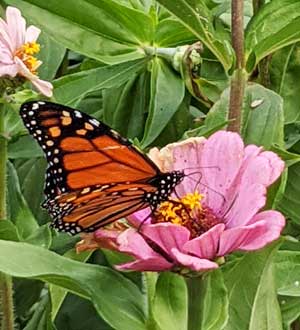
In addition to hummingbirds, monarch butterflies are also on their fall migration. This one stops to sample nectar from a zinnia. (Photo by Lisa Aciukewicz)
In the spring, around May, the feeders had been readied for the iridescent birds’ arrival; the males with red feathers at their throats, a gorget, showing up first in order to establish their territories, then the females with white feathers at their throats. Hummingbirds, of which there are over 300 species, are found only in the Western Hemisphere and of those, the ruby-throated is the only eastern hummingbird. It’s said that they return to the same spot every year, and it does seem as if we have more hummingbirds each year. Occasionally, a curious hummingbird will hover in front of our faces, seeming to look directly into our eyes in recognition, before darting away.
The males are endlessly entertaining with super speedy aerial displays, impressing females and defending territory. One little bird sat on the same twig every day, fending off interlopers at the nearby feeder. But males and females are both enchantingly beautiful and possess superlative powers of flight and metabolism.
It’s speculated that diminishing daylight is the cue for the birds to begin heading south. On our return from Maine two weeks later, at the end of August, we noticed the pugnacious males in our garden had already departed on their journey south to Central America. Females and juveniles were still jetting around, however, bulking up at the feeders where it was now a bit quieter, with fewer chirps, squeaks, and buzzing sounds.
Eventually, all will gather midway into the trip on the Gulf Coast for one last refueling before flying directly across the Gulf of Mexico to the Yucatan in one 500-mile, nonstop flight in 18 to 22 hours, or flying overland, diverting through Mexico. They go it alone, even the young ones, rather than as a flock. It’s a stressful and dangerous journey that takes stamina, endurance, and good tailwinds.
Hummingbirds aren’t the only creatures on the move. Monarch butterflies migrate at the same time toward the same destinations as hummingbirds. Both consume nectar from the same flowers, although hummingbirds travel at a faster speed, and can endure cold and rain. The sight and sound of Canada geese flying in V-shaped formation are synonymous with the fall season. The summits of Mt. Wachusett, Mt. Watatic, and Mt. Tom are premier Massachusetts locations from which to observe and participate in the annual count of the hawk migration.

Look for the last of the hummingbirds at your feeders before they start their transcontinental migration. (Courtesy photo)
Some mammals, such as bats and marine and herd animals, migrate seasonally in search of food and to escape weather extremes. With the increase in global warming, migration patterns will change for animals and humans. Already some hummingbirds have been observed overwintering on the Gulf Coast. The harvest of fruits, vegetables, wheat, and other grains is dependent on migrant farm workers moving with the ripening crops. In September, students all over the world migrate from their homes to schools.
Some of the hummingbirds at our feeders may be migrants traveling from more northern areas, flying low over trees and water to spot the safe places for food and rest that all migrants need to complete their journeys.
The Audubon Society and the Cornell Lab of Ornithology recommend that we maintain feeders for these migrants after the locals have gone. With their prodigious memories, they may remember this act of charity.
Further reading
- Recipe for hummingbird nectar at www.audubon.org
- Stokes Guide to Bird Behavior, Vol. III, by Donald and Lillian Stokes
- A Field Guide to the Birds: East of the Rockies by Roger Tory Peterson
- BirdCast, A Project of The Cornell Lab of Ornithology, Colorado State University, and UMass Amherst
- “The Great Climate Migration Has Begun” by Abrahm Lustgarten, The New York Times Magazine, July 23, 2020
- “These Hummingbirds Take Extreme Naps. May Even Hibernate.” by Veronique Greenwood, New York Times, Sept. 10, 2020
- Hummingbird and Monarch Migrations Compared, www.journeynorth.org
- Cornell Lab of Ornithology, www.birds.cornell.edu