Almost half of Harvard’s registered voters took part in Tuesday’s state primary, but the overwhelming majority did so with early or absentee ballots. Town Clerk Marlene Kenney said 521 people came to the polls in person, but just over 1,600 mailed in their ballots, deposited them in the box at Town Hall, or voted early at Town Hall.
Harvard’s overall turnout was unusually high for a state primary, up from about 33% in 2018, and far higher than the miniscule 5% in 2016. Massachusetts Secretary of State William Galvin had predicted record turnout statewide, with voters drawn to the polls by a hotly contested race to be the Democratic nominee for U.S. Senate between incumbent Edward Markey and challenger Joseph Kennedy III.
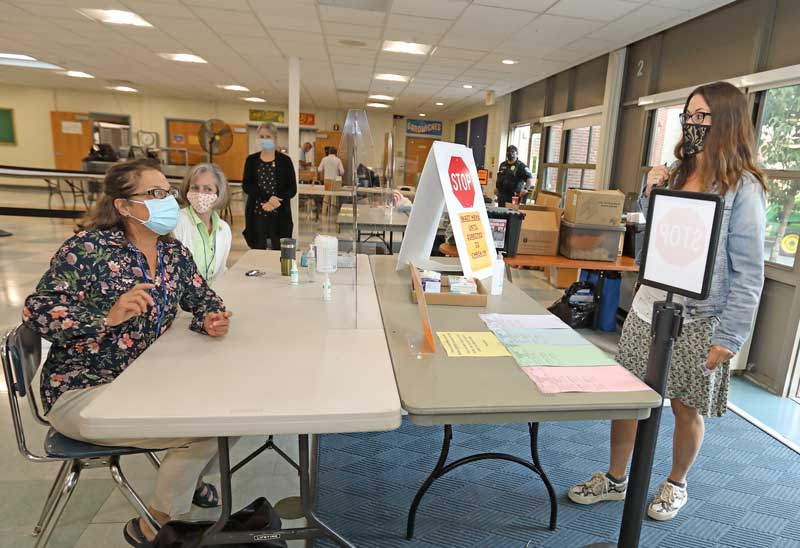
Poll volunteer Susan Holcomb explains the check-in procedure to Kate Jones as Jones arrives to vote in the state primary at the Bromfield cafeteria Tuesday, Sept. 1. New protocols included wearing masks, bringing one’s own pen, and keeping 6 feet apart. (Photo by Lisa Aciukewicz)
Even though such a large share of votes arrived early, election workers are not allowed by law to begin counting ballots until election day itself, Kenney said. But, with in-person turnout so light, workers could feed the early ballots into one of the two voting machines without delaying in-person voters, who used the other. So Kenney was able to post the preliminary results on the town website late Tuesday night, as in the past.
At the top of the ticket for Democratic voters was the U.S. Senate race between Markey and Kennedy. Harvard Democrats supported Markey in a big way, giving him 73% of the 1,845 votes cast. That was a far larger margin than Markey’s statewide win, in which he led Kennedy 56% to 44% when the race was called around 10 p.m.
Harvard Republicans divided their votes nearly equally between the two candidates vying to challenge Markey for the Senate seat in November. Shiva Ayyadurai received 132 votes to Kevin O’Connor’s 129. Statewide, however, O’Connor won handily with about 60% of the Republican vote, according to The Boston Globe’s online tally Wednesday morning.
In the down-ballot Democratic races, U.S. Rep. Lori Trahan, state Sen. Jamie Eldridge, state Rep. Dan Sena, and Councillor Marilyn Devaney were unopposed in their races. For register of probate in Worcester County, Kasia Wennerberg won in Harvard over John B. Dolan III. But Dolan won in the county with about 54% of the vote, again according to the Globe.
Republicans fielded no candidates to challenge Trahan, Devaney, or Eldridge. Catherine Clark was unopposed in the GOP primary and will run against Sena in November. Likewise, Stephanie Fattman will oppose Dolan for the county probate office.
A smooth day at the polls
By 2:30 p.m. Town Clerk Marlene Kenney said the polls had been a bit quieter than during a typical election, something she expected based on the volume of mail-in and absentee ballots her office processed this year. By that point in the day there had been only about 250 in-person voters.
Inside the polls, Kenney said voters complied with signs asking people to respect social distancing, keep their masks on, and avoid touching their faces. Poll workers checking people in were separated from voters by a plexiglass barrier, booths were set 6 feet apart on the floor, and there were separate entrance and exit areas.
The only issue Kenney said she had encountered so far was a pen panic: A sign outside the door recommended voters bring in their own pens but failed to clarify that pens were also provided for anyone who might have forgotten. The miscommunication sent many voters rushing back to their cars to rummage through purses and glove boxes but was soon remedied with a friendly note taped to the misleading sign.
A steady trickle of mid-afternoon voters said they felt safe voting in person. “I think people are being careful,” Jan Abraham told the Press shortly after leaving the polls. She pointed out that other activities people are participating in regularly, such as shopping, have a similar risk for exposure. “If we can grocery shop, we can vote,” she said.
In-person versus mail-in
Abraham also said she felt more secure voting in person than mailing in her ballot. “I absolutely want my ballot in the box. I don’t want to mail it and I don’t need to.” This sentiment was echoed by other voters such as Lorin Johnson, who said he feels mail-in ballots can be tampered with. “I think that the mail-in ballot has a place and that place would be, of course, if you are a service member or otherwise unable to make a personal appearance, but I think using [mail-in voting] mainstream is asking for trouble,” he told the Press.
Many Harvard voters, however, felt differently about the security of mail-in ballots. While they were not present outside the polls to comment, their stance was represented by the unprecedented number of requests for mail-in ballots—about 1,600—the town clerk reported receiving.
Experts who have studied mail-in voting say fraud is exceedingly rare, though slightly more common than occurs with in-person voting. Amber McReynolds, CEO of the National Vote at Home Institute, and Charles Steward, director of the MIT Election Data and Science Lab, analyzed nationwide fraud data collected by the Heritage Foundation and concluded that mail-in fraud occurred at a rate of 0.00006% of total votes cast. In June, a Washington Post team analyzed data collected by three states that vote entirely by mail and found that officials identified just 372 possible cases of double voting or voting on behalf of deceased people out of about 14.6 million votes cast by mail in the 2016 and 2018 general elections, or 0.0025%.