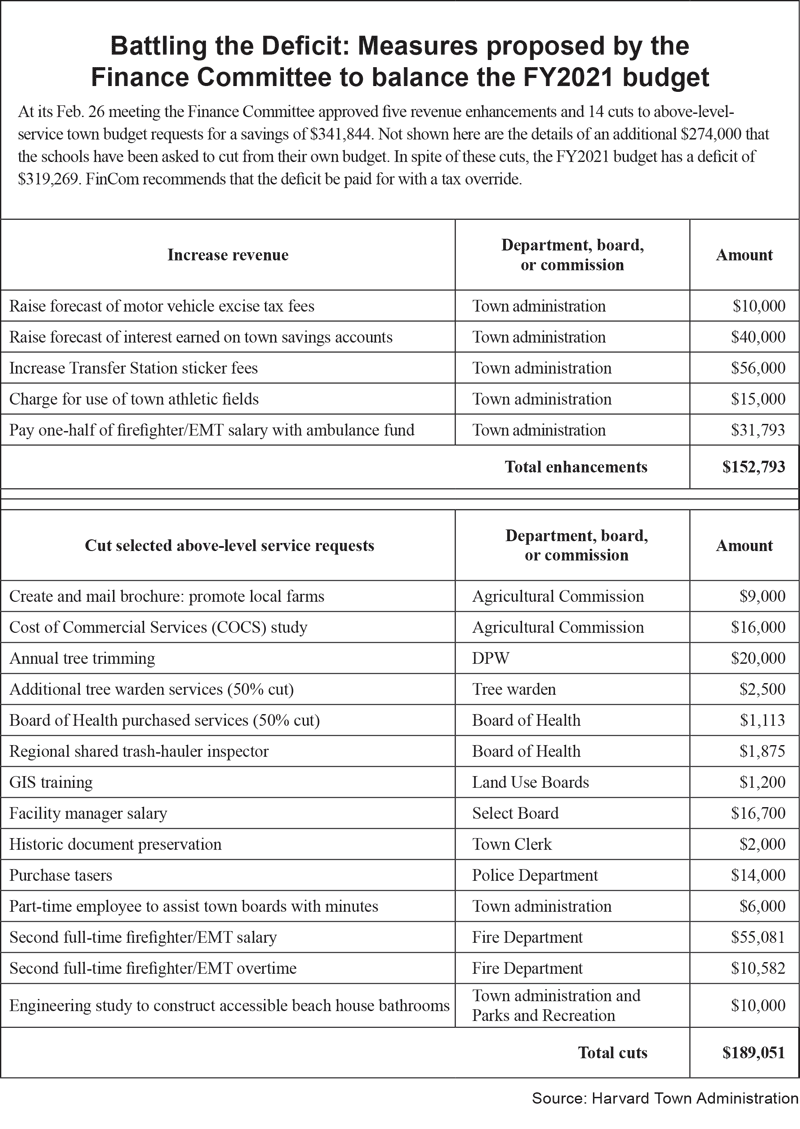
Higher taxes, increases in user fees, and a pruning of budget requests from town departments and boards have not been enough to balance next fiscal year’s $33 million budget. Town officials say that without additional income, expenses will outpace revenues by $319,269 and the Finance Committee has recommended a tax override to make up the difference.
An override allows a town to increase the tax levy on real estate and personal property above the limit set by state law: 2.5% plus the assessed value of new construction. Voters must approve the increase at Town Meeting and the ballot box. Once enacted, an override is permanent, embedded in the base amount the town may increase each year.
With a jump in excluded debt already planned for next year to cover the cost of financing the new elementary school, the recommended override would further increase the taxes of Harvard homeowners, adding approximately $0.26 per $1,000 of assessed value to their fiscal 2021 tax bills, or an additional $130 for the owner of a $500,000 home. The actual number will depend on the assessed value of Harvard properties next year.
This year’s request is the first in a decade. The last successful override was in 2008, when residents voted, 674-612, to raise an additional $200,000 to balance that year’s budget. A subsequent $107,000 override request in 2010 to underwrite user fees at the Bromfield School failed, 834-305.
FinCom Chair Don Ludwig and Town Administrator Tim Bragan delivered the news Saturday morning, Feb. 29—2020’s leap year day—to a well-attended meeting of the Select Board, School and Finance committees, and other departments, boards, and commissions. Bragan, Assistant Town Administrator Marie Sobalvarro, and Finance Director Lori Bolasevich have been instrumental in laying out options for FinCom, whose members met throughout January and February—though rarely with 100% attendance—to review the fiscal 2021 requests of town departments and boards. The budget presented Saturday was the culmination of their work.
Level-service spending can’t guarantee a balanced budget
Each year, the process of assembling a budget for the coming fiscal year gets underway in September with an all-boards meeting followed by an October memo from the Select Board that sets spending guidelines. In recent years, a time of relative prosperity, departments and boards have been asked to submit level-service expense budgets, spending that is sufficient to deliver the same level of service in the coming fiscal year as in the current one. But they have been told not to increase the sum total of their personnel and expense budgets by more than 2.5%, in keeping with the base increase allowed by Proposition 2 ½.
This year, while some departments, such as the library, submitted budgets for fiscal 2021 well below that guideline, others, such as the schools—with a 4.1% increase—exceeded it. And benefits for municipal workers and teachers jumped by more than 7%, from $5.3 million to $5.7 million, as the cost of health insurance continues to rise. Although excluded debt payments will increase 75% in fiscal 2021—from $2.2 million to $3.8 million—as taxpayers begin to pay down the cost of the new elementary school, those payments are not responsible for the deficit: Excluded debt adds to the size of a municipal budget but allows taxes to increase beyond the 2.5% limit to cover it.
Departments and boards were also invited, as in past years, to submit prioritized lists of additional fiscal 2021 spending needs. Among them were a Parks and Recreation Commission request for the construction of new accessible bathrooms at the town beach house, and the purchase of tasers for the police.
Requests for spending on major projects—those whose cost is greater than $20,000 and with an estimated lifetime greater than five years—went straight to the Capital Planning and Investment Committee, which completed its work in January. Most of its approved items will be funded with money from the Capital Stabilization and Investment Fund, not the budget, and will not increase taxes. But excluded debt would be needed to pay for three capital items—a $4.3 million Hildreth House addition, $1.3 million for repair of the old library roof and masonry, and $660,000 for a new ramp for the Bromfield middle school.
Fincom has recommended building the ramp, but not the other two projects. At Saturday’s meeting, Select Board Chair Alice von Loesecke said it was the board’s policy to let the town decide such projects and she expected all three requests would be on the Spring Town Meeting warrant.
Level service in name only?
With fiscal 2021 requests in hand, FinCom found itself in early February with a deficit of $844,655 on a budget of $34 million. In the weeks that have followed, FinCom has whittled that amount to $319,269 by increasing forecast revenues, trimming above-level-service requests and eliminating several one-time, small warrant article requests (for details see chart.) The School District has been asked to cut its budget by $274,000, which School Committee Chair John Ruark said they will do by deferring some expenses and making up the remaining amount by drawing on their Devens fund.
In spite of town and school cutting, the budget remains a level-service budget, although one that requires an override. No personnel have been cut and some above-level-service spending requests remain. But in the discussion that followed Bragan’s presentation, Harvard Police Chief Ed Denmark and Ruark said they viewed the budget as level service in name only. And Bragan warned that given the growth in salaries and benefits, coupled with a lack of growth in state aid, this year’s override, if approved, is likely to be one of several in coming years.
Beyond Harvard’s control
Select Board member Lucy Wallace said she feared the town would view the override request as evidence of overspending. But some factors are beyond Harvard’s control, she said. “I think we need to be honest with the community and say, ‘This is the community you want, these are the services we’re trying to provide, and this is what it costs.’ Harvard has a really good reputation for its school system, as a great place to live, with a great sense of community that keeps our property values high. If that all starts to unwind, we’re all gonna suffer.”
FinCom member John Seeley said the town needs to do a better job of increasing revenue to pay for services. “We’re putting the entire burden on the homeowner and I’m not sure how sustainable that is,” added Ludwig.
The budget unveiled Saturday is a recommendation. Now it is up to the Select Board to either accept FinCom’s work or ask for revisions. While Harvard’s town charter assigns the task of assembling the budget to the Finance Committee, delivering a final, balanced budget to Town Meeting is the job of the Select Board.
The board met Tuesday, March 3, with Ludwig, Seeley, and FinCom member Jennifer Finch, and School Committee Chair Ruark to review budget details. While the board did not object to any of the proposed cuts, it took no action. At a future meeting it must also consider whether to ask for a general or a “tiered” override, one with specific amounts tied to particular budget items. And members must compile a list of additional cuts should an override fail. In the event of a failure, a special town meeting would be required before the end of fiscal 2020 to approve a slimmed-down budget.
“Sorry for the gloom and doom,” remarked Bragan as Saturday’s meeting adjourned.