
The Council on Aging’s first story slam debuted Tuesday, Feb. 12, and featured a movie extra and a former hockey star turned musician/magician. Jen Schoenberg, programs coordinator, said the COA hopes to have a slam once a month, where one or two community members share any kind of story they choose. “There have to be so many more stories, accomplishments, and adventures out there that our seniors have achieved, lived through, or witnessed, and I can’t be the only one that would love to learn more about our neighbors,” she said to clapping from the audience of about 16 gathered in the Hildreth House living room. “Stories matter, and people want to hear them.”
The first speaker was Brian Sandy, a movie extra who has been in 15 films, including “Spotlight,” “Ghostbusters,” and “Castle Rock,” and has also appeared in TV shows, commercials, and live theater. He’s currently working on gathering his stories together in a book called “Extra Ordinary.” Sandy moved to Bowers Brook in Harvard less than a year ago, too late to add “Little Women” to his list of credits.

Brian Sandy. (Courtesy photo)
Sandy told the story of the highlight of his career as an extra in the 2015 movie “Joy,” starring Jennifer Lawrence, Robert De Niro, and Bradley Cooper. He had been called to the “gene pool” for a scene at an industrial plant in Wilmington and had been standing around with the other extras for about three hours, when someone pointed to him, saying, “You. You are going to be in the scene. Go to wardrobe.” It was music to his ears. He was dressed as a factory worker and assigned to a drill press. When a bunch of extras, each at a different machine, were told to leave, he was excited that he and one other guy were the only ones left for the scene.
The movie is based on the true story of Joy Mangano, who invented “the magic mop.” Someone stole her patents, and in this scene she comes into the factory and recovers them. However, the “bad guys” are after her, and pretty soon the cops come. Sandy had been filled in on the gist of the action and told not to leave his machine. He was totally into the scene and after the shoot, the director told him, “You did great.” But that didn’t mean he would make it into the movie. Sandy described “the dailies,” unedited footage of the day’s scene where the actors get to weigh in, and said he was excited to learn that Lawrence had said of his scene, ’Yes, I want him in the film.” Later, when he was watching the movie with friends and it came to the factory scene, one of them called out loudly, “Hey, you actually got to act this time!”
Sandy described how he first got into the extras business. In 2010 he was in Lowell when “The Fighter,” starring Mark Wahlberg, was being filmed. Having coffee in Starbucks, Sandy was going on about how much he’d like to be in the movie, when a woman gave him a contact. For the next 10 years, he answered the extras call whenever he could. His latest role is as a drunken fisherman in a Gloucester barroom in the movie “CODA.” Sandy said the scene took 25 takes before the director was satisfied. “It’s a lot of hurry up and wait.”
Paul Flaherty of Ayer Road was up next. A recent memory box activity at Hildreth House had stirred up Flaherty’s recollections of the hockey days of his youth in Massachusetts. In 1961 at Melrose High School, he was voted MVP in an all-star game, and that team went on to win the state and then the New England championships. He was one of five Americans who went to a training camp for the Niagara Falls Flyers, a major junior hockey team. He said Bobby Orr and Derek Sanderson were there, and a guy who played on the same line as Flaherty went on to become a member of the Hockey Hall of Fame. Flaherty was asked to skip his senior year of high school to play for the team. He didn’t need much persuasion from his parents to see that would be an unwise decision. At Boston College on a hockey scholarship, Flaherty thought of going pro after graduation. But those dreams—and others—ended when he had to give up hockey because of injuries.
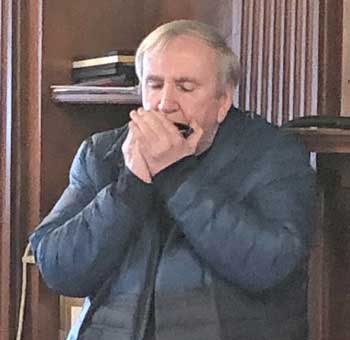
Paul Flaherty. (Courtesy photo)
Flaherty talked about another passion— music. Music was a big part of his family life, he said, and “the nuns thought I could sing.” In his early 20s, he was playing piano and harmonica with jazz musicians. He played in Boston with the famous jazz pianists Dave McKenna and Al Vega. Currently he often plays the piano or harmonica at Hildreth House, and once a month he plays in Westford with a group called Jazz Destruction.
Though he described himself as a nervous person—“as nervous as a long-tailed cat in a roomful of rocking chairs”—the audience would never have known it as Flaherty played a jazz rendition of “Somewhere Over the Rainbow” on his harmonica.
Flaherty’s talents extend beyond hockey playing and music to include those of a magician. He announced he would do a disappearing act. He told audience members to keep their eyes on the floor and his feet as he made one leg disappear. He draped his jacket over his knees and slowly raised it. “Did you see it?” he asked. The audience was a bit dumbfounded and had to confess they hadn’t really seen anything happen. Undaunted, Flaherty repeated his instructions and this time, as the jacket slowly rose, one leg did, indeed, disappear. The audience clapped appreciatively.
An Irish joke and a rendition of “Memory” from the musical “Cats” rounded out Flaherty’s repertoire. Some people had heard Flaherty’s harmonica playing before, but for newcomers, it was an incredible experience. The clear high notes, the “bending” of notes, the sheer beauty of the tones would make anyone think again about the underrated harmonica and be moved by Flaherty’s expertise on it.
The two presenters at the first slam set a high bar for future speakers, but they also had an informal, interactive approach that should encourage others to take a turn telling their stories.
The next story slam is scheduled for Feb. 4. “I would really like to have this be a community event and hope to see all ages attend and listen to what our seniors have to share,” Schoenberg later wrote. “ We have a really special home up here on the hill and I want more people to come through the door and feel welcomed as though they are visiting with a long lost friend. I hope this program will strengthen our community, foster companionship, and create new friendships as we learn a little more about our neighbors.”