While residents decorate their trees or finish up last-minute shopping, the town’s capital committee members will spend part of their holiday season preparing to vote on their recommendations for capital spending in fiscal 2021.
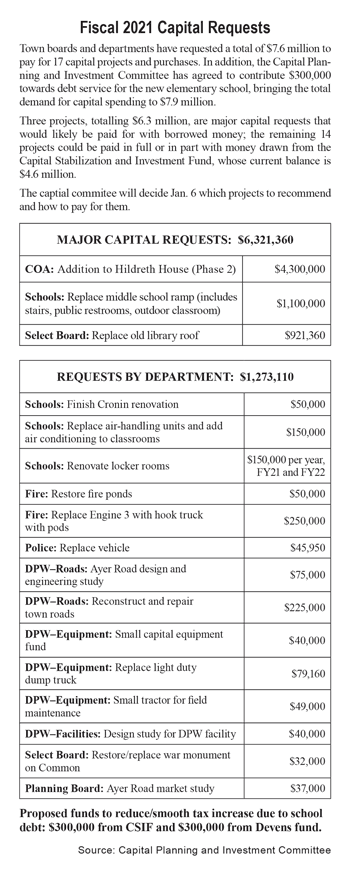
That vote, scheduled for Jan. 6, will determine which of the 17 projects submitted by seven departments and boards, and totaling an estimated $7.6 million (see table below), will be blessed by the five-member Capital Planning and Investment Committee and forwarded to the Finance Committee for its review. Whether to proceed with construction of Hildreth House Phase 2 and replacement of the old library roof are likely to dominate the committee’s January deliberations.
The capital committee’s vote is a crucial first step in determining which requests make it to the spring Town Meeting warrant or, in the case of additional debt, to the May Town Election ballot. Its recommendations, when they involve additional debt, can have a direct impact on taxpayers, as well as the ability of town government to deliver services and maintain town buildings, fields, and equipment.
In deciding which projects to recommend, the five voting members use a one-page rating form to come up with a score for each project. Each project is graded according to seven criteria:
- Is the project legally mandated or critical to public safety? (0-10 points)
- Does the project protect, enhance, or increase the longevity of town-owned infrastructure? (0-3)
- Is the project justified as a priority for the town? (0-3)
- Is the project plan sufficiently detailed and its costs substantiated? (0-3)
- Can the cost be offset by grants, donations, or other non-tax funding? (0-3)
- What impact will the project have on the town’s or requesting department’s operating budget? (0-4)
- What percentage of town residents will be served and how often will the new asset be used? (0-3)
If a member were to award a project the maximum number of points available, it would receive a score of 29. Once all 17 projects have been scored, the results for each will be averaged and the projects ranked, from highest average score to lowest. Inevitably, some with low numbers will be delayed or rejected. The scores of each committee member are being collected by member SusanMary Redinger and will be reported at the committee’s January meeting. At that time a final list will be decided on and a source of money for each project determined.
Test run
At a Monday morning meeting this week, committee members took their first stab at rating next fiscal year’s projects. Though the results are by no means final, a new police cruiser, money for repair of the town’s fire ponds, and a new Bromfield Middle School ramp topped the list. Hildreth House Phase 2, on the other hand, was tied for last place with a request to add air conditioning to the middle school wing.
Some members argued that the score for the Hildreth House Phase 2 project suffered because the request is for construction of a new building, not improvements to an existing structure. Accessibility and other improvements were made to Hildreth House during Phase 1, von Loesecke noted; Phase 2 does not extend the life of an existing asset, but is a means to consolidate the delivery of services to seniors in a new location. Seeley said Phase 2 would require borrowing and that the debt service on the estimated $4.3 million cost would top $400,000 in its first year.
The schools’ request to replace the middle school ramp also drew attention because of its inclusion of new outdoor bathrooms, stairs, and an outdoor classroom area. Members agreed each element should be rated individually to separate work that is desirable from work that is necessary.
The committee appeared divided over a last-minute request for $920,000 from the Select Board to replace the old library roof. “The project makes no economic sense,” declared CPIC Chair John Seeley, who said that alternative uses of the building, including its sale, have not been adequately explored. Member Alice von Loesecke said disposal of the building was for the Select Board to decide, not CPIC. And Permanent Building Committee member Pablo Carbonell said his board had concluded that replacing the library’s 130-year old slate roof was a “no-brainer,” the best use of the town’s money to fix a problem created by decades of neglect.
A guide, not a test
While these and other results were discussed in an open meeting, the compilation—essentially a test run of the rating form— was not distributed. Final results will be available Jan. 6. And in an email, Chair Seeley cautioned against making too much of the preliminary ranking. “This was our committee’s first rating, and our discussion on Jan. 6 will likely change some member’s scores,” he wrote.
“I don’t think ‘low score’ means ‘don’t do it,’” added committee member Nate Finch in an email to the Press. “It’s more like, ‘this isn’t an easy yes, so it requires deliberation.’ Our ratings are really only a guide for our discussion. In the past, [they] mainly let us skip discussing projects that are clearly worthwhile, and focus on those that are more contentious or complicated. If a project supports a clear priority for the town, is well documented, and repairs or maintains something we already have, it doesn’t really require much discussion—it’s a good idea, and the ratings will make that clear.”
The Capital Planning and Investment Committee was established by Town Meeting in 2009 and consists of five voting members; currently they are School Committee representative Redinger, Finance Committee rep Seeley, Select Board member von Loesecke, and two citizens at large, Finch and Teresa Jardon. Town Administrator Tim Bragan, Finance Director Lori Bolasevich, and School Superintendent Linda Dwight attend meetings as nonvoting members. The committee is charged with reviewing any project whose cost is $20,000 or more and has a useful life of at least five years.
The town has two principal means to pay for capital projects: drawing money from the Capital Stabilization and Investment Fund (CSIF), whose current balance is $4,608,390, or borrowing the amount. Use of the capital fund requires a two-thirds vote of town meeting; debt that raises taxes requires a two-thirds vote of town meeting and a majority vote at town election.
With the town’s debt payments expected to leap past $4 million in fiscal 2021, committee Chair Seeley and others have said they will be reluctant to approve any projects that increase debt for fiscal 2021.
Editor’s note: This story is part of a periodic series in which we are documenting assembly of the fiscal 2021 budget.