Believing in something can be completely different from taking action to make the belief a reality. For 247 years our country has professed to believe in the founding principle that all men are created equal and endowed with the unalienable rights of life, liberty, and the pursuit of happiness, and yet we continue to struggle to actualize equality. Which is why it was heartening to me to learn of the various organizations actively engaged in helping LGBTQ youth feel equal and free of discrimination.
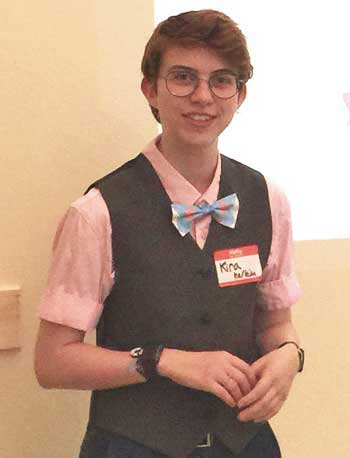
Kira Houston leads the LGBTQ workshop. (Courtesy photo)
Kira Houston (Bromfield Class of 2019), working with the state Safe Schools program, led an LGBTQ workshop Saturday, Aug. 17, with the goal of educating the community and inspiring advocacy. The two hours were a time of learning, discussing, and self-reflecting. And they showed the powerful bonds that form when a group comes together in meaningful conversation and plans for action.
“I take my advocacy very seriously,” Kira told the circle of 20 or so people, ranging from teens to senior citizens like me. No one could doubt his statement. Not only does Kira, an 18-year-old transgender male, exude earnestness, openness, and optimism, he is also an active member of several organizations advocating for LGBTQ youth. Chief among them is the Safe Schools Program for LGBTQ Students, created in 1993 by the Mass. Department of Elementary and Secondary Education and the Mass. Commission on LGBTQ Youth. Kira travels to middle and high schools around the state to give a version of the workshop he held for the community at the UU Fellowship Building. He is a member of the state GSA Leadership Council, which holds bimonthly meetings and a three-day retreat every August. In addition, he is part of the Harvard Catalyst Project, research the university is doing on how school health professionals can be more active resources for LGBTQ youth. Kira will continue his advocacy as a freshman at Clark University, where he plans to major in art history.
Praise for Bromfield support
While at Bromfield, Kira was active in the GSA, a group started by two Bromfield freshmen in 1996 as the Gay Straight Alliance. As evidence of its evolution toward inclusivity, the group now has the acronym stand for Gender and Sexuality Alliance. Kira credited “the amazing” Bromfield history department leader Kathleen Doherty for more than 20 years of support for the group. He said he had been very happy at Bromfield, finding supportive teachers and always feeling safe. In many other schools that isn’t so, he said.
Telling us his goal for the workshop was to educate and have fun, he stated group agreements: Don’t talk over one another (“One diva, one mic,” quipped Kira); apologize if you realize you have said something insensitive; respect the privacy of others’ experiences; remember that we’re all here to learn; make an effort to get out of your comfort zone into your stretch zone.
Kira’s first presentation` was about LGBTQ-inclusive language. The word “homosexual” connotes a medical diagnosis; more appropriate is the word “gay” for gay and lesbian people. He said he personally likes the term “queer” because it is most inclusive, but he acknowledged that historically the word was a slur and one should be careful using it. I, for one, have trouble getting beyond the connotation “queer” had in the 1950s—some secret, weird, bad person that I knew nothing about.
Why ‘cisgender’
While it’s clear we need the adjective “transgender” for someone who has changed gender from their “assigned” one, for a moment I wondered why we need “cisgender” to describe a person who identifies with birth gender. But then I realized how discriminatory I was being. Kira pointed out that “trans” is a process and people proceed at different rates and to different degrees. He said being a transgender female is the most harshly judged gender because our society traditionally most values males.The term “gender dysphoria” is recognized as a mental health condition, where one’s assigned gender is incongruent with one’s identity. Rather than saying “both genders” or “opposite sexes,” it is more inclusive to say “all genders.”
For many people, a difficult inclusive change is using “they” to describe a person who identifies outside the established definitions. Those who have taught English or had grammar drilled into them may refuse to let the word escape their lips in use with a singular verb. I have put away my red pen and come to think it’s better to use “they” than some made up word that would call more attention to itself. And, “they” connotes an inclusiveness that seems appropriate to the LGBTQ community itself.
Kira spoke of important gay people of the past, such as Walt Whitman, and the history of the 1969 police raid on Stonewall, a gay bar in New York, that triggered the formation of the Gay Liberation Front. Although states abandoned laws against homosexuality at different times, it wasn’t until 2003 that the Supreme Court said laws against homosexuality were unconstitutional. Kira urged us more than once to watch the documentary, “The Stonewall You Know Is A Myth. And That’s O.K.”
The workshop offered participants opportunities to explore their own identities. We filled out a worksheet called “Social Identity Wheel” that asked about race, ethnicity, age, religion, physical or emotional development ability, and more. We talked in small circles about which of our identities we think about most often, least often, would like to explore, and most strongly affect how we see ourselves as people. In my group, we realized how privileged we are not to feel terribly vulnerable because of our identities.
The Gender Unicorn
The Gender Unicorn, which Kira said is his favorite worksheet, had a diagram that required reflection on the degree to which we were female, male, other/intersex in the areas of: gender identity, gender expression, sexually attracted to, and emotionally attracted to. The task was to think about how much of each bar you wanted to fill in as it went farther toward each gender option. For example, for “gender expression” did I want to fill in the whole bar of “female,” or were there other gender expressions I have?

The last part of the workshop dealt with LGBTQ advocacy. Currently the State Commission on LGBTQ is studying three areas that importantly affect gay students: educational exclusion, health, and homelessness. Kira described the so-called school-to-prison pipeline, where LGBTQ students are subjected to bullying by peers and often to discriminatory discipline by teachers and administrators. This results in students dropping out and becoming more prone to ending up in the prison system. In the area of health, Kira said the latest version of health education for public schools was written in 1999, and there are no health curriculum frameworks for Massachusetts public schools. As a result, LGBTQ students never hear anything in health class that describes them, so they tune out and don’t hear even information that is relevant. Mental health is rarely addressed, and statistics show a high suicide rate among LGBTQ youth. Homelessness is a problem among young gay people, with familial rejection the main reason, followed by mistreatment at school, and aging out of foster care. Participants discussed the steps that might be taken to make gay students feel safer and and more successful. Kira said he would take our ideas back to the commission.
Kira’s mom, Kim, had information on Home for the Holiday, a program where a family welcomes a homeless or rejected LGBTQ youth into their home. Kim herself is active in a group called Stand with Trans where she is an “ally mom” who is only a phone call away from a transgender kid who needs an understanding listener.
I think I speak for others when I say I learned a lot at the workshop. In my case I am amazed at the gender identities and expressions being recognized among young people today as opposed to in my own adolescence and how comfortable so many people are in talking about them. I also more deeply realized how painful and terrifying it is for some gay youth who struggle with their identity and who have no support system. It was meaningful to brainstorm ways that schools and communities can make life safer for LGBTQ kids and to believe that Harvard is a place where that can happen.