At the request of Harvard’s Board of Health, the Army has agreed to offer testing for the presence of PFAS in the drinking water from 48 private wells in northwest Harvard. That decision was announced at the July 25 meeting of the Army’s Restoration Advisory Board (RAB), which meets quarterly to update the public on the status of the cleanup at the former Fort Devens.
PFAS stands for per- and polyfluoroalkyl substances, a family of chemical compounds used to manufacture stain-resistant, water-resistant, and nonstick products. Although scientists are just beginning to investigate the substances’ effects on humans, studies show they may interfere with the development of fetuses and infants. PFAS have been found extensively in multiple locations at the former Fort Devens. They travel easily in groundwater and are known as “forever chemicals” because they do not break down easily, posing a threat to drinking water in nearby communities.
The Board of Health (BOH) requested the tests in June after PFAS were found in several small public water supplies in Harvard, as well as in Devens’ Patton and Shabokin wells, which are close to the border of Harvard. The Army also added the Patton and Shabokin wellfields to its areas of investigation to determine the PFAS source for those wells (see PFAS map below).
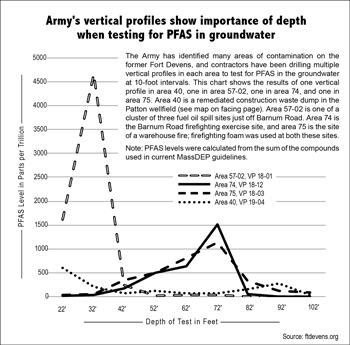
The Patton well is located just off Patton Road in Devens, about a half-mile west of a section of Old Mill Road near Harvard’s northwest boundary with Devens. About two months ago Army contractors drilled four vertical profile sites near the well to test groundwater there at multiple depths. Vertical profiles are necessary because PFAS levels vary greatly even in intervals of 10 feet (see depth chart). One of the new test sites, located about 600 feet east of the Patton well, was a former construction waste dump, previously identified by the Army as area of contamination number 40 (see map).Test results at that site showed PFAS levels of 394 parts per trillion (ppt) using the Environmental Protection Agency (EPA) calculation method. Using the Massachusetts Department of Environmental Protection (MassDEP) calculation method, the results were 605 ppt. Those results are well over both agencies’ advisory levels (see PFAS Limits above).
Mapping the contamination
Army contractor Katie Thomas of Koman Government Solutions (KSG) told meeting attendees that area 40 was remediated years ago, but the cleanup predated PFAS investigations. She added the former dump is likely the source of contamination in the Patton well. It is unclear which way groundwater is flowing from that contamination source, but contractors have drilled two more vertical profile sites about 1,200 feet to the northeast and southeast. The new sites are about 1,000 feet from Old Mill Road, and Thomas said test results from those sites should be available later this month.

The Shabokin well is about a half-mile west of a small section of Depot Road that lies on the north side of Route 2. Additional vertical profiling sites were also drilled in the area around that well, and maps presented at the meeting as well as data on the RAB website showed no PFAS levels over EPA or MassDEP guidelines at any of those sites. Results from one site are still pending.
BOH member Sharon McCarthy and Nashoba Associated Boards of Health agent Ira Grossman worked together to select representative properties in Harvard to sample in a checkerboard pattern based on proximity to the Shabokin and Patton wellfields. The list includes private residences as well as some businesses that have private wells (see map).
Jim Ropp of KGS said testers will try to get information on the depth of the private wells they’ll be testing, but he said that information is not always available. Without it, it could be difficult to map the movement of PFAS in Harvard’s groundwater. Results from the Army’s vertical profiling tests show that PFAS levels can vary greatly in just a 10-foot interval (see chart). In addition, one of the engineers said that drinking-water wells pull water from different sources at different times of year, so it may be difficult to use water from those wells to locate PFAS “plumes.”
Seeking home treatments
Old Mill Road resident Ann Whitney attended the meeting and said she recently had her water tested for PFAS, that the level was about 20 ppt, and she asked where to find recommendations for treatment systems. Ayer’s DPW Superintendent Mark Wetzel said Ayer residents tested two household tap filters, and while they did seem to remove a lot of PFAS, they became clogged quickly, and chlorine in the water reduced their effectiveness. MassDEP Regional Director Mary Jude Pigsley said the National Science Foundation has a list of certified filters on its website (nsf.org), and that Culligan Water recently installed 600 whole-house filters in Vermont. But she added that MassDEP can’t give guidance on filters because choosing the best filter depends on what else might be in the water. McCarthy pointed out that some systems may be problematic because water from some Harvard wells contains radionuclides such as radon, and that would cause filters to become hazardous waste when they need to be changed.
Testing will begin in the fall. The Army or its contractors will be contacting the 48 property owners on the list soon to ask for permission to test their water. Results will be shared with property owners, the BOH, the EPA, and MassDEP. The next RAB meeting will be Oct. 17 at 6:30 p.m. at Ayer Town Hall.
Ayer and Devens: PFAS remediation efforts continue
Part of the July 25 Restoration Advisory Board meeting focused on progress made in both Ayer and Devens toward treating their municipal water supplies for PFAS. In Ayer, two 20,000-pound carbon vessels were installed to temporarily treat the water in well #8 at Grove Pond. That well was taken offline more than a year ago because of PFAS levels that exceeded the EPA advisory.
The system was expected to be online this week, and once operational, well #8’s water will once again mix with the other two Grove Pond wells, which contain lower levels of PFAS. The hope is that the blended water will be below the proposed MassDEP PFAS guideline of 20 ppt. According to Bob Simeone, the Devens Base Realignment and Closure environmental coordinator, the carbon vessels will likely cost about $1 million to rent and operate for a year, and the Army will cover that cost.
Installation of a permanent ion exchange system for the Grove Pond wells will begin in August and is expected to be ready by fall 2020. It will cost about $3.2 million to enlarge the existing treatment plant off Barnum Road and install the system. Ayer is working with the Army to cover the cost of the system and the first year’s supply of the resin the system uses to remove PFAS from water.
Ayer has two other wells near the Groton/Littleton line at Spectacle Pond, and they also have PFAS levels above the proposed MassDEP guideline. According to MassDEP Regional Director Mary Jude Pigsley, the agency is looking for the source of contamination of those wells, but unless a responsible party is found, Ayer will have to bear the financial burden. Earlier this year the town voted to support funding for design of a PFAS treatment system for the Spectacle Pond wells.
Devens
In Devens, all three municipal wells have PFAS levels over the proposed MassDEP guideline. Utilities Manager Jim Moore reported that a 10,000-pound carbon vessel was installed at the MacPherson well in June and was expected to be online at the end of July. MacPherson well meets about half of Devens’ demand for water, but it has to be taken offline in winter because the system is not winterized. Shabokin well will receive four temporary carbon vessels over the next two months, and it should be able to fulfill the remaining water demand in Devens. A temporary ion exchange system is scheduled to be online at the Patton well by winter, in time for the MacPherson well to be taken offline.
Moore said the temporary systems at the Patton and Shabokin wells will have to run for a while, because MassDevelopment was in the process of installing a system to treat iron and manganese in the water when the PFAS problem popped up. So far, the financial burden of PFAS treatment systems at all three wells has fallen on MassDevelopment. Vice President Jessica Strunkin said the organization has sent a letter to the Army asking for help to cover PFAS treatment costs, but has not yet received a response.