In the early centuries of Harvard’s history, almost every home had a barn for farm equipment and the two or three animals the family kept for its own needs. While there are still a surprisingly high number of old barns in town, even more have been lost to time and catastrophe. It is therefore both exciting and gratifying when someone rescues an old barn and preserves its history. Such was the case for the 1835 barn at the Great Elms farm on Stow Road when, in 2015, Will and Rika Stevenson bought the deteriorating building and gave it a new home on South Shaker Road. Will produced a documentary of the barn’s entire journey and transformation and will show the film Thursday, May 23, at 7 p.m. at the Historical Society as part of Freedom’s Way Hidden Treasures, a regional event held during the month of May.

The Great Elms barn, built in 1835, looked the worse for its years in 2015. (Courtesy photos)
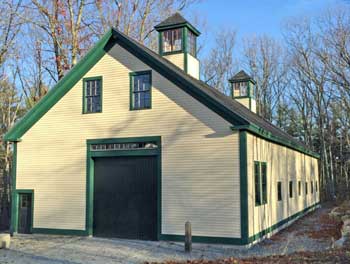
Reassembled and restored, the Great Elms barn is ready for another 200 years.
In the old days, people moved buildings frequently and sometimes for seemingly random reasons. But four years ago it would have been unusual to see a large truck transporting 35-foot beams, a flatbed with smaller pieces of an interior structure, and a police escort clearing the way for a double-wide load of original barn doors to their new location on the opposite side of Harvard.
“I had been designing barns in my head for a long time,” said Will about his and Rika’s desire to purchase the old barn. He said he had a car shed on his property that he never liked and that was inadequate for storage. For a time the Great Elms barn belonged to the Harvard Conservation Trust and stored such things as crew equipment and a large apple sorter owned by the Historical Society. Continuing this tradition, the barn now holds Scouting equipment and has been of service to Scouts and other town organizations. In 2015 the barn was owned by a Lowell housing development company, and the Stevensons purchased it for $1.
Will said it took almost a year to take the barn apart and put it back together again. The roof and siding contained lead paint and couldn’t be reused, but the entire inside structure was saved. In disassembling the barn, the team of eight workers discovered that the boards and beams had been numbered, suggesting the structure may have been moved once before. Each piece was relabeled with hatch marks and numbers. The video shows men on the top level of the old structure with the landscape stretched out around them.
During the three or four months the barn was being taken down, a foundation was built at the new location. Some of the original boards had to be replaced and that was done using lumber from the Stevensons’ woods. During another three or four months, the barn was raised, post, beam, and wood pegs, and encased by new clapboards and a resheathed roof. The original barn had one cupola; Will decided two would look more proportional, and they were built to admit light.
The inside structure of the barn differs from the original only in the number and layout of the stalls. Outside, stones from the original foundation have been used in landscaping; the original threshold stones edge an entryway to the door; and the granite hitching post stands ready.
Will said the team of workers thought this barn project was the most fun of any they have had, and they returned to admire the completed work.
The barn will be on the Historical Society’s Barn to Barn fundraising tour Saturday, Sept. 28, from 10 a.m. to 4 p.m.