Summer has its pleasures and its plagues. It is clear in which category tick bites fall. But not all tick bites lead to complications, and a soon-to-be finalized partnership will give residents a break on the cost of assessing their own risk of infection from a bite.
The Nashoba Associated Boards of Health (NABH) and the UMass Amherst Laboratory of Medical Zoology (LMZ) are teaming up to offer a discount on tick analyses from LMZ’s TickReport lab. Normally $50 per tick tested, the cost in 2019 will be subsidized by funds from donations to the Friends of Nashoba Nursing Service & Hospice, a nonprofit organization, and matching funds from LMZ for up to a specified number of reports.

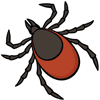
Blacklegged ticks in different phases. From left, larva, nymph, adult female, adult male. (Photo courtesy Fairfax County/Flicker/Creative Commons)
NABH Director of Public Health Jim Garreffi, who has been working with LMZ to finalize the details, expects to soon provide the exact discount amount and the parameters of the program to all the boards of health in the 16-town association. Garreffi credited Harvard Board of Health (BOH) Chair Libby Levison with the idea to partner with the UMass lab on testing.
Enough of the program was in place for a preliminary announcement at last Thursday’s BOH-sponsored Tick Talk with microbiologist and LMZ Director Stephen Rich, who explained the hows and whys of TickReport’s professional services.
Since 2006, Rich’s research lab has received ticks from across the country, 40 percent of them from Massachusetts. The collected data provide public health insights to who is being bitten by ticks, when they get bitten, and what pathogens are present.
Harvard-specific data show that ticks found in Harvard harbor more of the most common pathogens for tick-borne diseases than the state average. Borrelia burgdorferi, the bacteria responsible for Lyme disease, was found in 45 percent of Harvard ticks analyzed since 2006. The state average is 35 percent. Rates for babesiosis and anaplasmosis agents are similarly higher. Babesia microti were found in 9 percent of submitted ticks and Anaplasma phagocytophilum in 12 percent, but the state averages for both are closer to 6 percent.
Peak periods
Although ticks are active and carry infection risk year-round, LMZ data show two peak periods of activity. In spring, the number of reported bites from deer tick nymphs begins a steady rise until it peaks mid-June and falls off into August. A second wave from adult-stage ticks begins in September and peaks in October, gradually tapering off through the fall. Even though adult ticks are twice as likely to carry Lyme disease pathogens as are nymphs, significantly more cases of Lyme disease are reported from the early nymph bites, because the poppy seed-sized nymphs of summer are easier to miss than the larger adult ticks prevalent in the fall.

Prevention is best—wearing protective clothing, using effective repellents, avoiding high-tick habitats, checking for ticks, and keeping ticks from coming in with pets. But if a tick gets through these lines of defense, the next steps after removing a feeding tick are to watch for signs of illness, most often flu-like symptoms and sometimes a tell-tale bull’s-eye rash, and to consider ordering a tick test to assess the risk of disease exposure.
Tick analyses can be ordered from LMZ’s informative TickReport website, www.tickreport.com, which promises a report by email within three business days of receiving a tick.
After first identifying a tick’s species, usually a black-legged (deer), dog, or lone star tick, the lab photographs it and estimates how long the tick may have been feeding. It then looks for pathogens via DNA analysis. Feeding time is important, because often the longer the feeding time, the higher the risk. Deer ticks feeding for less than 24 hours are not considered a risk for transmitting Lyme or babesios agents. Anaplasmosis risk is minimal if the tick is removed within 12 hours. On the other hand, the rare but serious powassan virus can be transmitted within the first 15 minutes of a bite.
Assessing risk
A positive test indicates your risk of exposure from the tick tested, what to look out for, and what a physician might want to test for. But it doesn’t necessarily mean you have a disease. For example, a report for a tick identified as a black-legged tick that had been feeding for three days and tested positive for the Lyme and anaplasmosis pathogens indicates a high risk of contracting one or both of those diseases. On the other hand, even though the powassan virus can be transmitted quickly, a test positive for powassan may not indicate a high risk of the disease, because developing powassan encephalitis is rare, even with exposure.
Conversely, negative test results don’t eliminate having a disease, because you may have picked up something from a tick that you didn’t find.
Communicating about tick- and mosquito-borne diseases and prevention has been a BOH priority for the past few years. This is the third year the BOH brought in a leading Massachusetts expert for a public Tick Talk. Rich’s full presentation is available on the Harvard Cable TV website, www.harvardcabletv.com. The slides or recordings from the 2017 and 2018 Tick Talks can be found at the town BOH website, along with prevention tips and a well-curated resource list.
What to do if you find
a feeding tick on your body
- Remove the tick by grasping it with pointed tweezers and pulling straight up.
- Put the tick in a sealable plastic bag.
- Apply an antiseptic to the bite area.
- Watch for signs of illness, particularly flu-like symptoms or a bull’s-eye rash.
- Save the tick. A tick analysis can usually be done at any future time.
To order a TickReport analysis, go to www.tickreport.com.