There are many stories at Fruitlands Museum and it is their diversity that makes the museum unique. At the same time, it is this diversity that makes it difficult to give the museum a clear identity. Is it the story of Clara Endicott Sears, the extraordinary woman who created the museum? Is it the history of the different cultures the four museum buildings represent? Do the objects and artifacts themselves tell the story? Or does the museum’s identity lie in its landscape?
A new exhibit in Fruitlands Art Gallery, curated by Shana Dumont Garr, melds the various stories and gives them coherence. “A New England State of Mind” tells the story of the “Pioneering Collector Clara Sears” by using the objects she collected to chronologically “map” the creation of each museum and how it reflects the history and sensibilities of its time and place.
In a recent preview for Fruitlands interpreters, Garr said the exhibit evolved from a pragmatic goal. The Trustees of Reservations, of which Fruitlands became the 116th property three years ago, wanted digitized records of the inventory of the museum, which has much of its collection archived off-site. As Fruitlands curator, Garr, with Anna Thompson, collections manager, inventoried those objects, as well as ones on display in the buildings, she realized that the acquisitions of the objects over 47 years tell the story of Sears’ expanding vision to preserve the history of the 19th century in a specific place, the Nashua River Valley.
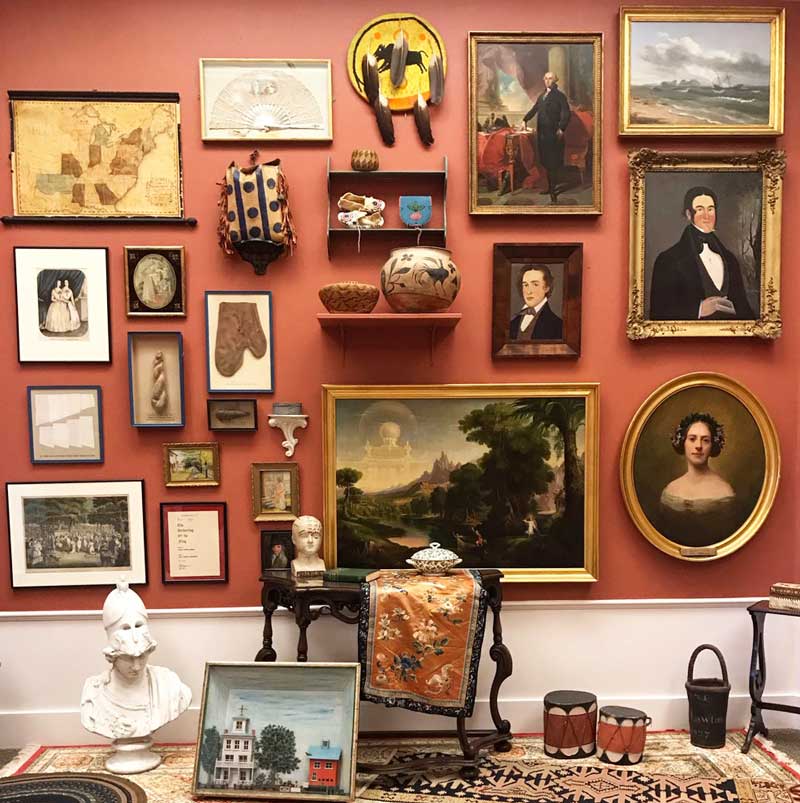
Evidence of Clara Sears as a pioneering collector. (Courtesy photo)
The exhibit is located in the north gallery of the art museum, where an entire wall is a floor-to-ceiling collage of objects. The first impression is of an amazing amount of “stuff,” which makes it a perfect reflection of the curious and pioneering mind of Sears as a collector. The number and diversity of the objects explain the multiple layers of Fruitlands Museum.
R.I.-based visual artist Kirstin Lamb helped Garr arrange the wall with an eye to color and balance, while keeping the chronological order. She then created a digital drawing of the wall, which serves as a key to the objects. Visitors are encouraged to take paper copies of the large map and fold it into quadrants to match sections of the wall and fully appreciate all aspects of the exhibit. The map offers clues by which, as Garr said, one follows Sears, an “obsessed detective,” as she tracks down 19th-century American history.
Assertive collector
Starting at the far left wall, a ceramic pitcher (number 1 on the map) is both literal and symbolic evidence of Sears as a collector—the one memorable find that set her off. While she was in Paris at the age of 7, her parents gave her money to buy a new doll, but instead she came back with this object from an earlier time. Later she was an assertive collector, purportedly knocking on doors asking people if they had paintings in their attic. As a determined researcher, she published inquiries in newspapers up and down the East Coast to gather information.
Along with the pitcher are personal objects such as a rag rug and assorted bandboxes. This section focuses on items Sears collected during her years (1912-1914) of researching the transcendentalists and restoring the Fruitlands farmhouse to which Bronson Alcott had brought his family in 1843 to begin a utopian community. One can find a bust of Ralph Waldo Emerson, Alcott’s benefactor; May Alcott’s sock knitted by her mother and worn at Fruitlands and Anna Alcott’s embroidered collar; pencils made by Henry David Thoreau; and locks of Louisa May and Anna Alcott’s hair (hair for remembrance was popular in the late 19th century). A painting of “The Judgment of Paris” shows Sears’ long-lasting interest in ancient Greece.
A collection of Shaker boxes is a lead-in to the middle wall, where objects tell the story of Sears’ fascination with the few remaining Shakers in Harvard and a commitment to preserve their history. There are homespun textiles; two paintings by Gertrude Fletcher Sanderson, “Harvard Shaker Village” and “Shaker Woman”; a mitten worn by a Shaker brother; and a specimen of the last flax plants grown in the village.
One also sees objects from Native American people collected when Sears was working on a third museum in 1929, her interest sparked by an arrowhead unearthed in her iris bed. Objects came from across the country: a Plains shield made for Sears in 1931; a Crow parfleche (rawhide) bag; a Pueblo olla (unglazed clay pot); and Cochiti Pueblo drums.
19th-century art
Sears had an interest in early 19th century portraits and in landscapes from the Hudson River School painters, as shown in middle and right walls, and in 1939 she built a gallery to house them as her final museum. The landscapes collection came together when Sears was in her 80s. It is interesting that she chose a painting of George Washington by Jane Stuart, daughter of Gilbert Stuart, rather than one from a range of other possibilities. A bust of the goddess Artemis from the colonnade at Sears’ summer home, the Pergolas, complements the one of Emerson.
Several items that don’t “fit” one of the four museums reflect other interests of Sears as well as a broader history of the 1800s. “Daughters of Temperance” (1830) and “Camp-Meeting” (1840) show her interest in social movements around the time of the transcendentalists. An exquisite fan and a silk runner speak to her elegant taste, and a large “Still Life With Flowers” may show her love of gardening.
Moving across to the south wall, one sees a sparser display. A large portrait of Governor John Endecott (also spelled Endicott) connects Sears to her New England heritage, which also included Winthrops and Peabodys. Portraits of Sears herself—two in this room of her at ages 7 and 23 and one of her in the alcove at the age of 86—add to the family history. Also mounted on this wall is Lamb’s large digitally drawn map of the objects on the opposite wall, which not only renders the collection in a different medium but also connects the past with the present.
Two other collections, flanking the objects wall, add to the picture of Sears, showing her as an author and a bibliophile. A label quotes Sears: “When I started writing I decided I would make a greater impression if I wrote of one place.” True to her words, three novels, a book of poetry, and six history books are about Fruitlands itself or inspired by the landscape and the people of the valley. As an author, she decorated a dedicated writing space at the Pergolas with busts of writers like Emerson and Alcott for inspiration.
Sears had a large and valuable collection of books. Her quoted words explain some of her choices: “It is through old traditions and old-time tales that we touch the spirit of a time and place.” A collection of books on spirituality and mysticism perhaps helped her gain a deeper understanding of transcendentalism and of Native American beliefs, and even the inspiration of the landscape painters, but they may also show Sears’ exploration of different belief systems to shape her own spirituality.
“A New England State of Mind” makes clear how a powerful sense of place—the Nashua River Valley—propelled Sears, at the age of 50, on a 47-year journey collecting objects that would represent and preserve the sensibilities and spirituality she found there. Visitors are encouraged to follow their map and join Sears in her detective work.