Bluebirds at rush hour wait for their turn at the feeder. (Photos by David Durrant)
Winter and spring are good times to get to know our common birds. There are a limited number of species here now as most of the summer migrants have yet to return. A good time to just sit and watch your bird feeders is when you’re confined to the house on a cold day. By closely observing one species at a time, you can get to know the common birds so it will be obvious if an unusual one shows up. Our typical winter feeder birds are house finches, chickadees, tufted titmice, bluebirds; downy, hairy, and red-bellied woodpeckers; nuthatches, mourning doves, blue jays, cardinals, and unfortunately way too many English house sparrows. Just this week, Pam spotted a small bird climbing up the oak near the feeder. We identified it as a brown creeper, an unusual bird for our feeder area. Moral of the story: Know your common birds so you will notice any unusual species that may visit you.
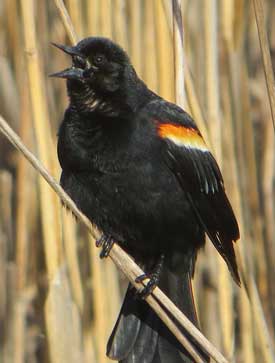
Newly returned red-winged blackbirds can be found in neighborhood wetlands and at feeders.
Observe which birds are attracted to different feeders and foods and observe their behavior. We feed our visitors a variety of seeds and have found that different species are attracted to one or all of them.
Mixes: Not worth it
It is not worth buying bags of wild bird seed mixes, as most of them contain filler seeds like milo, rapeseed, flax, canary seed, sorghum, and golden millet, which are not appealing to most songbirds. You are better off going to a feed store (we use Ericksons in South Acton) or Mass Audubon in Lincoln and buying the preferred seeds listed below. You can usually get small amounts packaged by Ericksons or buy the bulk in 25-pound or 50-pound bags.
Sunflower hearts (or pieces)
Place in tube feeders or on a platform feeder.
Sunflower hearts appear to be the best all-around seed attracting many species. Although more expensive than black-oil, the seed is easier for the smaller birds that cannot break open the black-oil husks. A big advantage (to us) is that the sunflower hearts leave no seed husks to clean up or attract rodents. Just about every species we have on the farm will take the sunflower hearts.

A turkey vulture feeds on a platform feeder.
Black-oil sunflower seed
Place in tube feeders or platform feeders.
These seeds attract the larger seed-eaters like evening grosbeaks and pine grosbeaks, white-breasted nuthatches, chickadees, and tufted titmice.
Cracked corn
Place on platform feeders or scatter on the ground.
If on the ground, as with any seed, just put small amounts so the birds clean it up before the chipmunks and squirrels get it—unless you enjoy watching these rodents! Probably the least expensive seed, it attracts a variety of birds including mourning doves, blue jays, cardinals, and so on.
Niger (thistle)
Use a thistle feeder or mesh bag.
Smaller birds like chickadees, house finches, purple finches, goldfinches, and nuthatches enjoy this. Buy in small quantities, as this seed dries out fast and is not as nutritious when dried out. In an eruptive year (more on this later) you may be lucky enough to get redpolls and pine siskins.
Beef suet or suet cakes
Blue jays can clean you out of suet fast, so we hang the suet still in the plastic tray in a wire basket with the suet face down. This method makes it harder for the larger greedy birds to get at the suet and also helps protect the suet from the elements.
Suet will attract downy, hairy, red-bellied, and if you are really lucky, pileated woodpeckers. Tufted titmice, white-breasted nuthatches, and chickadees also enjoy the suet.
White millet
Although we do not feed this seed, studies have shown that millet is an attractive seed to many ground-feeding species.
Peanuts
We do not feed peanuts, as we find most birds, like blue jays, which like peanuts, will eat cracked corn, which is a heck of a lot cheaper.
Bluebird mix
We feed four to six bluebirds all winter with this mix, but they also enjoy the sunflower hearts.
We have the recipe for the mix, and a drawing of a dedicated feeder we built for them, in a previous Wingin’it (Nov. 14, 2014)– check it out.
Roadkill
If you are not squeamish about it, you can do a favor for ravens, crows, hawks, and vultures (when they are around) by placing dead squirrels, mice etc. on a platform feeder well away from the house and high off the ground. This makes for easy picking, and is safer than trying to feed on the road, where most roadkill is found. Make sure the platform is high enough that coyotes and foxes can’t get to it.

A noisy flock of grackles—a familiar sight and sound at this time of year
Water
An essential item for birds when everything else is frozen is water. We made a water bath out of a small shallow rubber grain bucket set in an insulated wooden box. A thermostatically controlled heater keeps the water available all winter. You could also buy a heated dog bowl. Put some stones in the container for the smaller birds to stand on. All birds (and Tetley our dog) appreciate this open water when other water sources are frozen.
Tracking early migrants
As we write this, most of the juncos have left for the north woods and some of the early migrants have returned. We have flocks of robins, noisy groups of grackles, and a flock of red-winged blackbirds. A lone turkey vulture has been seen wheeling around over the farm. A song sparrow has returned, its musical song alerting us to its presence. The song sparrow will be with us all summer, usually nesting in one of the bushes in Pam’s perennial border.
Ducks are some of the earliest returnees, but not until the ice is off our pond. Last year the ice departed March 23 and we immediately had a pair of wood ducks followed a few days later by a pair of hooded mergansers. It is time to go around and clean out all the bluebird boxes, as they have already started looking for nesting places. We have to keep vigilant through the spring, tossing out the English house sparrow nests so the bluebirds have a chance to build their nests.
Irruptive species
An irruptive species is one that is not usually in this area in the winter but for various reasons, usually food-related, go south in search of food. This year was supposed to be one of those years. Irruptive species can include common redpolls, pine siskins, pine grosbeaks, evening grosbeaks, red-breasted nuthatches and both crossbill species. Although there have been reports of all the above in New England this year, we have not yet seen any here on the farm.
One of the most spectacular species to make occasional forays to New England is the snowy owl. Although chances of seeing one around Harvard (one was seen in Marlborough a few years ago) are pretty slim, you are almost assured of seeing one if you take the 60-minute drive north to the Parker River N.W.R. in Newburyport. Although snowy owls are hard to spot if there is snow and ice on the marsh, all one has to do is drive down the refuge road and look for a group of people “oohing and aahing” over one of these arctic birds.
Years ago rose-breasted and evening grosbeaks were a common sight around here. In fact, Pam just dug out a 1978 photo of our feeder covered with evening grosbeaks, but now they are rarely seen.
David and Pamela Durrant live on East Bare Hill Road at Micheldever Farm, where they watch their own peacocks and chickens as well as visiting wild birds.