
My household has at times been ruled by Pax Kayakana, peace through discount travel. Thus did my wife Laura and I recently find ourselves in Paris, standing in the rain outside the Musée du Luxembourg, waiting to be let into a retrospective exhibit of the works of Alphonse Mucha.
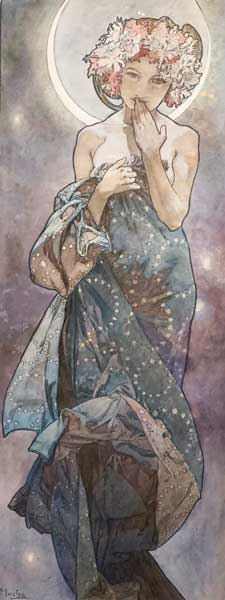
“The Moon,” by Alphonse Mucha (1902). (Photo by Marc Vilain)
Mucha, whose name is synonymous with Art Nouveau, was widely known as a painter of commercial art, from posters promoting Sarah Bernhardt’s performances to decorative cookie tins. But Mucha himself saw his major contribution to the world of art in his historical and allegorical paintings. And so it was that Laura and I made our way through the Luc (as Parisians call this gem of a museum) to my personal Mucha favorites, the quartet of paintings he called the Moon and the Stars.
It is with one of these paintings, fellow sky walkers, that we begin our lunar reverie, in anticipation of the forthcoming eclipse on the night of January 20 to 21.
A kiss by moonlight
As in all his allegorical works, Mucha imagined the moon, Polaris, and Venus as young women, with Venus appearing twice, as both the Morning and Evening stars. Of these four, the most endearing is without a doubt the moon maiden, draped in her starry robe, and crowned by the thinnest crescent moon. She is looking straight to you, fellow sky walker, and blows you a kiss.
Beyond being a painter, Mucha was also a philosopher, devout Catholic, and a mystic. He was a friend of the Swedish writer August Strindberg, with whom he shared a spiritual world view in which the divine interacted with the earthbound through manifestations of the natural world. It comes as no surprise, then, that Mucha’s paintings should be filled with natural scenes, his female models standing in as allegories of some facet of nature—the seasons, the stars, and of course, our moon maiden. What message, I wonder, is being conveyed in Mucha’s mythology through that kiss by moonlight.
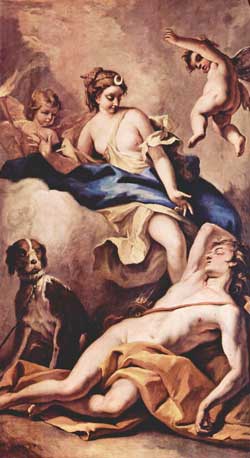
“Selene and Endymion,” by Sebastiano Ricci (1731). (Source: Wikimedia Commons)
A moon mythology
It is of course an age-old archetype that the moon should be associated with the feminine, and conversely the sun with the masculine. In Greek mythology, siblings Helios and Selene handle the solar and lunar roles respectively (we met their sister Eos, dawn, in last month’s column). Ancient depictions of Selene show her much as Mucha’s moon maiden: a young woman, graced with the crescent moon as a diadem on her forehead, or with the moon appearing halo-like behind her flowing hair.
But there is more to this mythological rapprochement than mere looks. Sappho wrote in the late seventh or early sixth century BC that Selene took on as her lover the handsome mortal Endymion. Zeus had granted Endymion eternal sleep instead of death, and as the story goes, Selene would descend from the sky to kiss Endymion in his sleep. Think of this, fellow sky walkers, as our moon maiden blows you her compelling kiss. There could be many worse ways to spend eternity.
It’s an interesting point of history that while Selene appears on the bas-relief of several temples in the Parthenon and elsewhere, she herself was not worshipped by the ancient Greeks. Her modern day neo-pagan descendent is, however, part of the ritual in some contemporary strands of earth-centered spirituality, where she appears as a tripartite female figure: the young crescent moon allegorical for the exuberance of youth, the full moon for motherhood, and the waning moon for the wisdom of the elderly.
What about that eclipse?
This is all by means of saying that archetypes of the moon as maiden, lover, or goddess, weave many age-old strands in a grand tapestry of moon mythology. All the more to enrich the experience of watching the lunar eclipse later this month, as our real-life moon, Miss Luna, makes her way through Earth’s shadow on the night of January 20-21.

The timeline of the eclipse will be as follows: Miss Luna will first encounter the deepest part of Earth’s shadow (the umbra) around 10:33 p.m. (all times are EST, calculated for New York, but close enough for our purposes). As she courses through the skies, Miss Luna is increasingly covered by darkness, and by 11:41 p.m. becomes fully engulfed in Earth’s shadow. This is totality, a phase of the eclipse that will linger until 12:43 p.m., at which point the events unwind in reverse order, on the opposite side of the lunar disc. Miss Luna emerges from the umbra at 1:50 a.m. on Jan. 21.
Earth’s shadow proper, however, is surrounded by a diffuse halo of near-shadow, the penumbra. As a result, the eclipse as described above is bookended on either side by additional hour-long penumbral stages, as shown in the above diagram. You may not notice the penumbra until Miss Luna is well into it and takes on increasingly more of a dark brown tinge.
Even in deepest totality, the moon does not go completely dark, but instead turns deep red. This is due to Miss Luna’s being illuminated by sunlight bending around Earth through the atmosphere. The atmosphere acts like a prism, separating the colors of the spectrum, with the blue end of the spectrum scattered into space. The red light bends a little further through the air, however, and ends up focused on the moon.
One last bit of astronomical lore: As with last January’s eclipse, this one will coincide with a supermoon, a full moon that occurs when Miss Luna is at the closest point in her orbit around Earth (the perigee). During a supermoon, she appears 14 percent larger to earthbound observers than at other times. This is barely noticeable to the naked eye, but since brightness goes up as the square of apparent size, one can often tell her increased brightness during a supermoon.
Under the moonlit skies
Fellow sky walkers, the popular press seems captivated by such monikers for the forthcoming eclipse as “the blood-red super wolf moon eclipse” (the January full moon is often called the wolf moon). To me, this language invokes an aggressiveness that wholly misses the point of the moon maiden archetype. Instead of wolves, may your time under the eclipse bring you a visit by our moon maiden, and may the kiss she blows you bring you love of whichever kind your heart is open to receive.
Marc Vilain lives with his family in Harvard center, and spends many moonlit nights walking the roads and fields of Harvard.