The proposed school budget for fiscal 2020 comes in a 42-page blue booklet with budget summaries for 10 cost centers, appendices full of extra information, a list of outside funding sources, tables showing enrollments and salary schedules, and a handful of graphs. The final version of this tome will be a must-read for voters at May’s Annual Town Meeting.
The town’s three major boards—Select Board, School Committee, and Finance Committee—discussed this mountain of information with school administrators for more than two hours last Saturday morning in upper Town Hall.
The main issue on many minds was that, at nearly $14 million, the school budget for fiscal 2020 is 3.98 percent higher than the current one, well above the 2.5 percent increase that the Finance Committee had set as the desirable limit for all departments. But when the question of cuts came up near the end of the meeting, Select Board Chair Lucy Wallace pointed out that the board had not yet heard from all town departments. “We’re not yet to the part of the process where we make those asks,” she said.
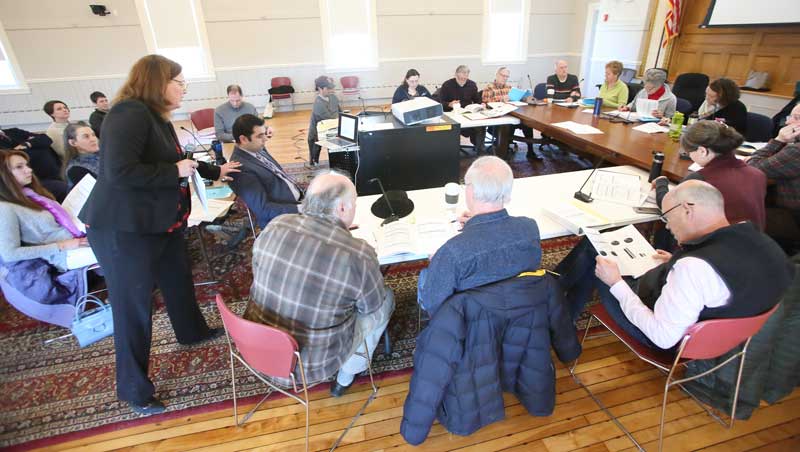
Superintendent Linda Dwight (standing) presents the school budget to the Select Board and Finance Committee.
(Photos by Lisa Aciukewicz)
Most of budget is set by contract
About 80 percent of the school budget is salaries, Superintendent Linda Dwight told the gathering, and salaries are determined by the district’s 2017 teachers contract. The other 20 percent covers textbooks and curriculum materials; bus transportation; heating and electricity; building maintenance and cleaning; special education tuitions and transportation; technology hardware, software, and lease agreements; and a host of other expenses.
Select Board member Alice von Loesecke asked why total salary costs had gone up sharply for fiscal 2020. Dwight cited three reasons. First, she noted that the overall cost for cleaning the schools had remained constant at $360,000, but that amount had moved from the contract category into the salary category when the district dropped its outside cleaning service and instead hired in-house custodians. Second, an unusually high number of teachers moved up in pay by taking additional courses or earning higher degrees. And third, Dwight said, there were zero retirements this year, which had never happened before in her eight years in the district.
A switch to in-house custodians
FinCom member Mark Buell asked why the school district had shifted back and forth, dismissing its own custodians in May 2016 to hire the Durkin Company, then terminating the contract with Durkin in June 2018 and hiring new custodians. Dwight said the school buildings in 2016 were simply not up to the cleanliness standard that teachers and others expected.
While Durkin did improve the level of cleanliness, the company did not honor other parts of its agreement, Dwight said at the time of the changeover last June. Durkin used subcontractors for the cleaning work, leading to constant turnover in personnel. And contrary to its promises, it did not provide benefits for its workers. Durkin also charged a premium price for snow removal, separate from the cleaning contract.
Dwight said Jon Snyer, who became facilities director last June, has been able to put a good team of custodians in place. At a recent meeting with the Devens Educational Advisory Committee, Dwight recalled, Devens parents said the schools seemed much cleaner now.
Those big yellow buses
In her overview at the beginning of the discussion, Dwight noted that the bus contract will go out for new bids this spring. Dee Bus Service was the only bidder for the contract three years ago, although then Finance Director Lorraine Leonard made repeated attempts to find competitors. (Gokey and Quinn, Harvard’s previous bus company, lost the bid because it did not meet the procurement requirements and has since gone out of business.)

Select Board member Alice von Loesecke listens to the school budget presentation.
Dwight mentioned that each bus service seemed to operate in its own territory. Buell asked if she was suggesting the companies were colluding in an illegal noncompete agreement. Dwight replied she was not suggesting that, and there were several reasons why Harvard might have trouble finding bidders. Among those were its small size and the distant towns to which its sports teams travel. But, Dwight said, contracting with a company was still less expensive for the district than having its own buses.
Von Loesecke suggested that the amount budgeted for bus service not be listed openly in the budget, because a company seeking the contract might submit a lower bid if that number were not obvious. Town Administrator Tim Bragan said the cost could be put in another budget line.
As a further complication, school officials plan to offer free bus transportation to elementary students during the two years while the new school is under construction. The goal is to reduce traffic and improve safety at drop-off and pick-up times, but the lost fees will amount to about $15,000.
The difficulty of budgeting for pupil services
Pupil services, which includes special education, is perhaps the most complicated budgeting issue as well as one of the largest segments of the school budget. Von Loesecke raised a question about the costs of van transportation. Marie Harrington, the director of pupil services, explained that the Concord Area Special Education (CASE) Collaborative sets a yearly fee for that service, based on a member school’s usage the previous year. But transportation needs change every year in part because Harvard’s CASE classroom serves students only up to second grade; after that grade, those students need transport.
The needs of students also change from year to year, Harrington said, and students enter the special education program unpredictably, making budgeting especially difficult. She said the fiscal 2020 budget is based on students who are in the program now, even though she knows that a new student who needs special services will likely move in soon.
Two factors help Harvard manage the unpredictability of these costs. One is the state’s special education reimbursement program, commonly known as circuit breaker payments. If a district’s special education costs for a student are well above the state average, Massachusetts repays a substantial share of those costs. The catch is that the repayment comes the year after the expenses. The second way the town manages unexpected jumps in special education costs, Town Administrator Bragan said Saturday, is by setting aside $175,000 for those needs in the town’s Reserve Fund. The town has kept that amount in reserve each year since 2007.
No decisions yet
Saturday’s meeting was primarily concerned with understanding the school budget, not with seeking to change it. Looking back to 2017 when the current teachers’ contract was signed, von Loesecke said the Board of Selectmen then projected that a very small override might be needed in fiscal 2020. Since then, she said, town revenue has risen more sharply than predicted, but so have salary costs. Von Loesecke emphasized that she was not speaking only of the schools. “We are asking everyone to cut their budgets,” she said. “The entire budget is more than we can support now.” However, neither the Select Board nor the Finance Committee has yet made any specific request for reductions.
The closest to a clearcut decision came while the group was discussing the district’s popular food service, which is self-supporting under the leadership of Chef Paul Correnty and returns $10,000 a year to the school budget. School Committee member Shannon Molloy asked, “What happens when Chef Paul leaves, and we don’t have this money?”
Without missing a beat, Select Board member Stu Sklar quipped, “We aren’t allowing him to leave!”