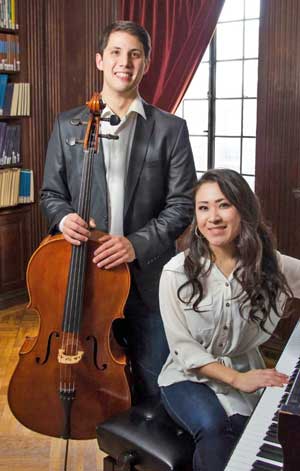
Jeremiah Barcus (left) and Rui Urayama. (Courtesy photo)
Although the Harvard Cultural Collaborative (HCC) is temporarily displaced from its physical location at the old library, it remains very active in its programming. On Saturday, Jan. 26, HCC is sponsoring a daytime workshop at the Unitarian Universalist Fellowship Building and an evening concert at the UU Church. The cello and piano duo of Jeremiah Barcus and Rui Urayama, whom residents may remember as a talented and popular pair from last spring’s HCC-sponsored chamber music festival, will be performing “Finding Treasures” from 7 to 9 p.m. In the afternoon, from 1 to 3 p.m., the duo will facilitate a workshop where participants will create visual responses to the music being played.
Both the workshop and the concert will provide opportunities for the audience to interact with the musicians, an idea at the heart of last spring’s week-long “Loving the Process,” where audiences could listen to the discussions among musicians themselves and with their music coach. Sitting in on rehearsals and classes, audience members were encouraged to offer observations and ask questions. Mark Mikitarian, president of HCC, said the collaborative wanted very much to keep alive that musical momentum and interactive concept.
Barcus and Urayama, who have performed recitals in the United States and Japan, felt a strong connection to the town and the community when they were here last spring, said Mikitarian. Barcus himself expressed this in an email: “We loved the people, the environment, the strong sense of community and everyone that we got to know and become close to.” Faith Cross, with whom Barcus and Urayama stayed during the festival, said that the two really enjoyed Harvard—even tromping through orchards in the mud without proper foot gear—and felt that everyone took good care of them. She described them as excellent house guests—personable, open, respectful and with a sense of humor—though not when they were playing music. Cross added that she learned more about music over breakfast while they were at her home than she had learned in any other way.
After the Saturday concert, Barcus and Urayama will talk informally with audience members over refreshments. Cross recalls being at the duo’s performance last spring where, sitting up close, she could see their faces and body movements as they played and was intrigued with how they became one with their instruments and were all-consumed by the music they were making. Saturday’s program will feature movements from sonatas of Debussy, Kabalevsky, and Rachmaninoff. Of special interest—and a topic of conversation—will be “Since the Blue Sunset,” arranged by Urayama.
A story in music
Barcus described “Finding Treasures” as a very special program for the duo. “It is essentially our story put into music. The Debussy sonata was the first piece on the program of our first full recital together. The Kabalevsky was the first piece that we learned and performed at a music festival together, and the Rachmaninoff was the piece that originally got me interested in learning cello, and we both (separately) searched for years to find a partner to play it with.” Urayama’s special project is writing piano solo arrangements of world folk songs and children’s songs, and she combines Japanese, Hungarian, and Spanish folk songs in “Since the Blue Sunset,” which has special meaning for both musicians. “‘Excited’ is an understatement for how much we want to share this program with the Harvard community,” wrote Barcus.
Urayama currently works as a staff accompanist at Boston Conservatory and teaches at two schools in the Boston area. At age 18 she was winning prizes at major competitions in Japan and when she graduated from Koyoto City University of Arts, she was named “most gifted young musician of the year.” She came to the United States in 2011 and earned a Master’s of Music and Artist Diploma from Boston Conservatory. An award in Japan’s most prestigious competition in 2013 opened doors to performances in Asia and Europe, and awards in this country furthered her career.
Barcus belongs to different chamber groups, from the more traditional to the Videri String Quartet that plays video game music in a classical style and has appeared across the country. He came to Boston in 2009 and received degrees in cello performance from the New England Conservatory and Boston Conservatory and a Graduate Performance Diploma from Boston Conservatory at Berklee. He has a busy private studio and is on the cello faculty at two schools in Boston.
To provide audience members an additional way to interact with music, Barcus and Urayama will facilitate a two-hour workshop on Saturday afternoon, starting at 1 p.m. “The wonderful thing about this workshop,” said Barcus, “is that really it is the community members and participants who will be running the show.” He said the duo will give the background story to the piece(s) they will be playing, including the inspirations of the composer and other relevant details. “Then as we are playing, the participants will draw what they hear,” responding to changes in mood and tempo. Barcus said in the past, such workshops have had incredible results, with people inspired to create unique and engaging pieces in the moment.
To reserve a spot in the workshop, email Admin@HarvardCultural.org. The HCC has suggested a donation of $15 for the evening concert and $10 for the afternoon workshop.