From Deramakot Forest Reserve, a trip described in the Nov. 9 issue of the Press, we transferred by road to Sepilok, Malaysia, home to the Rainforest Discovery Centre, and the Orangutan and Sun Bear Rehabilitation Centres. After checking into our rooms for a brief rest during the intense midday heat, we went to the Rainforest Discovery Centre where we headed straight to its canopy walkway. The walkway is 24-30 meters off the ground and suspended among a number of trees in the canopy of the rainforest. Pam saw a brilliant blue bird that one of the guides identified as a black-naped monarch. Next we saw several bushy crested hornbills alighting on a tree almost at eye level. They continued to move through the canopy, probably looking for a roost for the night.

From left: A tarsier clings to a tree. A long-billed spider hunter takes a break from feeding. A bushy-crested hornbill. A Pacific swallow. (Photos by David Durrant)
Our local guide pointed out several tree cavities that were known to house red giant flying squirrels. Our plan was to wait for dusk when these incredible creatures emerge. In fact they do not fly but launch themselves from high in a tree and glide through the forest to another tree in search of food. We waited on the walkway near a tree that the guide thought the squirrel might “fly” to. Although it was getting dark, we were able to see the squirrel emerge from its nest hole in a 60- to 75-meter tall dipterocarp tree. Lo and behold, this enormous squirrel, about twice the size of our grey squirrel, took off and did in fact land on the tree not 4 meters from us. We will never forget the sight of this glistening red mammal gliding right at us.

A red giant flying squirrel prepares for takeoff.
Next on the schedule was a night walk through the forest trails. Our first sighting was a cobra trying to swallow a large frog. Thanking our lucky stars it was preoccupied with its meal, we continued down the trail where we found a roosting red-legged crake and a small blue-eared kingfisher with brilliant blue back and orange breast. This kingfisher is a lot smaller than the belted kingfisher that we see around here. Continuing, our guide spotted to our amazement a tarsier clinging to a small tree not 3 meters off the trail. This small (30-40cm) ball of fur is one of the earliest primates and usually extremely hard to find. It has unusually large eyes that are fixed, but it is able to rotate its head 180 degrees while searching for prey, which includes insects, small birds, snakes, and lizards.

An orangutan sits on a railing at the rehabilitation center.
Orangs and bears
The following day we went to visit the famous Orangutan Rehabilitation Centre, where we would be able to get close looks at orangutans and learn how orphaned or injured orangs are cared for with the ultimate goal of releasing them into the forest. There were a few orangs free to range, one of them perched on a rail not 3 meters from us. This facility was a bit “touristy” for us, so we proceeded across the parking lot to the Sun Bear Rehabilitation Centre.
The Bornean sun bear, about half the size of an American black bear, is the smallest bear in the world and is found only in Southeast Asia. As with most forest animals, the bears are threatened by deforestation, illegal hunting for bear parts, and poaching for the pet trade. There are several dozen rescued bears, with many of them being able to be rehabilitated back into the wild. These bears are extremely hard to find and this at least gave us an opportunity to see these wonderful animals.
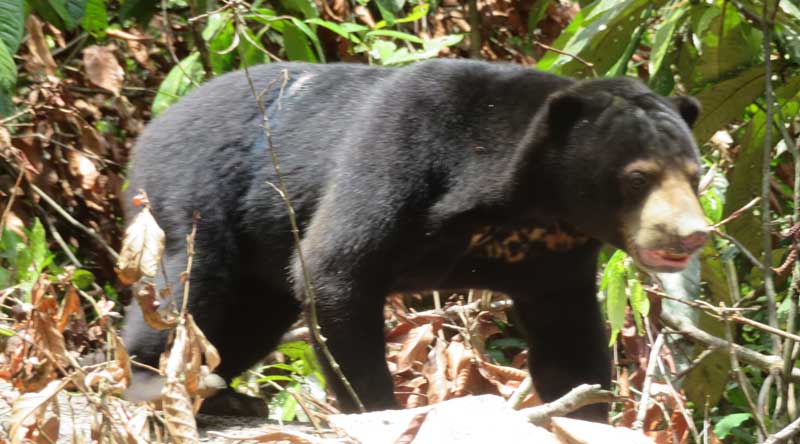
The Bornean sun bear, found only in Southeast Asia, is the smallest bear in the world.
Pete Oxford, our guide and organizer of the trip, had made a donation to the centre in our names, and we were honored to meet its founder,, Dr. (Hon) Wong Siew Te, D.J.N. Wong is a Malaysian wildlife biologist who was trained in Taiwan and the United States. He has been studying and working to preserve the sun bear since 1998. His pioneer studies of sun bears in the Bornean rainforest have taken him into some of the most threatened wildlife habitat where fieldwork is difficult. At the visitors centre Wong gave us a short PowerPoint presentation on the centre and its work and then took us on a “behind-the-scenes’’ tour of the facility. The bears are housed in large forested enclosures with very little human contact. We were able to get within a few feet of a bear that Wong had rescued as a baby and that had become habituated to Wong.
Next morning around the lodge, we saw greater green leafbirds, long-billed spiderhunters feasting on red flowers, and the omnipresent Pacific swallows hawking insects from their perch on a wire. Pete, Pam, and our friends took a walk on the nature trail and spotted a red-naped trogon, one of the six species of trogon in Borneo. We also saw a purple-throated sunbird, a couple of scarlet-billed flowerpeckers, and a chestnut-hooded laughing thrush.
Next: On to Kinabatangan
David and Pamela Durrant live on East Bare Hill Road at Micheldever Farm, where they watch their own peacocks and chickens as well as visiting wild birds.