
One childhood summer, I came to visit my American grandparents and returned with an ear worm, one of those tunes that lodges itself in your ears and stays there. Guilt for unleashing this ear worm went to Jerry Lee Lewis: “Goodness gracious, great balls of fire” was the line that had made its unwelcome home in my childhood ear.
Fellow sky walkers, though dated and not of shining lyrical depth, this song always comes to mind at this time of year. Indeed, balls of fire are au courant this week, as the Geminid meteor shower is upon us, peaking on the night of Thursday, Dec. 13 into Friday, Dec. 14.
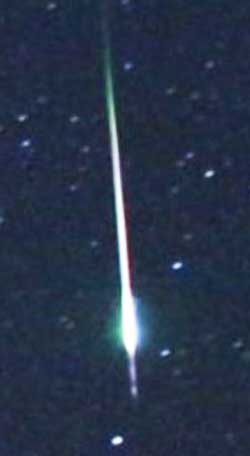
A fireball meteor. (Courtesy NASA Goddard Space Flight Center)
Winter’s Perseids
The Geminids are the cold season’s counterpart to the late summer Perseid meteor shower. The Geminids are just as spectacular as their summertime sibling, more so perhaps, as they tend to have many more of those especially showy meteors known as fireballs.
We usually think of meteors as zinging across the sky in narrow pencil lines: Blink, and you’ve missed them. The summertime Perseids are full of these celestial Ferraris. Geminid meteors, however, cross the sky at about half the speed of their Perseid siblings. As a result, the trail they cut as they lumber by is more of a fat Crayola track than a pencil line. In addition, there is often an easily discernible shape to the meteor—a fireball. To add to the visual excitement, some portion of these fireballs leave a persistent trail behind them and occasionally come to an end in a fiery explosion. It all feels an awful lot like Fourth of July fireworks, just without the long lines for parking at Fruitlands.
Observing the Geminids
The Geminids get their name from the geometry of their trajectories. If you had a big enough ruler and could trace lines along the meteors’ tracks across the sky, you would find that these lines roughly intersected around one point in the constellation Gemini. The sky chart shows how this geometry comes together around this point, the so-called radiant of the meteor shower.

The chart is somewhat misleading, however, since it suggests that you should look toward Gemini, to see meteors emerge out of the void, Star Wars style. What actually happens is that meteors will show up pretty much anywhere in the sky, it’s just that their tracks point back to Gemini.
To see as much of the sky as possible, stargazing advice columns often suggest bundling up in a sleeping bag, pulling out a lawn chair, and reclining. If you can bring yourself to make that kind of fashion statement in mid-December, fellow sky walkers, the more power to you. Instead, I have found it useful to go out with an observing companion, so that you can each look at different parts of the sky and call out to each other. The Geminids move slowly enough that you have time to turn around and catch what your companion spotted.
The peak of the meteor shower will occur the night of Dec. 13 into Dec. 14, with rates of around 120 visible meteors per hour, especially after midnight. Though some of these will be too faint to see against the light pollution, you will have no trouble seeing fireballs, so long as the forecast holds and the skies remain partially clear. The best time to observe will be after the moon has set (around 10:30 pm), and up until the pre-dawn hours. If you’re up before dawn, bonus points include views of Venus, Mercury, and Jupiter in the eastern sky.
How come meteors?
Meteors are space debris that happens to enter Earth’s atmosphere, typically just millimeters or centimeters in size. Traveling as fast as they do, friction against the air causes these bits of debris to burn up, giving us our showy shooting stars. With most meteors, this debris is of undistinguished origin; it’s just out there hanging around the solar system. In the case of meteor showers, however, here’s more to the story.
The debris that gives rise to meteor showers is typically left behind by comets as they loop around the solar system. As a comet nears the sun, solar radiation blasts material off its surface, forming a visible tail and leaving a trail of litter in the comet’s wake. When Earth happens to cross through one of these cometary tracks, it encounters all that debris, and we get meteor showers.
The Geminids are atypical for meteor showers in that they are formed by debris from an asteroid (a rocky object), not a comet (an icy object). The asteroid in question, 3200 Phaethon, has an unusual sun-grazing orbit, more typical of a comet than of an asteroid. Rather than lurking with other minor planets in the asteroid belt, Phaethon spends part of its orbit near the sun, then zooms back out to the far reaches of the solar system. The surface of Phaethon is baked by its close solar approach, flaking off the debris that gives us the Geminids. This debris tends to be larger and rockier than typical cometary debris, and thus burns more slowly as it hits the Earth’s atmosphere. Hence the Geminids’ preponderance of fireballs.
Phaethon
Drawing from mythology, Phaethon the asteroid is named for Phaethon, son of sun god Helios. Phaethon of myth meets an untimely end trying to control the fiery sun horses that Helios drives across the sky to give us the day. It’s not a pretty story.

Eos, by Evelyn de Morgan. (Courtesy Wikimedia Commons)
I prefer to think of another mythical Phaethon, the son of Eos, goddess of the dawn. Eos is usually portrayed as a winged woman, rosy of fingers and golden of arms, who arises each morning to open the celestial gates through which Helios drives his fiery horses. Having had a spat with Aphrodite (Venus to the Romans), Eos was cursed by Aphrodite to love many men but never find true love, while her son Phaethon became Aphrodite’s personal guard. From Eos to Aphrodite, some guys have all the luck.
Fellow sky walkers, I wish you luck in your search for Geminid meteors this week. If you stay up to watch them until dawn, give Eos my greetings, as I will give her yours. And may all the wishes we make on the Geminid shooting stars come true, or at least those that deserve to.
Marc Vilain takes long night walks, looking for meteors from the roads and fields of Harvard.